Oklahoma ELA 5.3.W.1
The Standard
Students will compose narratives reflecting real or imagined experiences that: • include plots with a climax and resolution • include developed characters who overcome conflicts and use dialogue • use a consistent point of view • unfold in chronological sequence • use sentence variety, sensory details, and vivid language to create interest • model literary elements and/or literary devices from mentor texts
Oklahoma Academic Standards for English Language Arts (2021)
Teacher's field guide
What This Standard Means
What Students Need to Do
- Write a true or made-up story with a character, a problem, a turning point, and an ending. Put events in time order and keep one point of view. Use dialogue, sensory details, varied sentences, and a writing move noticed in a story they read.
What Mastery Looks Like
- The character faces a problem, makes a choice at the turning point, and reaches a clear ending. Dialogue reveals the character, events follow time order, and the point of view stays steady. Sentence variety and sensory details make scenes clear, including a technique borrowed from a mentor text.
Common Misconceptions
- Students may call any exciting event the turning point, even when it changes nothing. Some stop after the big moment without showing how the problem ends. Others switch from "I" to "she" or copy a mentor sentence instead of using its technique.
How to Assess It
- For an exit ticket, ask students to write eight sentences about losing a library book, with dialogue, a turning point, and an ending that solves the problem. Check time order, point of view, and one sensory comparison modeled on "The hallway hummed like a beehive."
Lesson moves
Ways to Teach It
Give pairs four cards: dog escapes, gate locks, child climbs fence, dog returns; have them order the events and mark the turning point.
Read the mentor line "My shoes squelched like wet sponges"; ask, "How could your own comparison show what a character feels?"
Play point-of-view repair: give pairs a six-sentence story that switches from "I" to "she"; race to fix each switch.
Write about a real disagreement at recess, showing what each person said, your hardest choice, and how the disagreement ended.
Free download
Printable 5.3.W.1 Worksheet
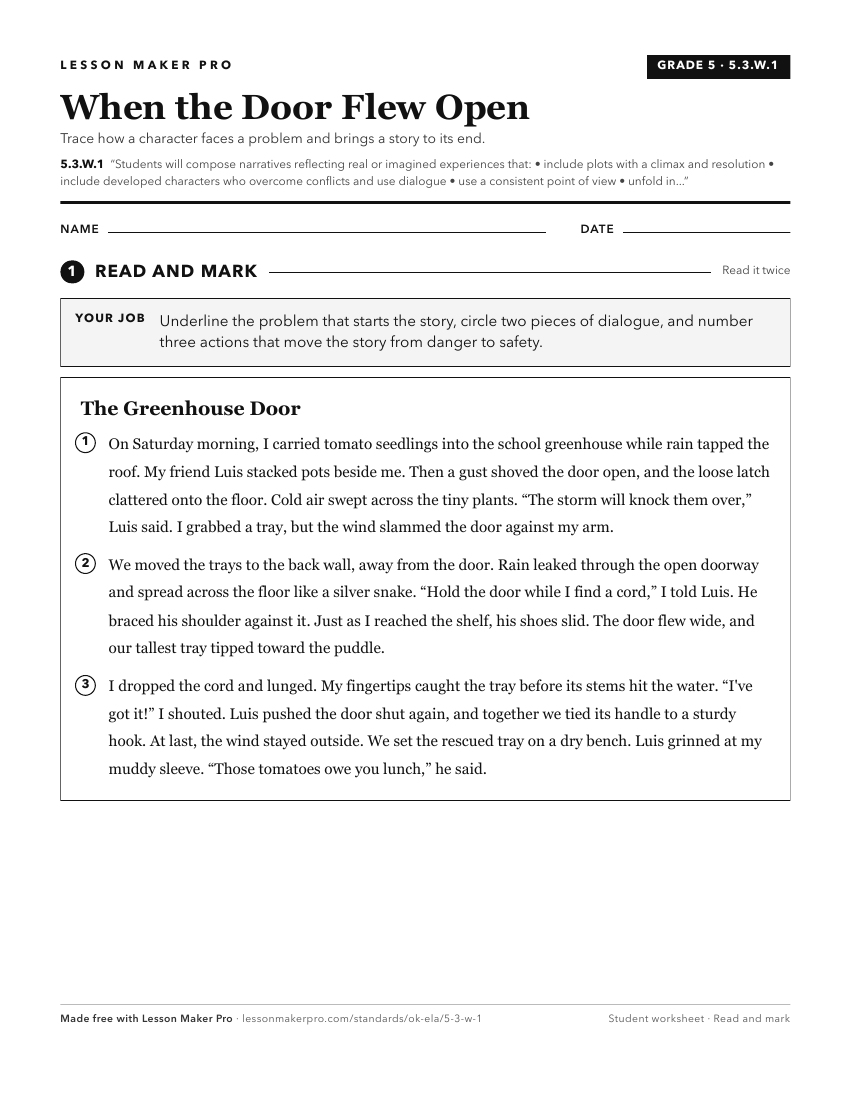
A ready-to-print activity worksheet aligned to 5.3.W.1, with an answer key for the teacher on its own page. No account needed.
PDF, US Letter, prints cleanly in black and white.
Download the worksheetKeep exploring
Related Standards
- 4.3.W.1
The 4th Grade version of this standard.
- 6.3.W.1
Compose narratives reflecting real or imagined experiences that:- include plots involving characters resolving conflicts- unfold in chronological sequence- incl...
- 7.3.W.1
Compose narratives reflecting real or imagined experiences that:- include plots involving complex characters resolving conflicts- unfold in chronological or sur...
- 8.3.W.1
Compose narratives reflecting real or imagined experiences that:- include plots involving complex characters resolving conflicts- unfold in chronological or sur...
Turn this exact standard into a lesson
Grade, subject, topic, and the complete standard are prefilled. Create one free, no account needed.
Also for this standard:Make a WorksheetMake a QuizMake a Sub Lesson