Oklahoma ELA 4.5.R.2
The Standard
Students will recognize parts of speech in sentences: • irregular possessive nouns (e.g., children’s) • irregular and past participle verbs and verb tense to identify settings, times, and sequences • subject and verb agreement • comparative and superlative adjectives • prepositional phrases • possessive pronouns and the nouns they replace (i.e., antecedents) • coordinating conjunctions • comparative and superlative adverbs • interjections
Oklahoma Academic Standards for English Language Arts (2021)
Teacher's field guide
What This Standard Means
What Students Need to Do
- Students identify how words work in sentences, including words that show ownership, location, and links between ideas. They use verb forms to track when events happen and check that subjects match verbs. They compare things and actions using adjectives and adverbs.
What Mastery Looks Like
- A student can explain that “children’s” shows ownership, “their” points back to “children,” and “under the table” tells where. They choose “children are” and use “went” and “have gone” to track time. They use “taller,” “tallest,” “more quickly,” and “most quickly,” and identify “but” and “Wow!”
Common Misconceptions
- Students may write “childrens” instead of “children’s” or lose track of which noun “their” refers to. They may write “children is,” treat “gone” as simple past, or use “more fastest.” They may call “under the desk” a full sentence or label “Wow!” a conjunction.
How to Assess It
- Give this exit ticket: “Wow, the children have gone to their tents, but one child stayed behind.” Ask students to mark the interjection, conjunction, past participle, and prepositional phrase, then name the noun “their” refers to.
Lesson moves
Ways to Teach It
Place three toy cars beside a box and race them; have students write where they started and which moved faster and fastest.
Write “Wow, the children went home, but they have come back”; ask students to label the interjection, conjunction, and verb forms.
Give pairs cards reading “child is,” “children are,” “children’s coats,” “our coats,” and “ours”; have them sort agreement, ownership, and pronoun reference.
Use a mock store chart with three backpack prices and shipping times; write which is cheaper or cheapest and which ships sooner or soonest.
Free download
Printable 4.5.R.2 Worksheet
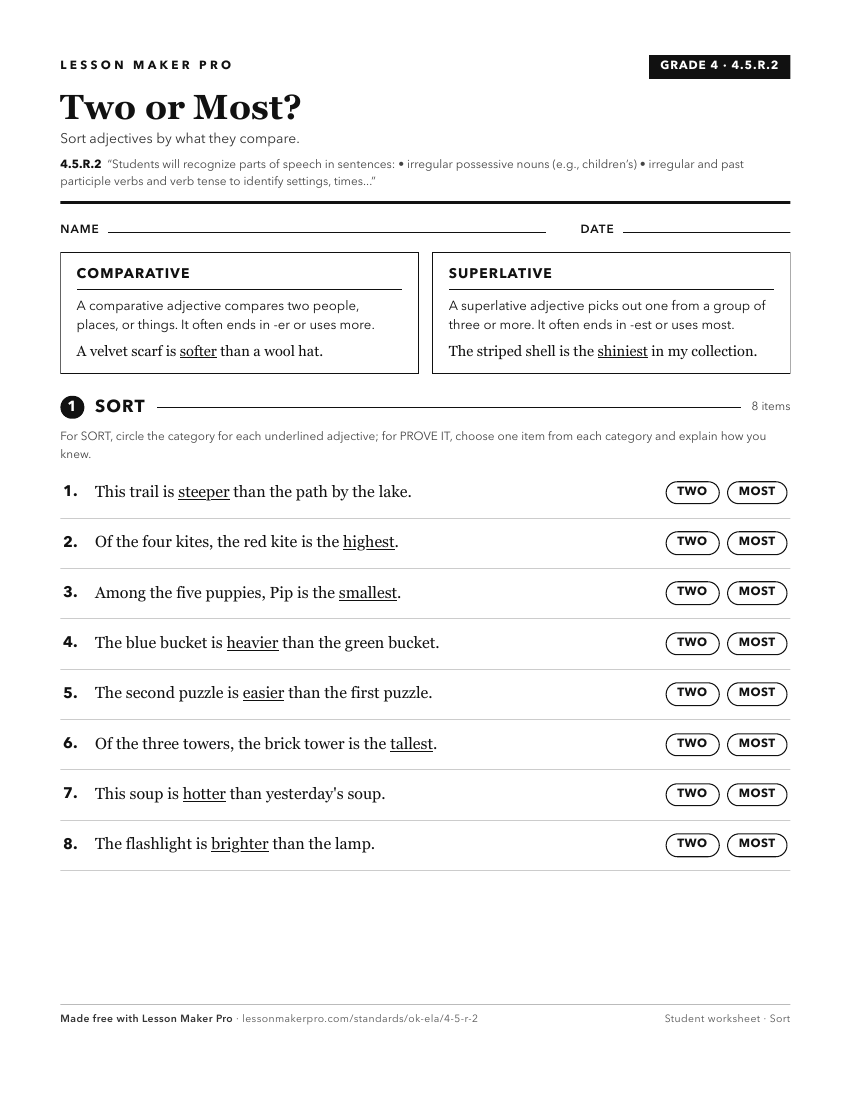
A ready-to-print activity worksheet aligned to 4.5.R.2, with an answer key for the teacher on its own page. No account needed.
PDF, US Letter, prints cleanly in black and white.
Download the worksheetKeep exploring
Related Standards
- 3.5.R.2
Recognize parts of speech in sentences:- concrete, abstract, and possessive nouns- different types of verbs (i.e., action, linking, helping) and their roles in ...
- 2.5.R.2
Recognize parts of speech in sentences:- common, proper, and irregular plural nouns- tenses of verbs (i.e., past, present, future)- the simple subject and simpl...
- 5.5.R.2
Recognize and explain the impact on meaning of parts of speech in sentences:- nouns- verb tense to identify settings, times, sequences, and conditions- subject ...
- 6.5.R.2
Recognize and explain the impact on meaning of parts of speech in sentences:- nouns- verb tense to signify various times, sequences, conditions, and states- sub...
Turn this exact standard into a lesson
Grade, subject, topic, and the complete standard are prefilled. Create one free, no account needed.
Also for this standard:Make a WorksheetMake a QuizMake a Sub Lesson