Oklahoma ELA 3.5.R.2
The Standard
Students will recognize parts of speech in sentences: • concrete, abstract, and possessive nouns • different types of verbs (i.e., action, linking, helping) and their roles in a sentence • the complete subject and complete predicate of a sentence • possessive adjectives • prepositional phrases • possessive pronouns and the nouns they replace • coordinating conjunctions (i.e., for, and, nor, but, or, yet, so) • adverbs of frequency (e.g., always, often, never)
Oklahoma Academic Standards for English Language Arts (2021)
Teacher's field guide
What This Standard Means
What Students Need to Do
- Students identify concrete, abstract, and possessive nouns, along with action, linking, and helping verbs. They mark complete subjects, complete predicates, prepositional phrases, and coordinating conjunctions. They distinguish possessive adjectives from pronouns and find words that tell how often something happens.
What Mastery Looks Like
- A student marks the full subject and predicate in a sentence, not just the main noun and verb. They explain that 'her' comes before a noun, while 'hers' replaces one. They can sort 'pencil' and 'joy' and explain the jobs of 'is' in 'is running' and 'is tired.'
Common Misconceptions
- Students may call 'joy' concrete because they can feel it, or read the apostrophe in 'Sam's' as a plural mark. They may mark only 'brother' instead of 'her little brother' as the complete subject. They may treat 'her' and 'hers' as interchangeable or leave 'the yard' out of the prepositional phrase 'in the yard.'
How to Assess It
- Give students: 'Her dog is often happy in the yard, but mine never plays there.' Ask them to mark each clause's full subject and predicate, label the verbs, box the prepositional phrase, and explain 'her,' 'mine,' 'often,' and 'never.'
Lesson moves
Ways to Teach It
Give pairs sentence strips and colored pencils; have them mark complete subjects, complete predicates, and prepositional phrases with a shared color key.
Write 'Her pencil is blue, but mine is red' on the board; ask partners what 'mine' replaces and why 'her' comes before 'pencil.'
Project 'She is running,' 'She is tired,' 'She often runs,' and 'She runs'; underline 'is,' 'is,' 'often,' and 'runs' for teams to label.
Use a cafeteria menu to circle food nouns, then write 'The cook's soup is hot, but mine is cold' and label 'cook's' and 'mine.'
Free download
Printable 3.5.R.2 Worksheet
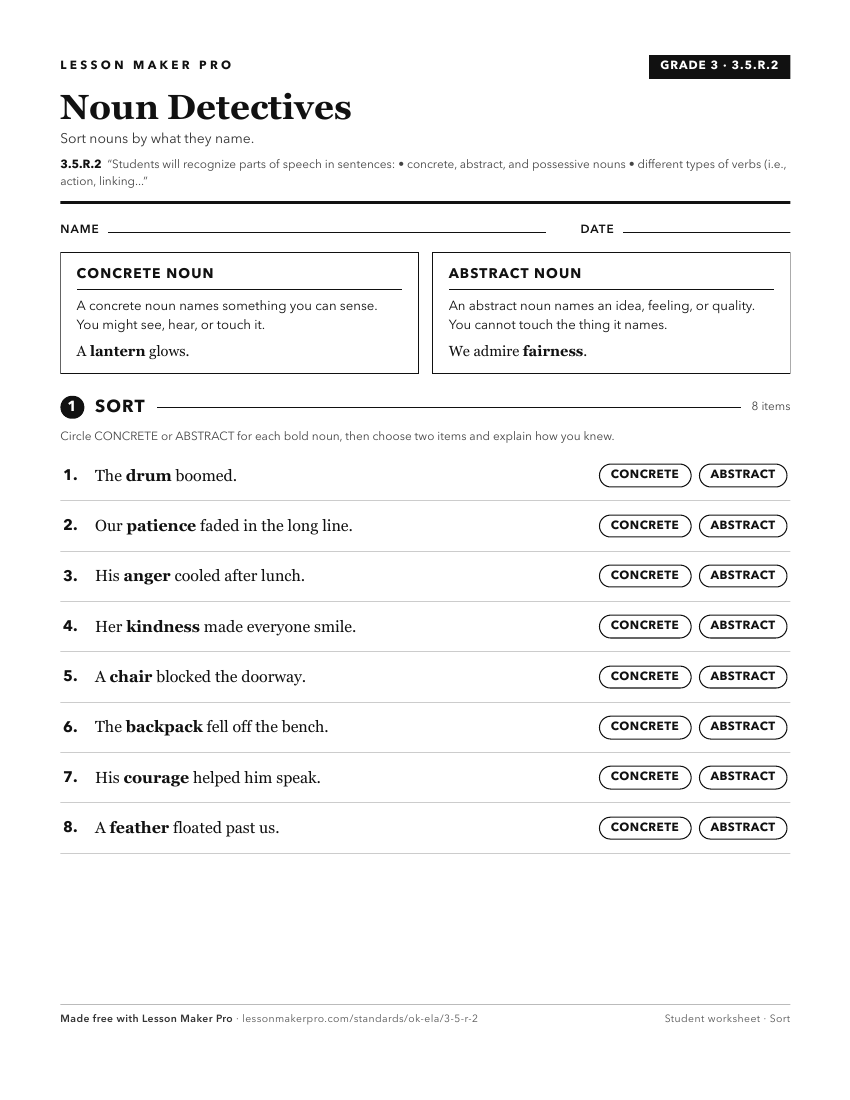
A ready-to-print activity worksheet aligned to 3.5.R.2, with an answer key for the teacher on its own page. No account needed.
PDF, US Letter, prints cleanly in black and white.
Download the worksheetKeep exploring
Related Standards
- 1.5.R.2
Recognize parts of speech in sentences:- nouns as concrete objects (i.e., people, places, and things)- regular plural nouns- present-tense verbs as actions- col...
- 4.5.R.2
Recognize parts of speech in sentences:- irregular possessive nouns (e.g., children's )- irregular and past participle verbs and verb tense to identify settings...
- 2.5.R.2
Recognize parts of speech in sentences:- common, proper, and irregular plural nouns- tenses of verbs (i.e., past, present, future)- the simple subject and simpl...
- 5.5.R.2
Recognize and explain the impact on meaning of parts of speech in sentences:- nouns- verb tense to identify settings, times, sequences, and conditions- subject ...
Turn this exact standard into a lesson
Grade, subject, topic, and the complete standard are prefilled. Create one free, no account needed.
Also for this standard:Make a WorksheetMake a QuizMake a Sub Lesson