Oklahoma ELA 2.5.R.2
The Standard
Students will recognize parts of speech in sentences: • common, proper, and irregular plural nouns • tenses of verbs (i.e., past, present, future) • the simple subject and simple predicate of a sentence • descriptive adjectives and articles (i.e., a, an, the) as adjectives • prepositions • singular and plural personal pronouns and the nouns they replace • the conjunctions and, or, and but • -ly adverbs
Oklahoma Academic Standards for English Language Arts (2021)
Teacher's field guide
What This Standard Means
What Students Need to Do
- Students identify the jobs of words in sentences. They tell common nouns from names, spot plurals like mice, and sort verbs by past, present, or future tense. They find the simple subject and predicate and name the noun each pronoun replaces.
What Mastery Looks Like
- Given “The mice ran quickly under a table,” a student marks mice as the simple subject and ran as the simple predicate. They identify mice as an irregular plural, quickly as an adverb, under as a preposition, and a as an article. In new sentences, they can find describing words and explain what she, and, or, and but do.
Common Misconceptions
- Students may write mouses, call the a noun, or label quickly an adjective because it adds detail. They may mark “the mice” as the simple subject instead of mice, or call will run present tense because it includes run. They may say she replaces the closest noun, even when the sentence points to someone else.
How to Assess It
- Put these sentences on an exit ticket: “The mice ran quickly under a red bench, but they hid. Maya will carry an apple.” Ask students to circle each simple subject, underline each simple predicate, and label mice, quickly, under, red, but, they, Maya, will carry, and an.
Lesson moves
Ways to Teach It
Give pairs cards reading The, mice, ran, quickly, under, the, table; have them build a sentence and sort the words by part of speech.
Write “Maya sees two geese. She watches them.” Ask partners which nouns she and them replace and why geese is plural.
Play tense toss: call walk, walked, or will walk; students throw a beanbag onto past, present, or future floor cards.
Give students a mock lunch menu reading “A crisp apple or an orange”; have them box A and an, underline crisp, and circle or.
Free download
Printable 2.5.R.2 Worksheet
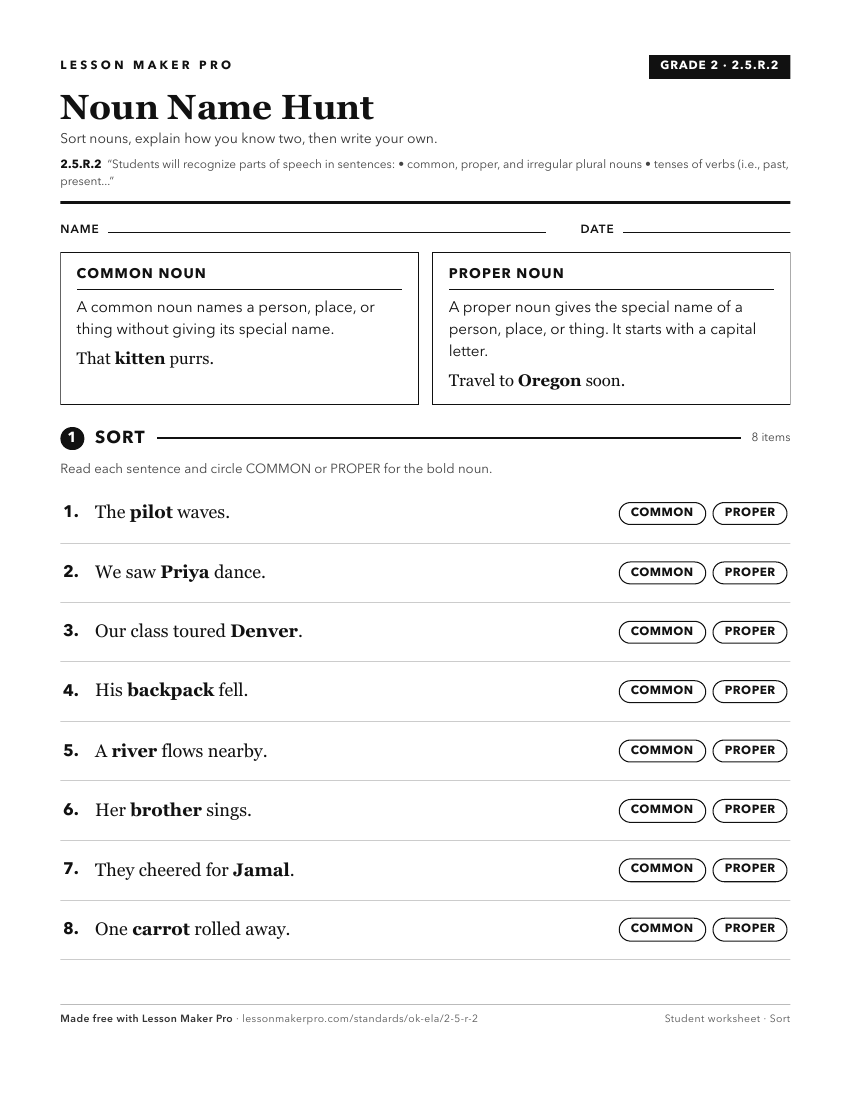
A ready-to-print activity worksheet aligned to 2.5.R.2, with an answer key for the teacher on its own page. No account needed.
PDF, US Letter, prints cleanly in black and white.
Download the worksheetKeep exploring
Related Standards
- 1.5.R.2
Recognize parts of speech in sentences:- nouns as concrete objects (i.e., people, places, and things)- regular plural nouns- present-tense verbs as actions- col...
- 3.5.R.2
Recognize parts of speech in sentences:- concrete, abstract, and possessive nouns- different types of verbs (i.e., action, linking, helping) and their roles in ...
- 4.5.R.2
Recognize parts of speech in sentences:- irregular possessive nouns (e.g., children's )- irregular and past participle verbs and verb tense to identify settings...
- 6.5.R.2
Recognize and explain the impact on meaning of parts of speech in sentences:- nouns- verb tense to signify various times, sequences, conditions, and states- sub...
Turn this exact standard into a lesson
Grade, subject, topic, and the complete standard are prefilled. Create one free, no account needed.
Also for this standard:Make a WorksheetMake a QuizMake a Sub Lesson