Oklahoma ELA 2.3.R.3
The Standard
Students will find examples of literary elements: • setting (i.e., time and place) • plot (i.e., beginning, middle, end) • characters and their traits
Oklahoma Academic Standards for English Language Arts (2021)
Teacher's field guide
What This Standard Means
What Students Need to Do
- Students read a story and find clues about when and where it happens. They put key events in order and describe a character using details from the story.
What Mastery Looks Like
- A student can point to a sentence or picture that shows the time and place. They can retell three key events in order and name a character trait supported by an action.
Common Misconceptions
- Some students name a place but miss clues about time. Others list events out of order or confuse a character’s feeling with a trait.
How to Assess It
- Give students this mini-story: “On a snowy morning at the park, Ana learns her neighbor’s puppy is missing; she searches behind the slide; she finds it and carries it home.” Ask them to name the time and place, list three key events in order, and give one trait Ana shows with proof.
Lesson moves
Ways to Teach It
Read The Snowy Day aloud, then have pairs arrange three drawn event cards and mark clues about the time, place, and Peter’s traits.
Ask, “What does Peter do that shows what he is like?” Have students point to a page that supports their answer.
Put time clues, place clues, event cards, and character actions from The Snowy Day in envelopes; have teams sort and explain them.
Have students draw a recent recess in three panels, label when and where it happened, and describe an action that shows someone’s trait.
Free download
Printable 2.3.R.3 Worksheet
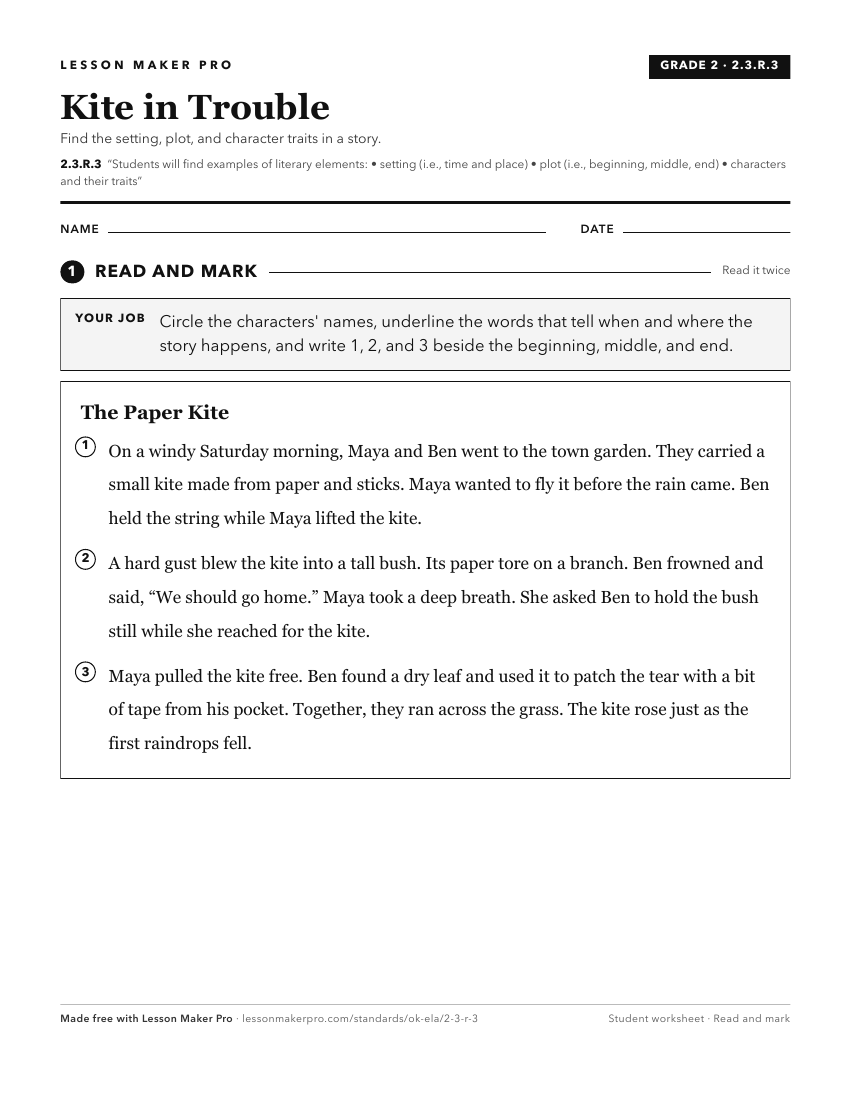
A ready-to-print activity worksheet aligned to 2.3.R.3, with an answer key for the teacher on its own page. No account needed.
PDF, US Letter, prints cleanly in black and white.
Download the worksheetKeep exploring
Related Standards
- 3.3.R.3
Find examples of literary elements:setting- plot- characters- characterization
- 1.3.R.3
Find textual evidence when provided with examples of literary elements:- setting ( i.e., time and place)- main characters and their traits
- 4.3.R.3
Find textual evidence of literary elements:- setting- plot- characters (i.e., protagonist, antagonist)- characterization- conflict
- 9.3.R.3
Evaluate how literary elements impact theme, mood, and/or tone, using textual evidence:- setting- plot structure (e.g., foreshadowing, flashback, in media res)-...
Turn this exact standard into a lesson
Grade, subject, topic, and the complete standard are prefilled. Create one free, no account needed.
Also for this standard:Make a WorksheetMake a QuizMake a Sub Lesson