Oklahoma ELA 1.3.R.3
The Standard
Students will find textual evidence when provided with examples of literary elements: • setting ( i.e., time and place) • main characters and their traits
Oklahoma Academic Standards for English Language Arts (2021)
Teacher's field guide
What This Standard Means
What Students Need to Do
- Students find words in a story that tell when and where it happens. They name the main character and point to an action in the story that shows a trait, such as kindness.
What Mastery Looks Like
- A student points to 'after lunch' for time and 'at the park' for place. They name the main character, describe a trait, and show the action that supports it.
Common Misconceptions
- Some students use a picture to name the setting without finding words in the story. Others pick a side character as the main character or mistake a passing feeling, such as fear, for a trait.
How to Assess It
- Give students this line: 'At night in the barn, Ana wrapped a cold kitten in her coat.' Ask them to circle the time and place and underline the action that shows Ana is kind.
Lesson moves
Ways to Teach It
Read The Snowy Day and give pairs sticky notes to mark words that show when and where Peter's story happens.
After reading The Snowy Day, ask, 'What is Peter like? Which action in the story makes you think that?'
Write 'morning,' 'in the yard,' and 'shared her snack' on cards; have students sort them into time, place, or trait clues.
Ask students to write two sentences about someone helping at recess, naming the place and the action that showed kindness.
Free download
Printable 1.3.R.3 Worksheet
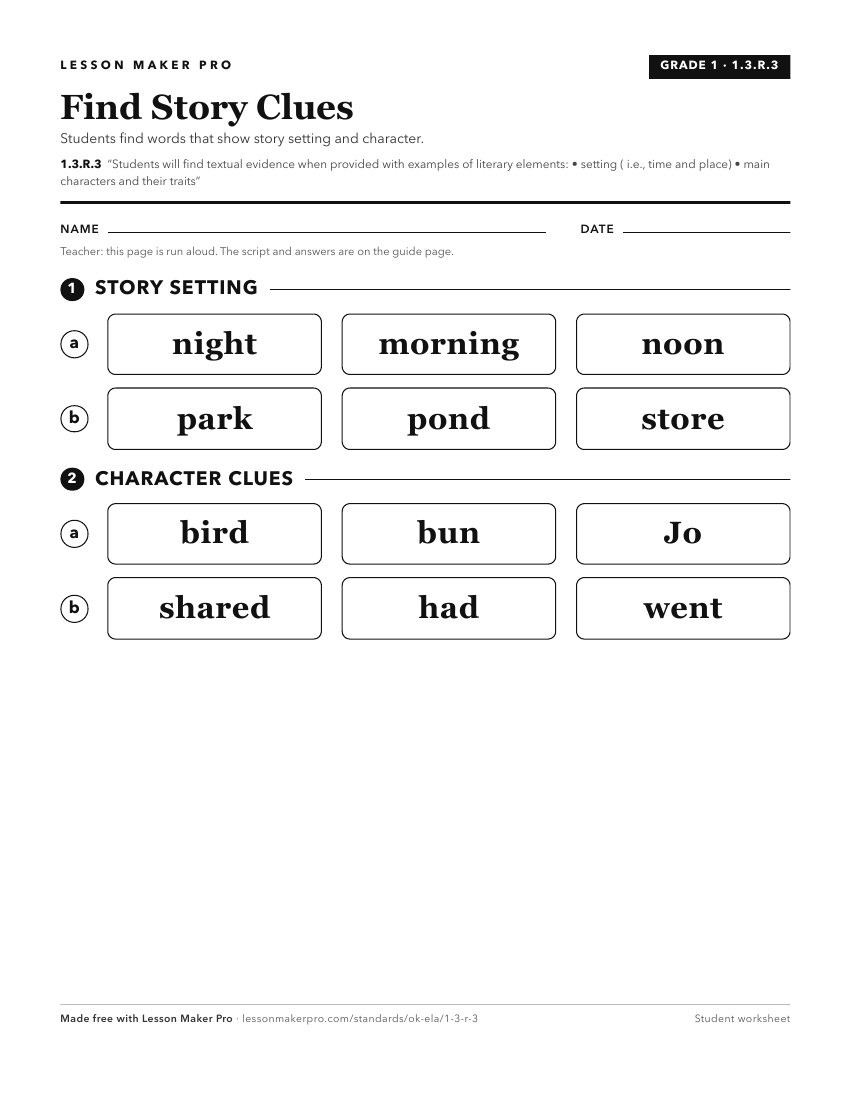
A ready-to-print activity worksheet aligned to 1.3.R.3, with an answer key for the teacher on its own page. No account needed.
PDF, US Letter, prints cleanly in black and white.
Download the worksheetKeep exploring
Related Standards
- 4.3.R.3
Find textual evidence of literary elements:- setting- plot- characters (i.e., protagonist, antagonist)- characterization- conflict
- 2.3.R.3
Find examples of literary elements:- setting (i.e., time and place)- plot (i.e., beginning, middle, end)- characters and their traits
- 3.3.R.3
Find examples of literary elements:setting- plot- characters- characterization
- 10.3.R.3
Evaluate how literary elements impact theme, mood, and/or tone, using textual evidence:- setting- plot structure (e.g., foreshadowing, flashback, in media res)-...
Turn this exact standard into a lesson
Grade, subject, topic, and the complete standard are prefilled. Create one free, no account needed.
Also for this standard:Make a WorksheetMake a QuizMake a Sub Lesson