Oklahoma ELA 12.3.R.5
The Standard
Students will evaluate how authors writing on the same issue reached different conclusions because of differences in assumptions, evidence, reasoning, and viewpoints, including examining rhetorical appeals, bias, and use of logical fallacies.
Oklahoma Academic Standards for English Language Arts (2021)
Teacher's field guide
What This Standard Means
What Students Need to Do
- Students compare two editorials on school phone bans and explain why the writers disagree. They check what each writer takes for granted, what proof appears, and where emotion or flawed logic steers the reader.
What Mastery Looks Like
- A student can cite lines from both editorials to show what each writer assumes and whether the evidence supports the claim. They can explain how a personal story sways readers and spot a false choice, such as banning all phones or giving up on learning.
Common Misconceptions
- Students may call any opinion biased or accept a statistic without checking its source. They may treat one personal story as proof about every student, or miss an argument that presents only two options.
How to Assess It
- Exit ticket: In two opposing editorials on school phone bans, quote one claim from each, explain a different assumption behind them, and identify one weak argument or emotional appeal.
Lesson moves
Ways to Teach It
Give pairs printed editorials on school phone bans and colored pencils; have them mark claims, evidence, assumptions, emotional appeals, and weak reasoning.
Ask: 'Does one student's phone distraction prove phones hurt everyone?' Have students write why that example does or does not support a schoolwide ban.
Make four claim cards about phone bans, including a false choice and a sweeping generalization; pairs sort them and defend their labels.
Read the school phone policy; draft a three-sentence email to the principal that challenges one assumption and proposes evidence to check it.
Free download
Printable 12.3.R.5 Worksheet
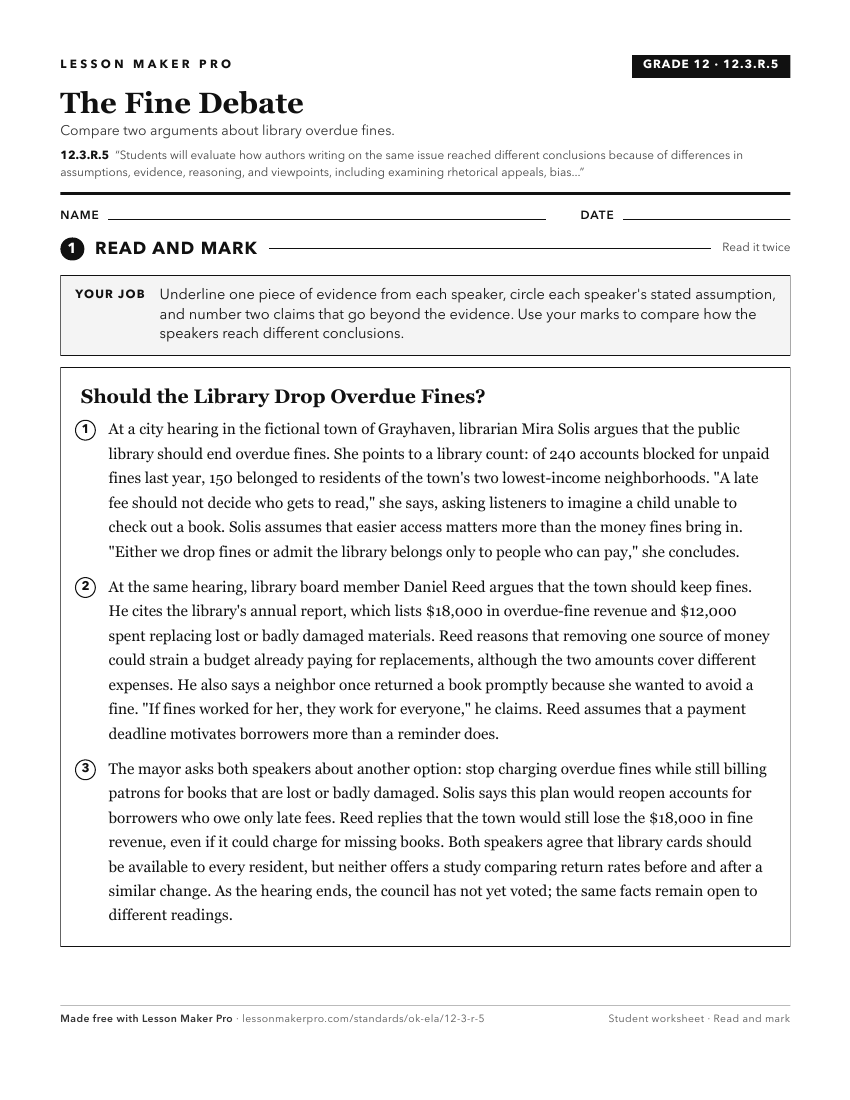
A ready-to-print activity worksheet aligned to 12.3.R.5, with an answer key for the teacher on its own page. No account needed.
PDF, US Letter, prints cleanly in black and white.
Download the worksheetKeep exploring
Related Standards
- 11.3.R.5
The 11th Grade version of this standard.
- 10.3.R.5
Evaluate the validity of a speaker's argument:- distinguish the kinds of evidence (e.g., logical, empirical, anecdotal)- distinguish substantiated from unsubsta...
- 9.3.R.5
Evaluate the validity of a speaker's argument:- distinguish the kinds of evidence (e.g., logical, empirical, anecdotal)- distinguish substantiated from unsubsta...
- 7.3.R.1
Read works written on the same topic from a variety of historical, cultural, ethnic, and global perspectives and compare the methods the authors use to achieve ...
Turn this exact standard into a lesson
Grade, subject, topic, and the complete standard are prefilled. Create one free, no account needed.
Also for this standard:Make a WorksheetMake a QuizMake a Sub Lesson