Oklahoma ELA 10.3.R.5
The Standard
Students will evaluate the validity of a speaker’s argument: • distinguish the kinds of evidence (e.g., logical, empirical, anecdotal) • distinguish substantiated from unsubstantiated claims • analyze rhetorical appeals (i.e., ethos, logos, pathos) • identify bias • identify logical fallacies
Oklahoma Academic Standards for English Language Arts (2021)
Teacher's field guide
What This Standard Means
What Students Need to Do
- Listen to a speaker's argument and tell apart data, personal stories, and reasoning. Check which claims have support. Identify appeals to credibility, logic, or emotion, and spot bias or faulty reasoning.
What Mastery Looks Like
- Given a short speech, a student can label the evidence and point to the words that support a claim. They can explain how an appeal works, whose interests the speaker represents, and why a flawed argument does not hold up.
Common Misconceptions
- Students may treat one personal story as proof of a general trend. They may mistake a confident tone for evidence or assume an either-or claim lists every possible choice. Some call any emotional language a fallacy, even when the speaker also gives sound evidence.
How to Assess It
- Read aloud: “We must ban phones because one student failed a test after texting. Either we ban phones or nobody will learn.” Ask students to name the evidence type, an unsupported claim, and the faulty choice presented.
Lesson moves
Ways to Teach It
Read aloud an argument for later school start times; pairs sort its sentences into data, anecdotes, reasoning, and unsupported claims.
Ask, “Does one student's late bus story prove the route is unreliable?” Have students write what evidence is missing.
Match claim cards, “Ban phones or nobody learns” and “Everyone does it,” to false dilemma and bandwagon.
Play a car safety ad; students check its crash-test claim on NHTSA's site and mark any fear appeal.
Free download
Printable 10.3.R.5 Worksheet
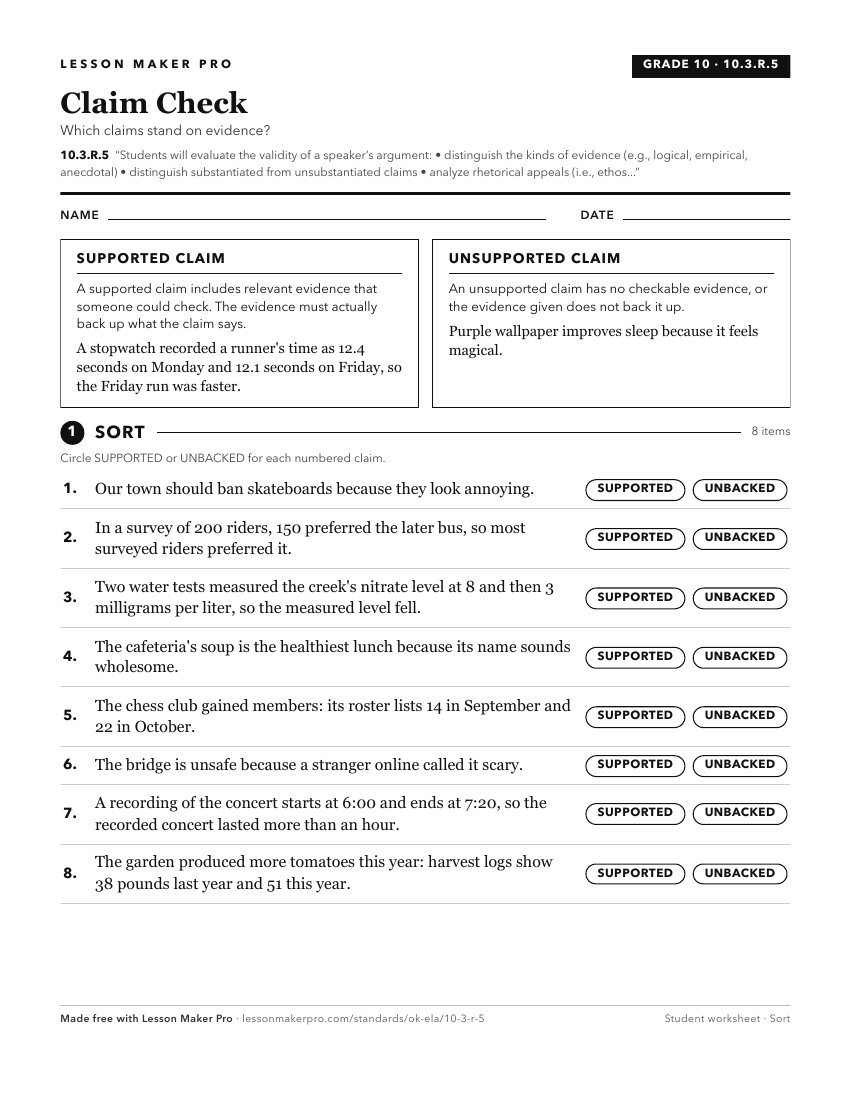
A ready-to-print activity worksheet aligned to 10.3.R.5, with an answer key for the teacher on its own page. No account needed.
PDF, US Letter, prints cleanly in black and white.
Download the worksheetKeep exploring
Related Standards
- 9.3.R.5
The 9th Grade version of this standard.
- 12.3.R.5
Evaluate how authors writing on the same issue reached different conclusions because of differences in assumptions, evidence, reasoning, and viewpoints, includi...
- 11.3.R.5
Evaluate how authors writing on the same issue reached different conclusions because of differences in assumptions, evidence, reasoning, and viewpoints, includi...
- 10.3.W.3
Compose argumentative essays, reviews, or op-eds that:- introduce precise, informed claims- include a defensible thesis- acknowledge counterclaims or alternate ...
Turn this exact standard into a lesson
Grade, subject, topic, and the complete standard are prefilled. Create one free, no account needed.
Also for this standard:Make a WorksheetMake a QuizMake a Sub Lesson