NY Next Generation Math NY-K.OA.3
The Standard
Decompose numbers less than or equal to 10 into pairs in more than one way. Record each decomposition with a drawing or equation.
New York State Next Generation Mathematics Learning Standards
Teacher's field guide
What This Standard Means
What Students Need to Do
- Students break numbers through 10 into two parts in more than one way. They record each pair with a drawing or equation.
What Mastery Looks Like
- The student decomposes 7 as 1 and 6, 2 and 5, 3 and 4, and other valid pairs. The student connects each model to an equation.
Common Misconceptions
- Students may repeat one pair in reverse and think no other combinations exist. They may change the total while moving objects between the two parts.
How to Assess It
- Give students eight counters and two circles. Ask for three different ways to split the counters and a drawing or equation for each.
Lesson moves
Ways to Teach It
Shake two-color counters in a cup, spill them, and record the two parts that still make the target number.
Ask students how they know they found a new pair without changing the total.
Play decomposition cover-up by hiding one part of a set and naming the visible and hidden parts.
Split a set of classroom items between two containers in several ways while keeping the same total.
Free download
Printable NY-K.OA.3 Worksheet
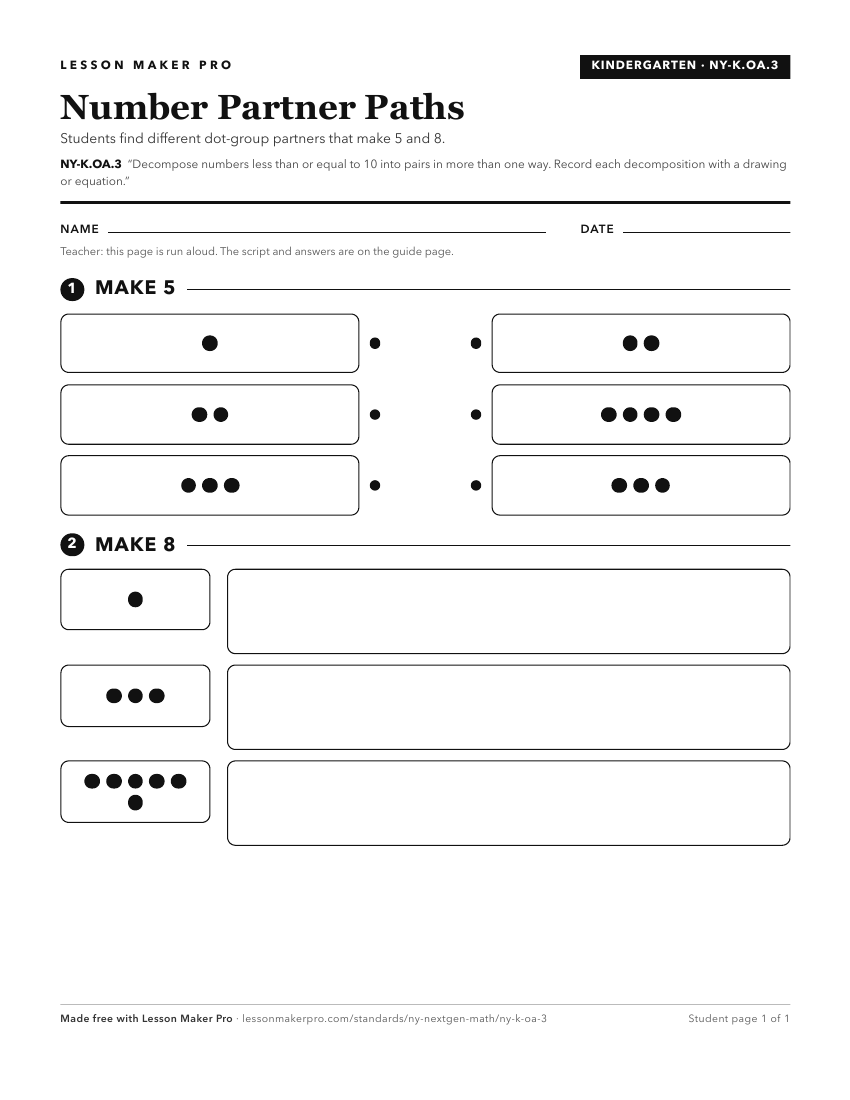
A ready-to-print activity worksheet aligned to NY-K.OA.3, with an answer key for the teacher on its own page. No account needed.
PDF, US Letter, prints cleanly in black and white.
Download the worksheetKeep exploring
Related Standards
- NY-K.OA.4
Find the number that makes 10 when given a number from 1 to 9. Record the answer with a drawing or equation.
- NY-1.NBT.5
Given a two-digit number, mentally find 10 more or 10 less than the number, without having to count; explain the reasoning used.
- NY-K.CC.7
Compare two numbers between 1 and 10 presented as written numerals.
- NY-K.NBT.1
Compose and decompose the numbers from 11 to 19 into ten ones and one, two, three, four, five, six, seven, eight, or nine ones.
Turn this exact standard into a lesson
Grade, subject, topic, and the complete standard are prefilled. Create one free, no account needed.
Also for this standard:Make a WorksheetMake a QuizMake a Sub Lesson