NY Next Generation Math NY-K.G.3
The Standard
Understand the difference between two-dimensional (lying in a plane, "flat") and three-dimensional ("solid") shapes.
New York State Next Generation Mathematics Learning Standards
Teacher's field guide
What This Standard Means
What Students Need to Do
- Students distinguish flat, two-dimensional shapes from solid, three-dimensional shapes. They use the words flat and solid to describe the difference.
What Mastery Looks Like
- A student sorts circles, squares, and triangles as flat shapes and spheres, cubes, and cones as solid shapes. The student explains that flat shapes lie in a plane while solid shapes take up space.
Common Misconceptions
- Students may call a circle and a sphere the same shape or classify a picture of a cube as flat because the paper is flat. They may also sort by size instead of dimension.
How to Assess It
- Give the student shape cards and solid blocks to sort into flat and solid groups. Ask for one sentence explaining the difference between the groups.
Lesson moves
Ways to Teach It
Handle paper shapes and solid blocks, sort them into two groups, and label the groups flat and solid.
Ask students how a circle and a sphere are alike and how being flat or solid makes them different.
Play flat-or-solid relay by drawing an object card, naming its shape, and placing it in the correct group.
Sort classroom objects and their outline tracings, comparing each solid object with the flat shape it leaves.
Free download
Printable NY-K.G.3 Worksheet
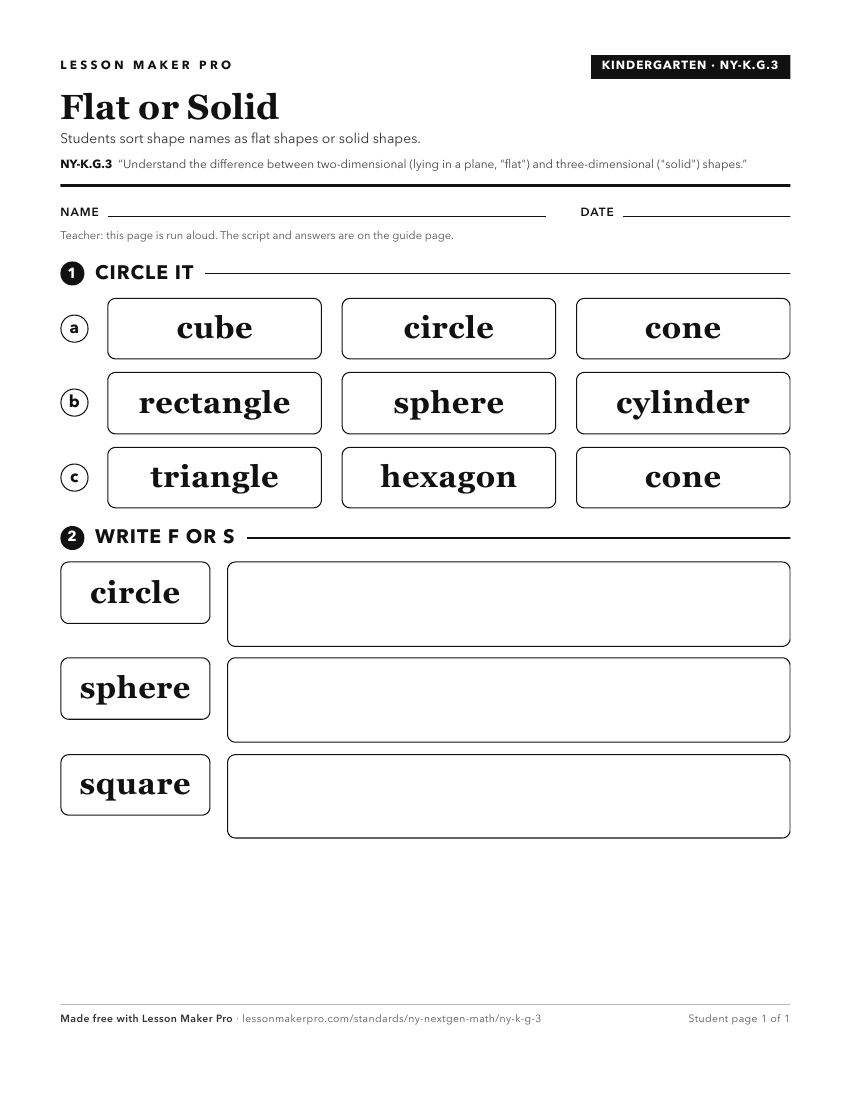
A ready-to-print activity worksheet aligned to NY-K.G.3, with an answer key for the teacher on its own page. No account needed.
PDF, US Letter, prints cleanly in black and white.
Download the worksheetKeep exploring
Related Standards
- NY-7.G.3
Describe the two-dimensional shapes that result from slicing three-dimensional solids parallel or perpendicular to the base.
- NY-3.MD.5
Recognize area as an attribute of plane figures and understand concepts of area measurement.
- NY-K.G.4
Analyze, compare, and sort two-and three-dimensional shapes, in different sizes and orientations, using informal language to describe their similarities, differ...
Turn this exact standard into a lesson
Grade, subject, topic, and the complete standard are prefilled. Create one free, no account needed.
Also for this standard:Make a WorksheetMake a QuizMake a Sub Lesson