NY Next Generation Math NY-5.NBT.3.b
The Standard
Compare two decimals to thousandths based on meanings of the digits in each place, using >, =, and < symbols to record the results of comparisons.
New York State Next Generation Mathematics Learning Standards
Teacher's field guide
What This Standard Means
What Students Need to Do
- Students compare two decimals through thousandths by examining the value of corresponding digits. They record each relationship with greater than, less than, or equal symbols.
What Mastery Looks Like
- A student compares 4.307 and 4.37 by writing 4.370 and identifying the hundredths place as decisive. The student records 4.307 < 4.370 and explains the comparison.
Common Misconceptions
- Students may assume the decimal with more digits is greater or compare digits without aligning places. They may treat a trailing zero as changing the value.
How to Assess It
- Ask students to compare 6.205 with 6.25 and 3.480 with 3.48. Require a symbol and place-value explanation for each.
Lesson moves
Ways to Teach It
Build decimal pairs on thousandths place-value charts, append equivalent trailing zeros, and compare from the greatest place.
Ask students why 2.700 and 2.7 represent the same value.
Play decimal comparison war with numeral cards and required place-value justifications for each symbol.
Compare recorded distances or masses measured to tenths, hundredths, or thousandths.
Free download
Printable NY-5.NBT.3.b Worksheet
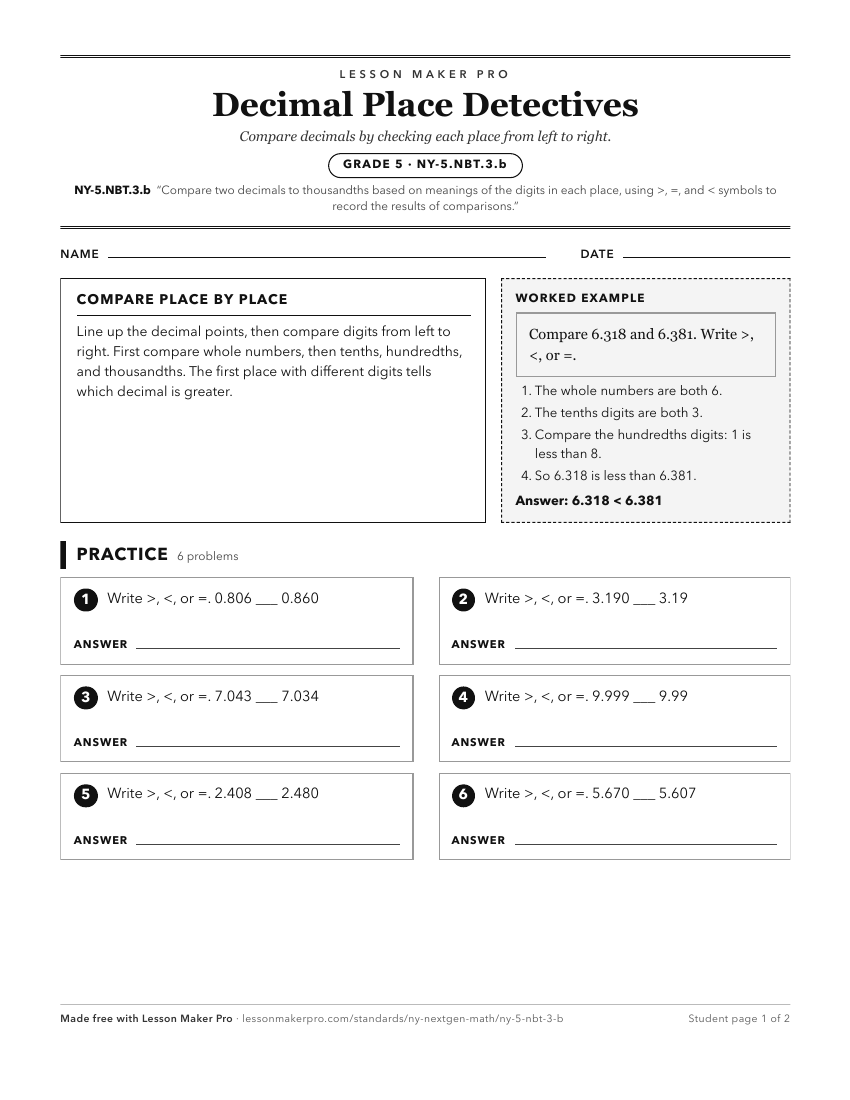
A ready-to-print activity worksheet aligned to NY-5.NBT.3.b, with an answer key for the teacher on its own page. No account needed.
PDF, US Letter, prints cleanly in black and white.
Download the worksheetKeep exploring
Related Standards
- NY-2.NBT.4
Compare two three-digit numbers based on meanings of the hundreds, tens, and ones digits, using >, =, and < symbols to record the results of comparisons.
- NY-1.NBT.3
Compare two two-digit numbers based on meanings of the tens and ones digits, recording the results of comparisons with the symbols >, =, and <.
- NY-4.NF.7
Compare two decimals to hundredths by reasoning about their size. Recognize that comparisons are valid only when two decimals refer to the same whole. Record th...
- NY-4.NBT.2.b
Compare two multi-digit numbers based on meanings of the digits in each place, using >, =, and < symbols to record the results of comparisons.
Turn this exact standard into a lesson
Grade, subject, topic, and the complete standard are prefilled. Create one free, no account needed.
Also for this standard:Make a WorksheetMake a QuizMake a Sub Lesson