NY Next Generation Math NY-4.MD.5.b
The Standard
Recognize an angle that turns through n one-degree angles is said to have an angle measure of n degrees.
New York State Next Generation Mathematics Learning Standards
Teacher's field guide
What This Standard Means
What Students Need to Do
- Students understand that an angle measuring n degrees is composed of n one-degree turns. They connect the numerical measure to the amount of rotation between the rays.
What Mastery Looks Like
- A student explains that a 65-degree angle contains 65 one-degree turns from one ray to the other. The student knows that increasing the number of one-degree turns increases the angle measure.
Common Misconceptions
- Students may count drawn tick marks without treating each interval as one degree or use ray length to decide the measure. They may confuse the degree count with a fraction's numerator or denominator.
How to Assess It
- Show an angle represented as 35 consecutive one-degree turns. Ask students to state its measure and explain what the number 35 counts.
Lesson moves
Ways to Teach It
Build angles by rotating a ray through labeled one-degree intervals on a circular template, then record each measure.
Ask students what changes when ten more one-degree turns are added to an angle.
Play degree-count match with angle diagrams, one-degree turn counts, and numerical measures.
Track the degree turn of a rotating sign or wheel pointer between two marked positions.
Free download
Printable NY-4.MD.5.b Worksheet
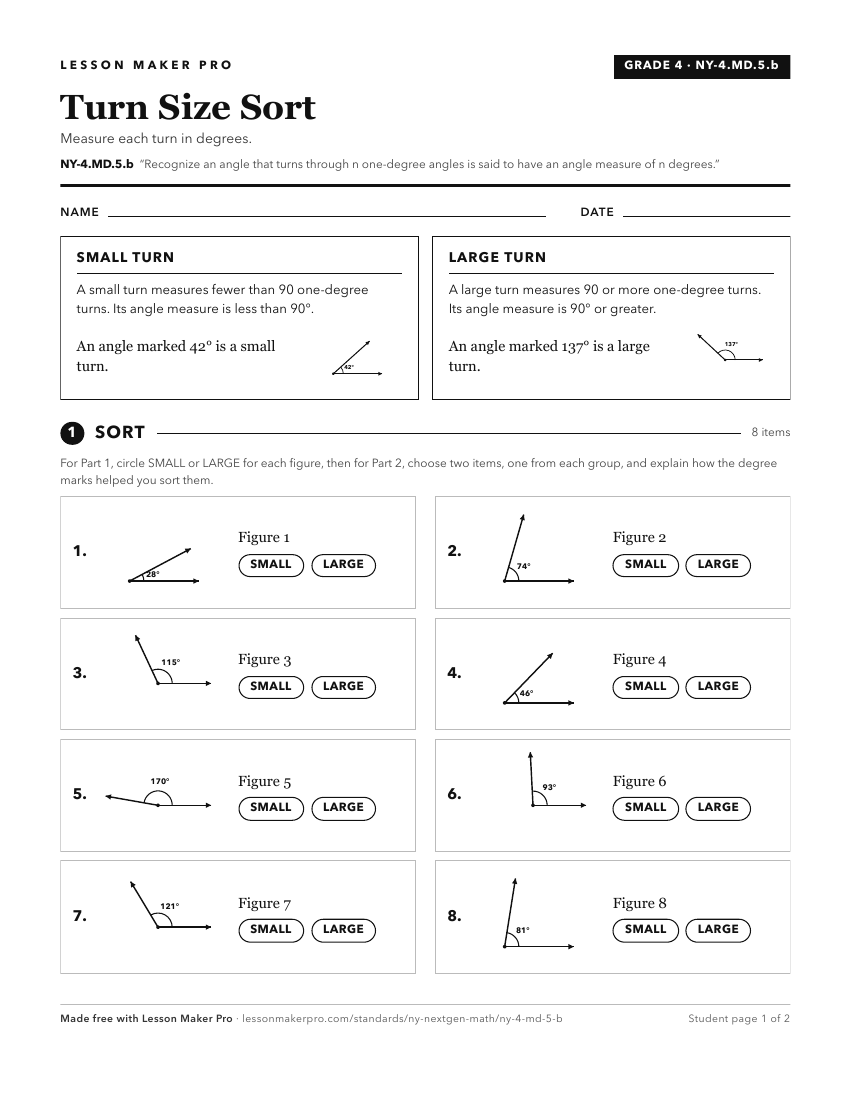
A ready-to-print activity worksheet aligned to NY-4.MD.5.b, with an answer key for the teacher on its own page. No account needed.
PDF, US Letter, prints cleanly in black and white.
Download the worksheetKeep exploring
Related Standards
- NY-4.MD.6
Measure angles in whole-number degrees using a protractor. Sketch angles of specified measure.
- NY-4.MD.7
Recognize angle measure as additive. When an angle is decomposed into non-overlapping parts, the angle measure of the whole is the sum of the angle measures of ...
- NY-4.MD.5
Recognize angles as geometric shapes that are formed wherever two rays share a common endpoint, and understand concepts of angle measurement.
Turn this exact standard into a lesson
Grade, subject, topic, and the complete standard are prefilled. Create one free, no account needed.
Also for this standard:Make a WorksheetMake a QuizMake a Sub Lesson