NY Next Generation Math NY-3.MD.7.c
The Standard
Use tiling to show in a concrete case that the area of a rectangle with whole-number side length a and side length b + c is the sum of a × b and a × c. Use area models to represent the distributive property in mathematical reasoning.
New York State Next Generation Mathematics Learning Standards
Teacher's field guide
What This Standard Means
What Students Need to Do
- Students split one whole-number side length into two parts and use tiles to decompose a rectangle. They connect the two partial areas to the distributive property.
What Mastery Looks Like
- A student splits a 6-by-8 rectangle into 6-by-5 and 6-by-3 rectangles. The student shows 6 × 8 = 6 × 5 + 6 × 3 and verifies both areas total 48.
Common Misconceptions
- Students may split one side but change the other dimension or leave a gap between parts. They may add partial products that do not recreate the original rectangle.
How to Assess It
- Ask students to tile a 7-by-9 rectangle, split 9 into 5 and 4, and write the matching partial-area equation.
Lesson moves
Ways to Teach It
Tile a rectangle, cut one side at a chosen point, and record both partial areas and the total product.
Ask students why the unchanged side length appears in both partial products.
Play distributive-area match with rectangles, decomposed side lengths, partial products, and total products.
Split a rectangular floor or garden plan into easier sections and add their areas.
Free download
Printable NY-3.MD.7.c Worksheet
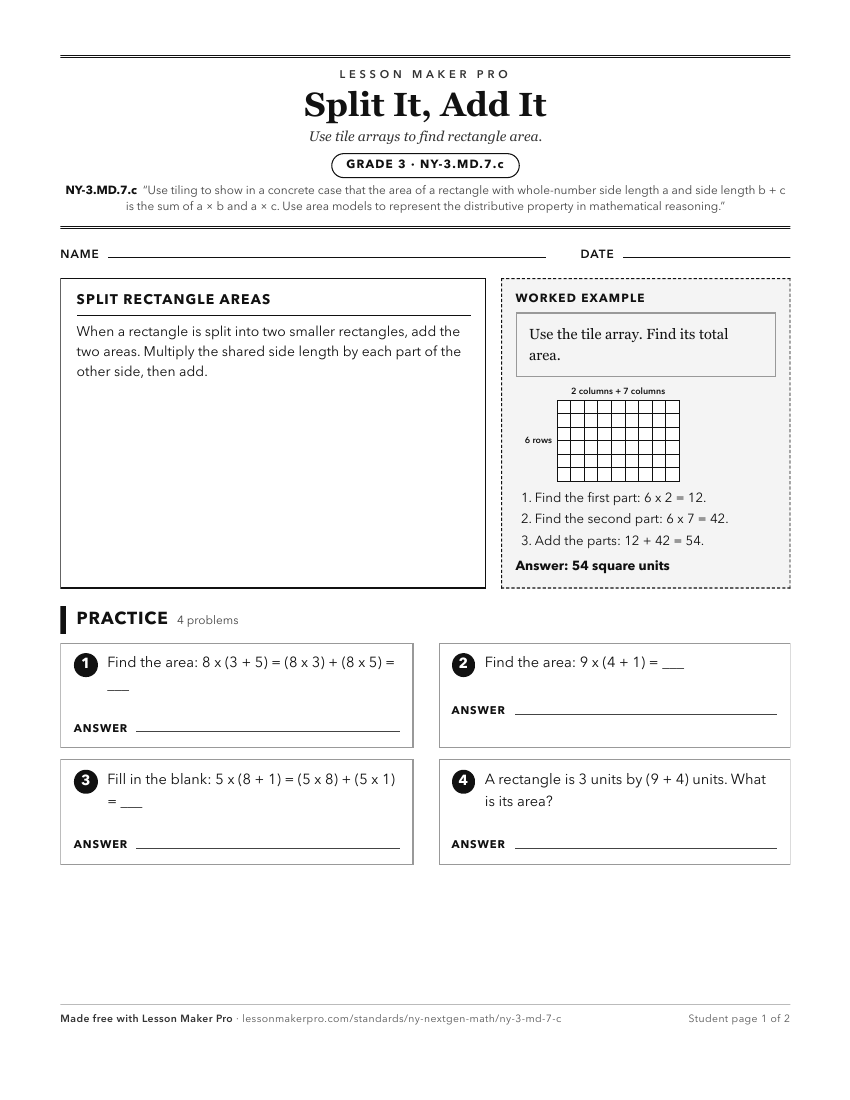
A ready-to-print activity worksheet aligned to NY-3.MD.7.c, with an answer key for the teacher on its own page. No account needed.
PDF, US Letter, prints cleanly in black and white.
Download the worksheetKeep exploring
Related Standards
- NY-3.MD.7.b
Multiply side lengths to find areas of rectangles with whole-number side lengths in the context of solving real world and mathematical problems, and represent w...
- NY-3.MD.7.a
Find the area of a rectangle with whole-number side lengths by tiling it, and show that the area is the same as would be found by multiplying the side lengths.
- NY-5.NF.4.b
Find the area of a rectangle with fractional side lengths by tiling it with rectangles of the appropriate unit fraction side lengths, and show that the area is ...
Turn this exact standard into a lesson
Grade, subject, topic, and the complete standard are prefilled. Create one free, no account needed.
Also for this standard:Make a WorksheetMake a QuizMake a Sub Lesson