NY Next Generation Math NY-2.NBT.7.b
The Standard
Understand that in adding or subtracting up to three-digit numbers, one adds or subtracts hundreds and hundreds, tens and tens, ones and ones, and sometimes it is necessary to compose or decompose tens or hundreds.
New York State Next Generation Mathematics Learning Standards
Teacher's field guide
What This Standard Means
What Students Need to Do
- Students add or subtract matching place values in numbers with up to three digits. They compose a ten or hundred when adding and decompose a ten or hundred when subtracting as needed.
What Mastery Looks Like
- The student explains that 10 ones become 1 ten and 10 tens become 1 hundred. During subtraction, the student can decompose 1 hundred into 10 tens or 1 ten into 10 ones.
Common Misconceptions
- Students may combine digits from different places or exchange units without preserving value. They may treat a decomposed hundred as one extra ten instead of ten tens.
How to Assess It
- Ask students to model 268 + 157 and 402 - 185. Have them identify every composed or decomposed unit.
Lesson moves
Ways to Teach It
Trade base-ten blocks while adding or subtracting three-digit numbers, naming each ten-for-ones or hundred-for-tens exchange.
Ask students why decomposing one hundred adds ten tens without changing the total value.
Play exchange detective by finding and correcting invalid compositions or decompositions in worked examples.
Update a three-digit supply count after deliveries and use, explaining any place-value exchanges needed.
Free download
Printable NY-2.NBT.7.b Worksheet
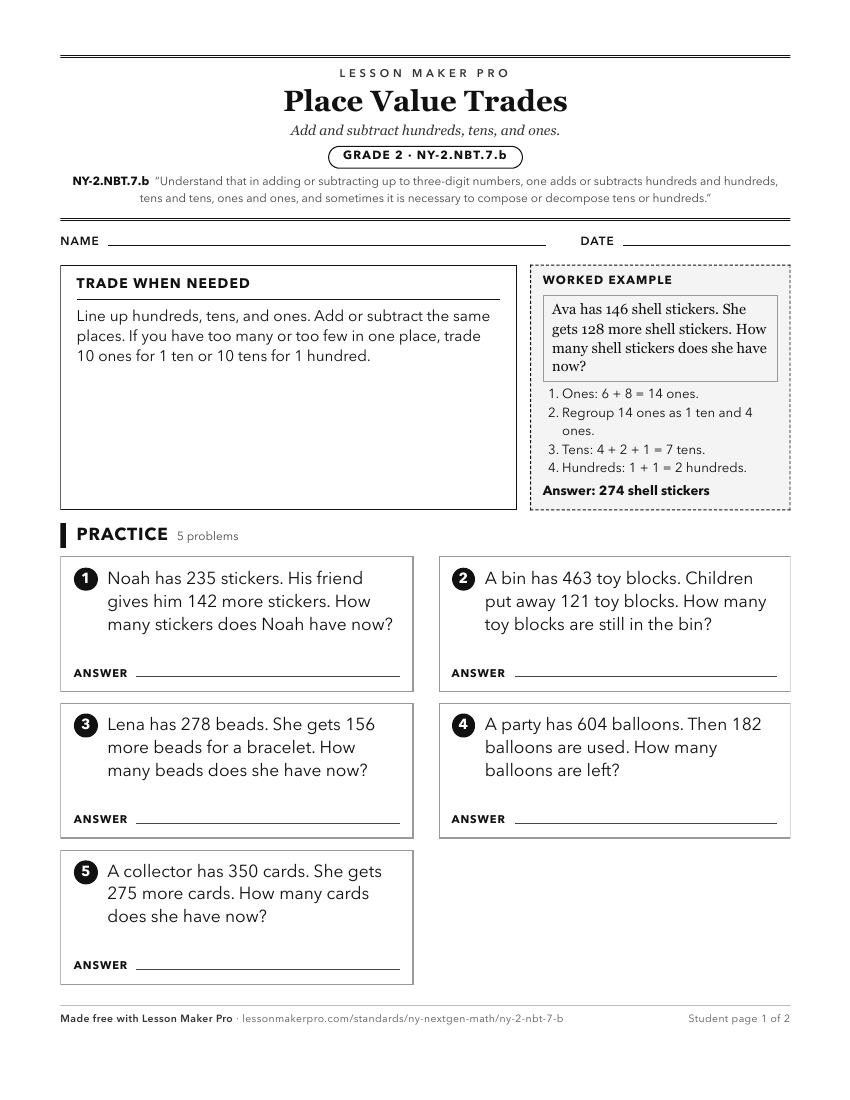
A ready-to-print activity worksheet aligned to NY-2.NBT.7.b, with an answer key for the teacher on its own page. No account needed.
PDF, US Letter, prints cleanly in black and white.
Download the worksheetKeep exploring
Related Standards
- NY-2.NBT.4
Compare two three-digit numbers based on meanings of the hundreds, tens, and ones digits, using >, =, and < symbols to record the results of comparisons.
- NY-1.NBT.2
Understand that the two digits of a two-digit number represent amounts of tens and ones.
- NY-2.NBT.1
Understand that the digits of a three-digit number represent amounts of hundreds, tens, and ones.
- NY-3.NBT.4.a
Understand that the digits of a four-digit number represent amounts of thousands, hundreds, tens, and ones.
Turn this exact standard into a lesson
Grade, subject, topic, and the complete standard are prefilled. Create one free, no account needed.
Also for this standard:Make a WorksheetMake a QuizMake a Sub Lesson