NY Next Generation Math NY-3.NBT.4.a
The Standard
Understand that the digits of a four-digit number represent amounts of thousands, hundreds, tens, and ones.
New York State Next Generation Mathematics Learning Standards
Teacher's field guide
What This Standard Means
What Students Need to Do
- Students interpret each digit in a four-digit number as thousands, hundreds, tens, or ones. They state the value represented by a digit based on its position.
What Mastery Looks Like
- For 3,245, the student identifies 3 thousands, 2 hundreds, 4 tens, and 5 ones. The student states that the 2 represents 200, not 2.
Common Misconceptions
- Students may name a digit instead of its value or shift place names when a zero appears. They may read each digit as separate ones.
How to Assess It
- Give the number 6,407. Ask students to name the amount in each place and explain what the zero represents.
Lesson moves
Ways to Teach It
Build four-digit numbers with place-value disks and place each group in a labeled chart.
Ask students how the value of 5 changes between 5,230 and 2,503.
Play place-value reveal by drawing digit cards and naming each digit's amount in the completed number.
Read a four-digit attendance, distance, or inventory count and identify each place-value amount.
Free download
Printable NY-3.NBT.4.a Worksheet
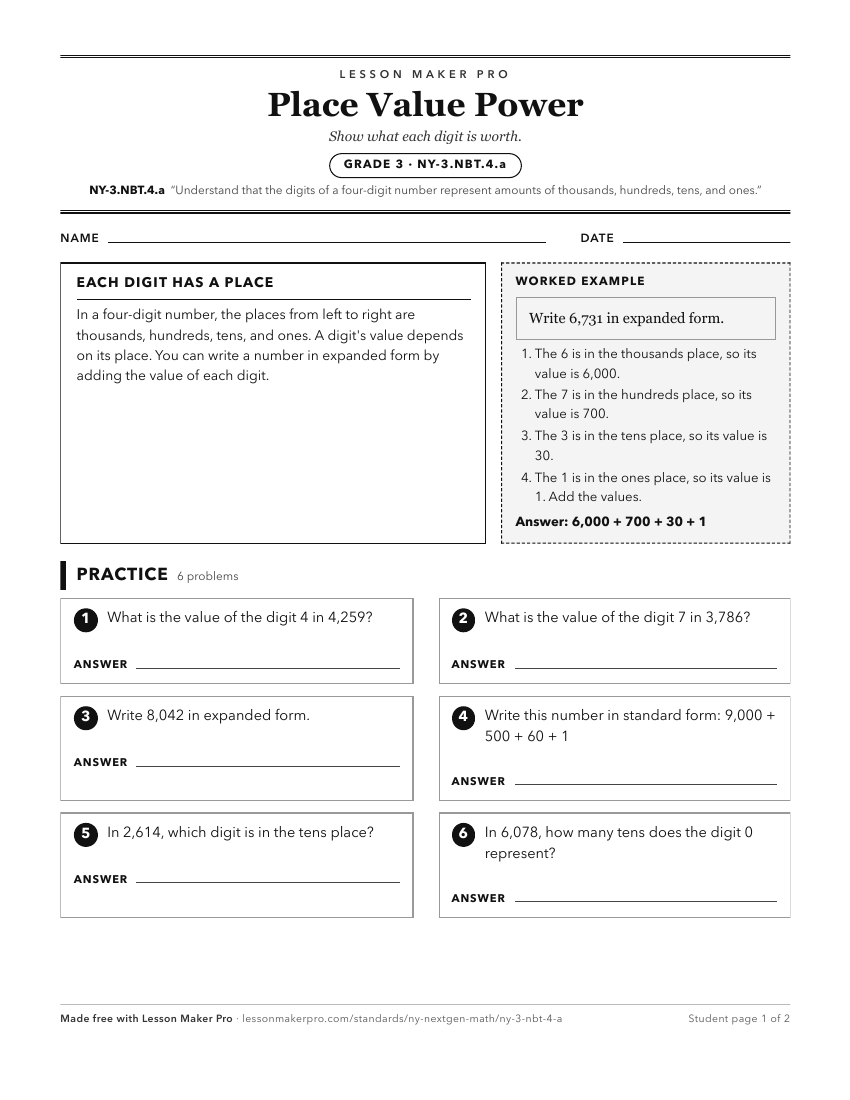
A ready-to-print activity worksheet aligned to NY-3.NBT.4.a, with an answer key for the teacher on its own page. No account needed.
PDF, US Letter, prints cleanly in black and white.
Download the worksheetKeep exploring
Related Standards
- NY-1.NBT.2
Understand that the two digits of a two-digit number represent amounts of tens and ones.
- NY-2.NBT.1
Understand that the digits of a three-digit number represent amounts of hundreds, tens, and ones.
- NY-4.NBT.1
Recognize that in a multi-digit whole number, a digit in one place represents ten times what it represents in the place to its right.
- NY-2.NBT.1.b
Understand the numbers 100, 200, 300, 400, 500, 600, 700, 800, 900 refer to one, two, three, four, five, six, seven, eight, or nine hundreds (and 0 tens and 0 o...
Turn this exact standard into a lesson
Grade, subject, topic, and the complete standard are prefilled. Create one free, no account needed.
Also for this standard:Make a WorksheetMake a QuizMake a Sub Lesson