NY Next Generation Math NY-2.MD.2
The Standard
Measure the length of an object twice, using different "length units" for the two measurements; describe how the two measurements relate to the size of the unit chosen.
New York State Next Generation Mathematics Learning Standards
Teacher's field guide
What This Standard Means
What Students Need to Do
- Students measure the same object with two different length units. They explain that a smaller unit produces a larger measurement number and a larger unit produces a smaller number.
What Mastery Looks Like
- A student measures a 24-inch strip as 24 inches and 2 feet. The student explains that more inches are needed because an inch is smaller than a foot.
Common Misconceptions
- Students may expect both measurements to have the same number because the object did not change. They may claim the larger number means the object became longer.
How to Assess It
- Give the student a 24-inch paper strip, an inch ruler, and a foot ruler. Ask for both measurements and an explanation of the different numbers.
Lesson moves
Ways to Teach It
Measure one tabletop with inch tiles and foot-long strips, recording both results beside the unchanged object.
Ask students why measuring with a smaller unit requires more units.
Play unit prediction by choosing which of two units will produce the larger measurement before measuring.
Compare room dimensions recorded in feet with the same dimensions recorded in inches.
Free download
Printable NY-2.MD.2 Worksheet
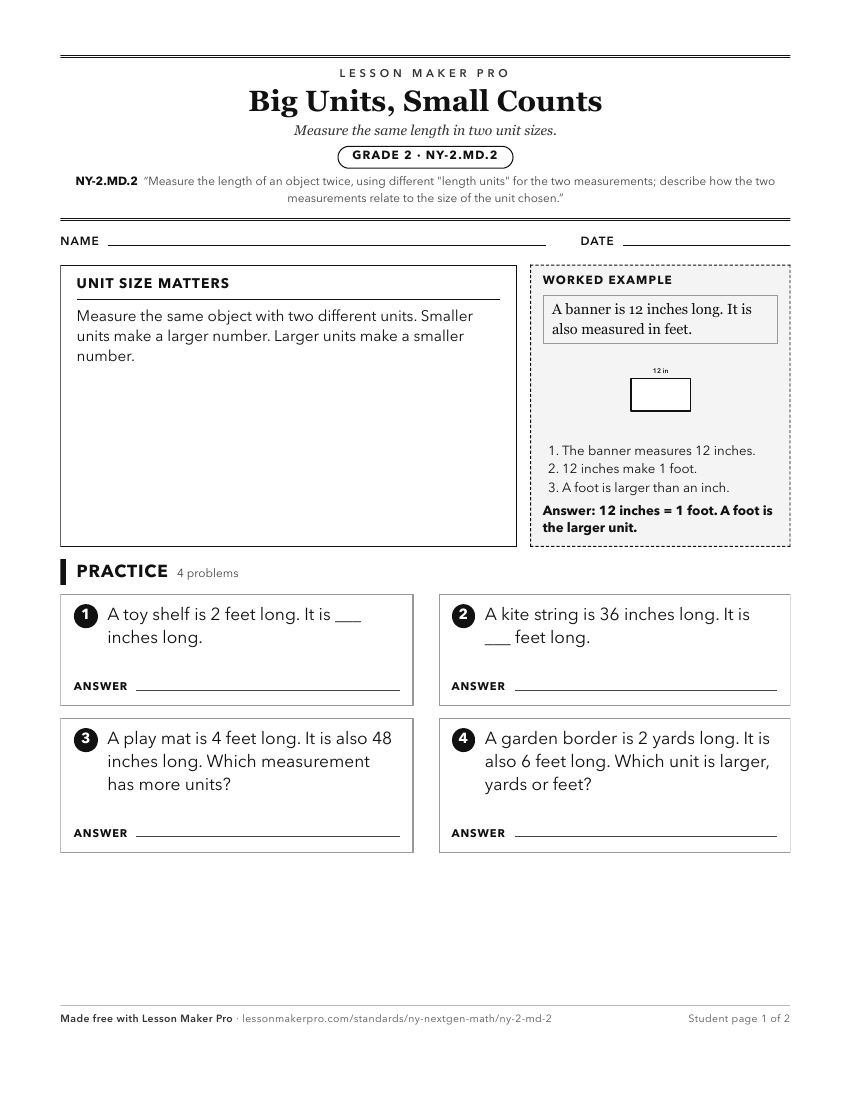
A ready-to-print activity worksheet aligned to NY-2.MD.2, with an answer key for the teacher on its own page. No account needed.
PDF, US Letter, prints cleanly in black and white.
Download the worksheetKeep exploring
Related Standards
- NY-2.MD.4
Measure to determine how much longer one object is than another, expressing the length difference in terms of a standard "length unit."
- NY-1.MD.2
Measure the length of an object using same-size "length units" placed end to end with no gaps or overlaps. Express the length of an object as a whole number of ...
Turn this exact standard into a lesson
Grade, subject, topic, and the complete standard are prefilled. Create one free, no account needed.
Also for this standard:Make a WorksheetMake a QuizMake a Sub Lesson