NY Next Generation Math GEO-G.CO.4
The Standard
Develop definitions of rotations, reflections, and translations in terms of points, angles, circles, perpendicular lines, parallel lines, and line segments.
New York State Next Generation Mathematics Learning Standards
Teacher's field guide
What This Standard Means
What Students Need to Do
- Students define translations, rotations, line reflections, and point reflections using geometric objects and relationships. They specify every parameter needed to determine each motion.
What Mastery Looks Like
- The student defines a translation with a vector, a rotation with center and directed angle, and a reflection with a line. The definitions predict an image point precisely.
Common Misconceptions
- Students may name a motion without its vector, center, angle, or reflection line. They may confuse a point reflection with a line reflection or reverse rotation direction.
How to Assess It
- Show four point-image pairs. Ask students to define the responsible motion precisely, including every required parameter.
Lesson moves
Ways to Teach It
Use transparencies, vectors, pins, and mirrors to create motions and record their defining data.
Ask what information is missing from the instruction rotate the figure.
Play motion specification with cards for centers, angles, vectors, lines, and point pairs.
Describe sprite movement in a graphics program using precise geometric motion definitions.
Free download
Printable GEO-G.CO.4 Worksheet
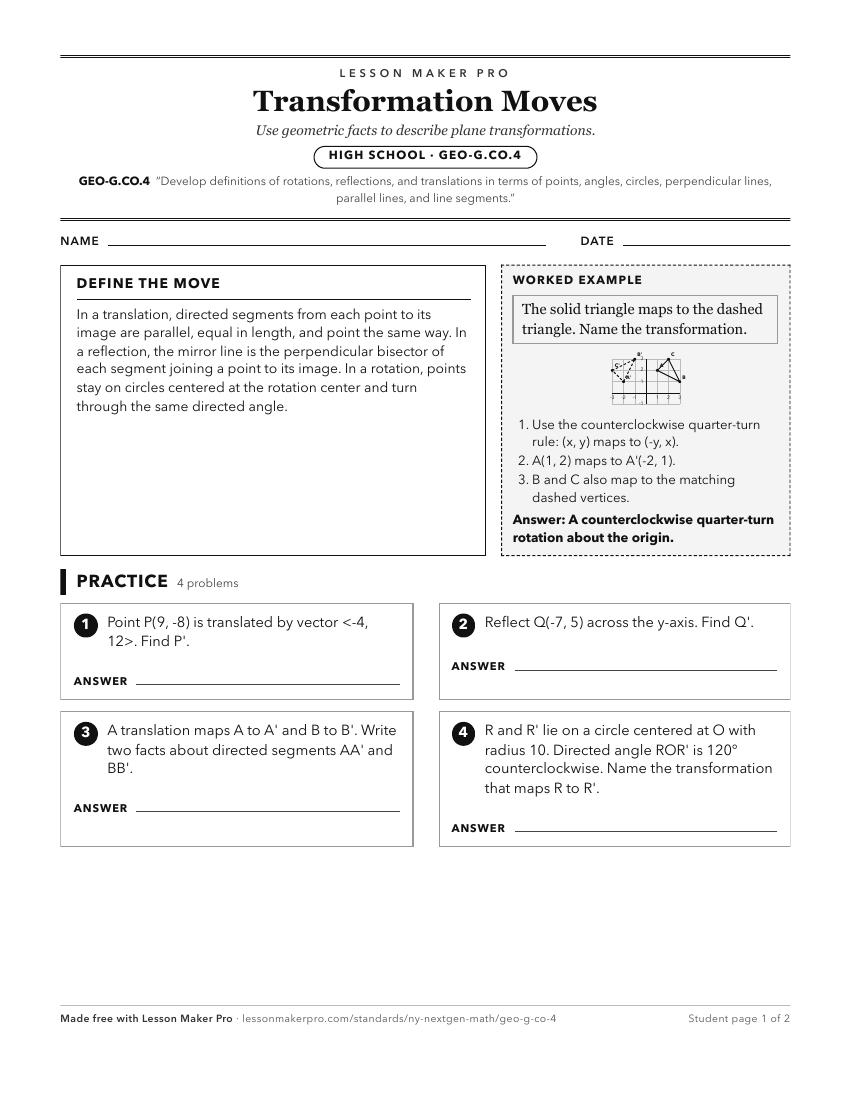
A ready-to-print activity worksheet aligned to GEO-G.CO.4, with an answer key for the teacher on its own page. No account needed.
PDF, US Letter, prints cleanly in black and white.
Download the worksheetKeep exploring
Related Standards
- GEO-G.CO.1
Know precise definitions of angle, circle, perpendicular lines, parallel lines, and line segment, based on the undefined notions of point, line, distance along ...
- NY-8.G.1
Verify experimentally the properties of rotations, reflections, and translations.
- NY-4.G.1
Draw points, lines, line segments, rays, angles (right, acute, obtuse), and perpendicular and parallel lines. Identify these in two-dimensional figures.
- GEO-G.CO.2
Represent transformations as geometric functions that take points in the plane as inputs and give points as outputs. Compare transformations that preserve dista...
Turn this exact standard into a lesson
Grade, subject, topic, and the complete standard are prefilled. Create one free, no account needed.
Also for this standard:Make a WorksheetMake a QuizMake a Sub Lesson