NY Next Generation Math AII-S.CP.4
The Standard
Interpret two-way frequency tables of data when two categories are associated with each object being classified. Use the two-way table as a sample space to decide if events are independent and calculate conditional probabilities.
New York State Next Generation Mathematics Learning Standards
Teacher's field guide
What This Standard Means
What Students Need to Do
- Students interpret a two-way frequency table as a sample space. They calculate marginal and conditional probabilities and decide whether two categorical events are independent.
What Mastery Looks Like
- The student selects the correct row, column, intersection, and conditioning total. The independence decision compares relevant conditional and overall probabilities.
Common Misconceptions
- Students may divide by the grand total when a conditional total is required. They may call events independent simply because both occur often.
How to Assess It
- Provide a two-way table with two categories. Ask for one conditional probability and an evidence-based independence decision.
Lesson moves
Ways to Teach It
Build a two-way table by sorting survey cards, then circle the denominator for each conditional question.
Ask what would remain unchanged in a table if two events were independent.
Play denominator choice with probability prompts and row, column, or grand-total cards.
Analyze a medical-test, product-preference, or school-survey table for conditional patterns.
Free download
Printable AII-S.CP.4 Worksheet
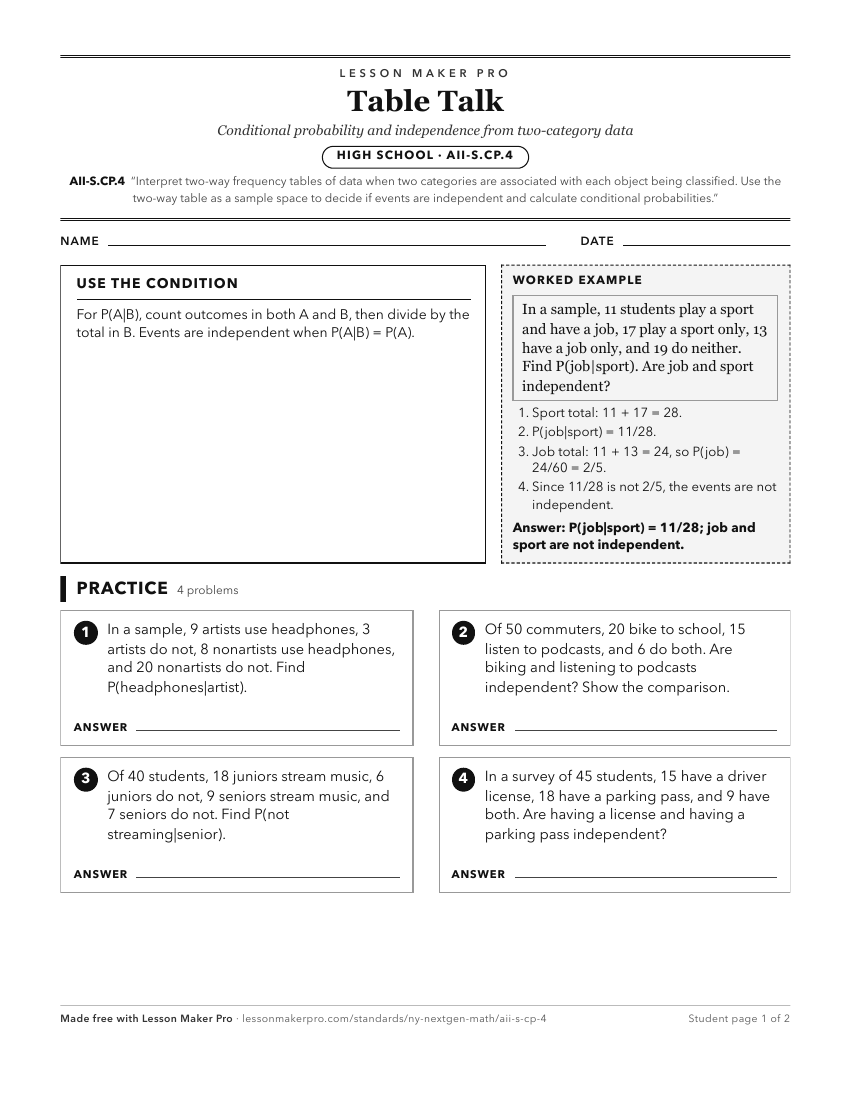
A ready-to-print activity worksheet aligned to AII-S.CP.4, with an answer key for the teacher on its own page. No account needed.
PDF, US Letter, prints cleanly in black and white.
Download the worksheetKeep exploring
Related Standards
- NY-6.SP.8
Develop a probability model and use it to find probabilities of simple events. Compare probabilities from a model to observed frequencies; if the agreement is n...
- NY-7.SP.8
Find probabilities of compound events using organized lists, sample space tables, tree diagrams, and simulation.
- NY-1.MD.4
Organize, represent, and interpret data with up to three categories; ask and answer questions about the total number of data points, how many in each category, ...
Turn this exact standard into a lesson
Grade, subject, topic, and the complete standard are prefilled. Create one free, no account needed.
Also for this standard:Make a WorksheetMake a QuizMake a Sub Lesson