NGSS K-2-ETS1-1
The Standard
Ask questions, make observations, and gather information about a situation people want to change to define a simple problem that can be solved through the development of a new or improved object or tool.
Next Generation Science Standards
Teacher's field guide
What This Standard Means
What Students Need to Do
- Students notice a situation that is not working well and ask questions about it. They use observations and simple information to explain the problem before proposing a tool or object.
What Mastery Looks Like
- Students describe a clear problem based on what they saw or learned. They identify who has the problem and what a useful solution should help accomplish.
Common Misconceptions
- Students may name a solution before explaining the problem, such as saying, “Build a holder.” They may also confuse observations with opinions or leave out who needs help.
How to Assess It
- Show a picture of pencils rolling off a desk. Ask students to write one observation, one question, and one sentence naming the problem.
Lesson moves
Ways to Teach It
Give pairs a leaking paper cup to observe, then have them list questions and state the problem before suggesting any fix.
Ask, “What problem makes our classroom harder to use?” Have students support one answer with two observations.
Play a card sort where students place statements under observation, question, problem, or solution.
Walk through the school and record one problem a new or improved tool could help solve.
Free download
Printable K-2-ETS1-1 Worksheet
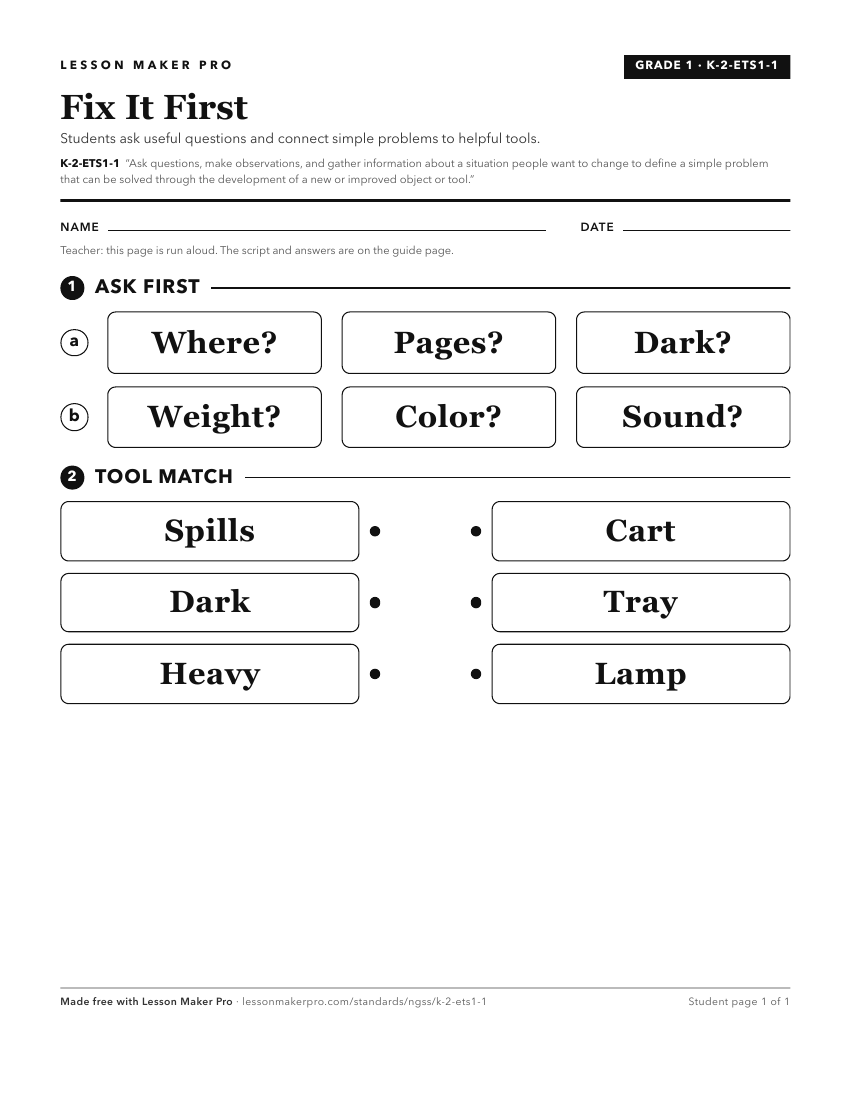
A ready-to-print activity worksheet aligned to K-2-ETS1-1, with an answer key for the teacher on its own page. No account needed.
PDF, US Letter, prints cleanly in black and white.
Download the worksheetKeep exploring
Related Standards
- HS-ETS1-2
Design a solution to a complex real-world problem by breaking it down into smaller, more manageable problems that can be solved through engineering.
- MS-ETS1-4
Develop a model to generate data for iterative testing and modification of a proposed object, tool, or process such that an optimal design can be achieved.
- 3-5-ETS1-3
Plan and carry out fair tests in which variables are controlled and failure points are considered to identify aspects of a model or prototype that can be improv...
- K-2-ETS1-2
Develop a simple sketch, drawing, or physical model to illustrate how the shape of an object helps it function as needed to solve a given problem.
Turn this exact standard into a lesson
Grade, subject, topic, and the complete standard are prefilled. Create one free, no account needed.
Also for this standard:Make a WorksheetMake a QuizMake a Sub Lesson