NGSS 1-LS1-1
The Standard
Use materials to design a solution to a human problem by mimicking how plants and/or animals use their external parts to help them survive, grow, and meet their needs.
Next Generation Science Standards
Teacher's field guide
What This Standard Means
What Students Need to Do
- Students identify how an outer plant or animal part helps the organism. They build a model that copies that feature to solve a human problem, then explain the connection.
What Mastery Looks Like
- A student can connect an outer plant or animal part to the job it performs. The student builds a simple solution, tests it, and explains how the copied feature helps.
Common Misconceptions
- Students may copy an organism’s appearance without copying the useful feature. They may choose internal body parts instead of visible outer parts. Some assume a design works without testing it.
How to Assess It
- Exit ticket: A cyclist needs head protection. Draw a design inspired by a turtle shell, label the copied feature, and explain how it helps.
Lesson moves
Ways to Teach It
Give pairs cardboard tubes, craft sticks, tape, and clay to build and test a tower base modeled on spreading tree roots.
Show photos of thorns, shells, webbed feet, and tails, then ask students which human problem each feature could help solve.
Play a card-matching game where students pair animal or plant parts with problem cards, then name a material for each solution.
Examine a bicycle helmet and compare its hard outer layer with a turtle shell or acorn shell.
Free download
Printable 1-LS1-1 Worksheet
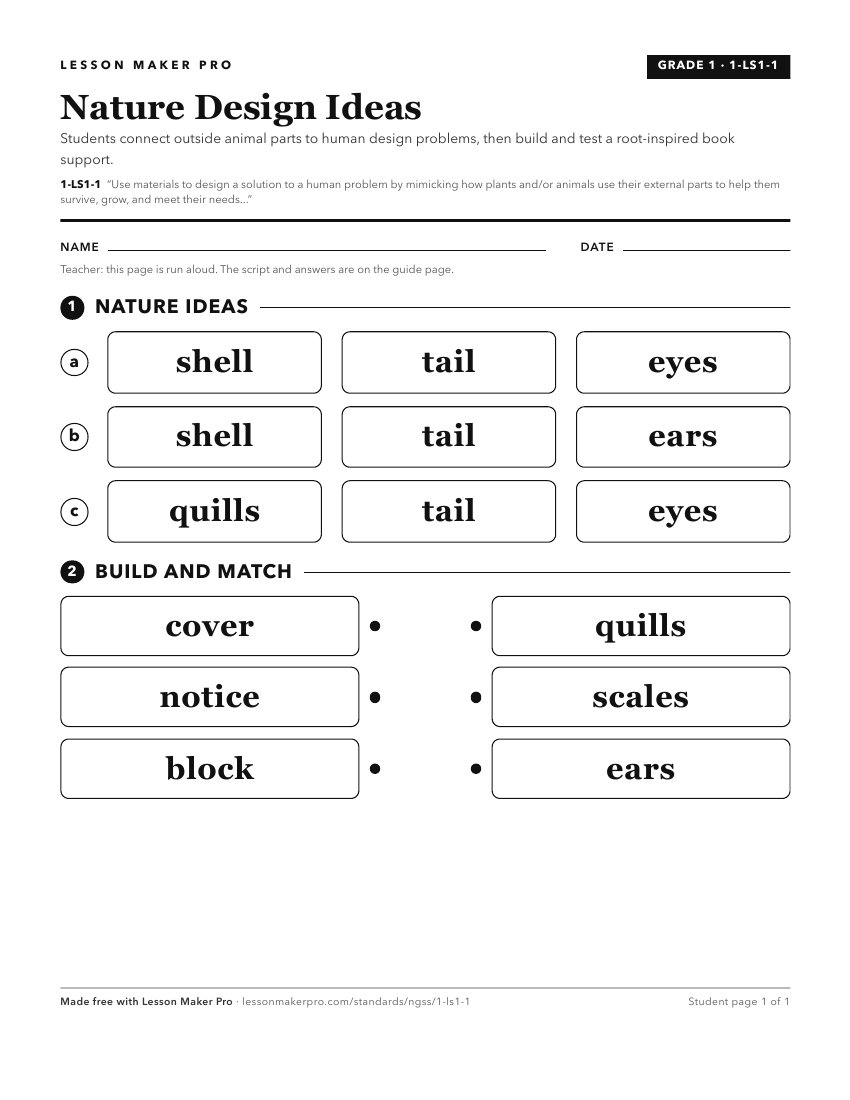
A ready-to-print activity worksheet aligned to 1-LS1-1, with an answer key for the teacher on its own page. No account needed.
PDF, US Letter, prints cleanly in black and white.
Download the worksheetKeep exploring
Related Standards
- MS-ESS3-3
Apply scientific principles to design a method for monitoring and minimizing a human impact on the environment.
- K-ESS2-2
Construct an argument supported by evidence for how plants and animals (including humans) can change the environment to meet their needs.
- K-ESS3-1
Use a model to represent the relationship between the needs of different plants or animals (including humans) and the places they live.
- K-LS1-1
Use observations to describe patterns of what plants and animals (including humans) need to survive.
Turn this exact standard into a lesson
Grade, subject, topic, and the complete standard are prefilled. Create one free, no account needed.
Also for this standard:Make a WorksheetMake a QuizMake a Sub Lesson