NGSS K-ESS3-1
The Standard
Use a model to represent the relationship between the needs of different plants or animals (including humans) and the places they live.
Next Generation Science Standards
Teacher's field guide
What This Standard Means
What Students Need to Do
- Students use a simple model to show how a plant, animal, or person gets what it needs from a place. They explain why that place is a good home.
What Mastery Looks Like
- Students create or use a drawing, map, or small model that connects a living thing to a suitable place. They explain one clear link, such as a frog needing pond water or grass needing sunlight.
Common Misconceptions
- Students may think any plant or animal can live anywhere. They may match animals to homes by appearance instead of food, water, sunlight, shelter, or space. Some may forget that people also depend on their surroundings.
How to Assess It
- Give each student a picture of a deer, frog, cactus, or person. Ask them to draw a suitable place and label one need found there.
Lesson moves
Ways to Teach It
Give pairs toy animals, plant pictures, and habitat trays, then have them build a home that provides food, water, light, or shelter.
Ask, "Why would a deer live in a forest instead of a parking lot?" Students draw and explain one reason.
Play a matching game where students pair plant and animal cards with habitat cards, then name the need each place provides.
Take a schoolyard walk, choose one living thing, and sketch how that place gives it water, light, food, shelter, or space.
Free download
Printable K-ESS3-1 Worksheet
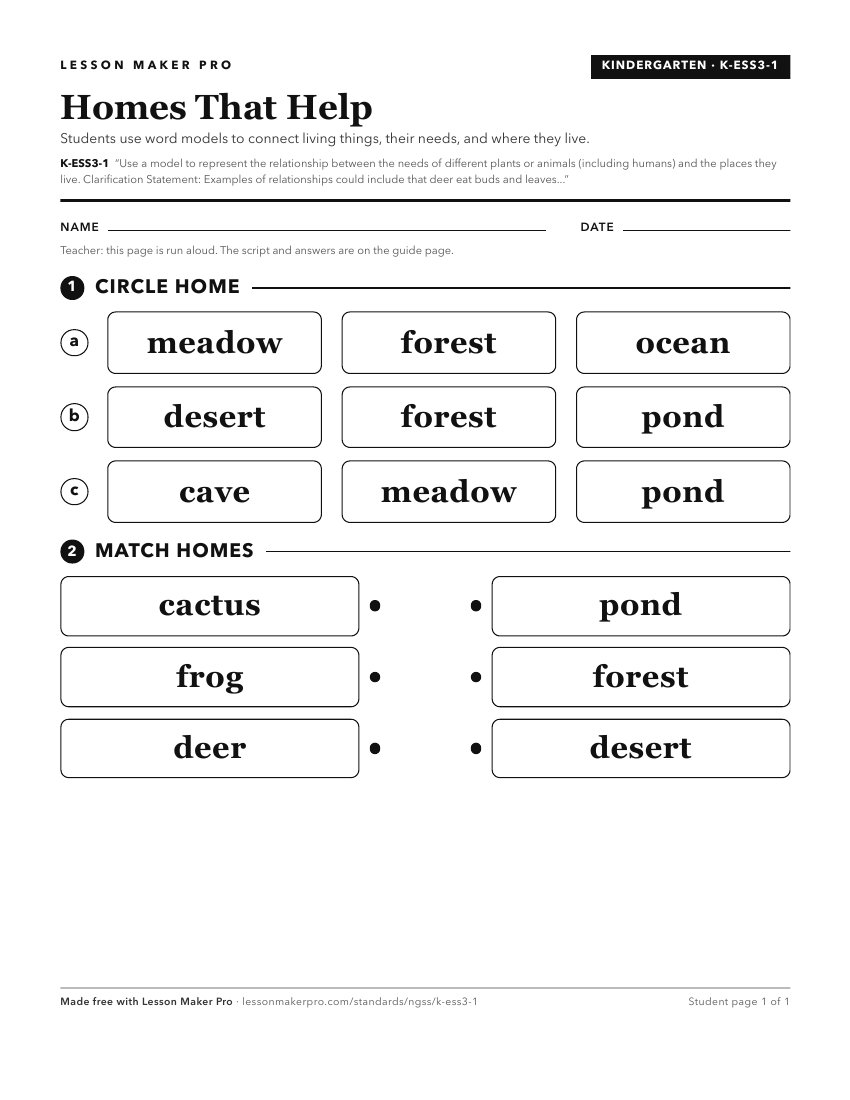
A ready-to-print activity worksheet aligned to K-ESS3-1, with an answer key for the teacher on its own page. No account needed.
PDF, US Letter, prints cleanly in black and white.
Download the worksheetKeep exploring
Related Standards
- 2-LS2-2
Develop a simple model that mimics the function of an animal in dispersing seeds or pollinating plants.
- 5-LS2-1
Develop a model to describe the movement of matter among plants, animals, decomposers, and the environment.
- K-LS1-1
Use observations to describe patterns of what plants and animals (including humans) need to survive.
- 1-LS1-1
Use materials to design a solution to a human problem by mimicking how plants and/or animals use their external parts to help them survive, grow, and meet their...
Turn this exact standard into a lesson
Grade, subject, topic, and the complete standard are prefilled. Create one free, no account needed.
Also for this standard:Make a WorksheetMake a QuizMake a Sub Lesson