Montana Math MT.PLUS.ALG.MOD.1.b
The Standard
- MT.PLUS.ALG.MOD.1
- Model situations in context with polynomial, exponential, logarithmic, and trigonometric functions. This standard should incorporate cultural context relating to Montana Indigenous Peoples and local communities by: Determining if a set of data is best modeled by a polynomial, exponential, logarithmic, or trigonometric function or none, and explaining why, and Understanding that there are contexts where solutions may not lie on the curve.
Model situations in context with polynomial, exponential, logarithmic, and trigonometric functions. This standard should incorporate cultural context relating to Montana Indigenous Peoples and local communities by: Understanding that there are contexts where solutions may not lie on the curve.
2026 Montana Mathematics Content Standards · Algebraic and Functional Reasoning
Teacher's field guide
What This Standard Means
What Students Need to Do
- Students choose polynomial, exponential, logarithmic, or trigonometric functions to model data. They might model daylight hours in Polson, on the Confederated Salish and Kootenai Tribes' Flathead Reservation. They explain why a real reading may miss the model's curve.
What Mastery Looks Like
- Given a data table, a student chooses a function, labels the inputs and outputs, and explains the choice. They compare a prediction with a real reading and reject answers the context rules out, such as 3.5 people.
Common Misconceptions
- Students may think every reading must land exactly on a fitted curve. They may accept fractional counts of people or mistake a logarithmic curve that slows down for an exponential curve that speeds up.
How to Assess It
- Exit ticket: Polson has about 9, 14, 15, and 11 hours of daylight in January, April, July, and October. Name a function family, sketch its yearlong shape, and explain why a reading might miss your curve.
Lesson moves
Ways to Teach It
Build rectangular beds with 12 craft sticks as fence segments; graph possible areas and circle fractional widths the equation allows but sticks cannot make.
Give a printed Polson daylight graph with a fitted sine curve; ask why some points miss the curve.
Match garden-bed area, seedling doubling, sound decibels, and seasonal daylight cards to four function graphs; explain each match.
Use a USGS Flathead Lake level graph at Polson to check whether a seasonal sine model hits every measured point.
Free download
Printable MT.PLUS.ALG.MOD.1.b Worksheet
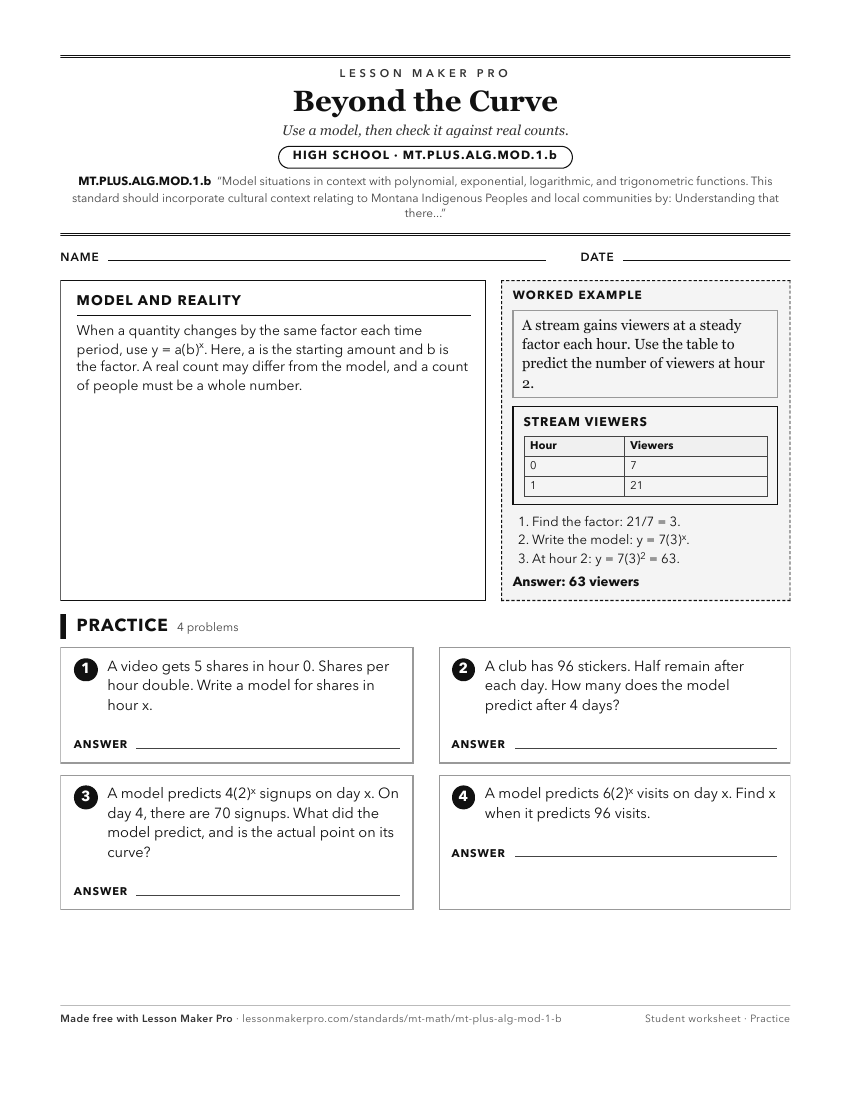
A ready-to-print activity worksheet aligned to MT.PLUS.ALG.MOD.1.b, with an answer key for the teacher on its own page. No account needed.
PDF, US Letter, prints cleanly in black and white.
Download the worksheetKeep exploring
Related Standards
- MT.CORE.ALG.FUN.3.a
Understanding that different representations highlight different aspects of functions, choosing the representation that is appropriate for the context, and
- MT.CORE.ALG.MOD.1
Model situations in context, with linear, quadratic, and exponential functions. This standard should incorporate cultural context relating to Montana Indigenous...
- MT.PLUS.DATA.NORM.3
Estimate areas under a normal curve to solve problems in context, using calculators, spreadsheets, and tables as appropriate.
- MT.CORE.ALG.MOD.1.b
Understanding that there are contexts where solutions may not lie on the curve.
Turn this exact standard into a lesson
Grade, subject, topic, and the complete standard are prefilled. Create one free, no account needed.
Also for this standard:Make a WorksheetMake a QuizMake a Sub Lesson