Montana Math MT.CORE.DATA.INT.1
The Standard
Use technology to organize data, including very large data sets, into a useful and manageable structure.
2026 Montana Mathematics Content Standards · Data Reasoning and Probability
Teacher's field guide
What This Standard Means
What Students Need to Do
- Students use a spreadsheet to make a large data file easier to work with. They select useful columns, filter rows, and group records into a table that answers a question.
What Mastery Looks Like
- Given a 5,000-row weather file, a student can filter for one city and make a table of average temperature by month. They label the table and use it to find the warmest month.
Common Misconceptions
- Students may sort temperatures as text, putting 100 before 20, or treat blank cells as zeros. They may delete rows that look alike without checking whether they record separate observations.
How to Assess It
- Give students a 500-row weather sheet with city, month, and temperature columns. Ask them to filter for Helena, make a monthly average temperature table, and circle the warmest month.
Lesson moves
Ways to Teach It
Give pairs a 5,000-row weather CSV and have them filter one city and build a table of monthly average temperatures in Sheets.
Ask, 'Would daily rows or monthly averages better show which season is warmest?' Have students defend their choice using the weather file.
Give groups a messy sales sheet and race to flag duplicate order IDs, blank dates, and sales totals by product.
Give students 5,000 rows of city service reports and have them count pothole complaints by neighborhood to recommend a repair priority.
Free download
Printable MT.CORE.DATA.INT.1 Worksheet
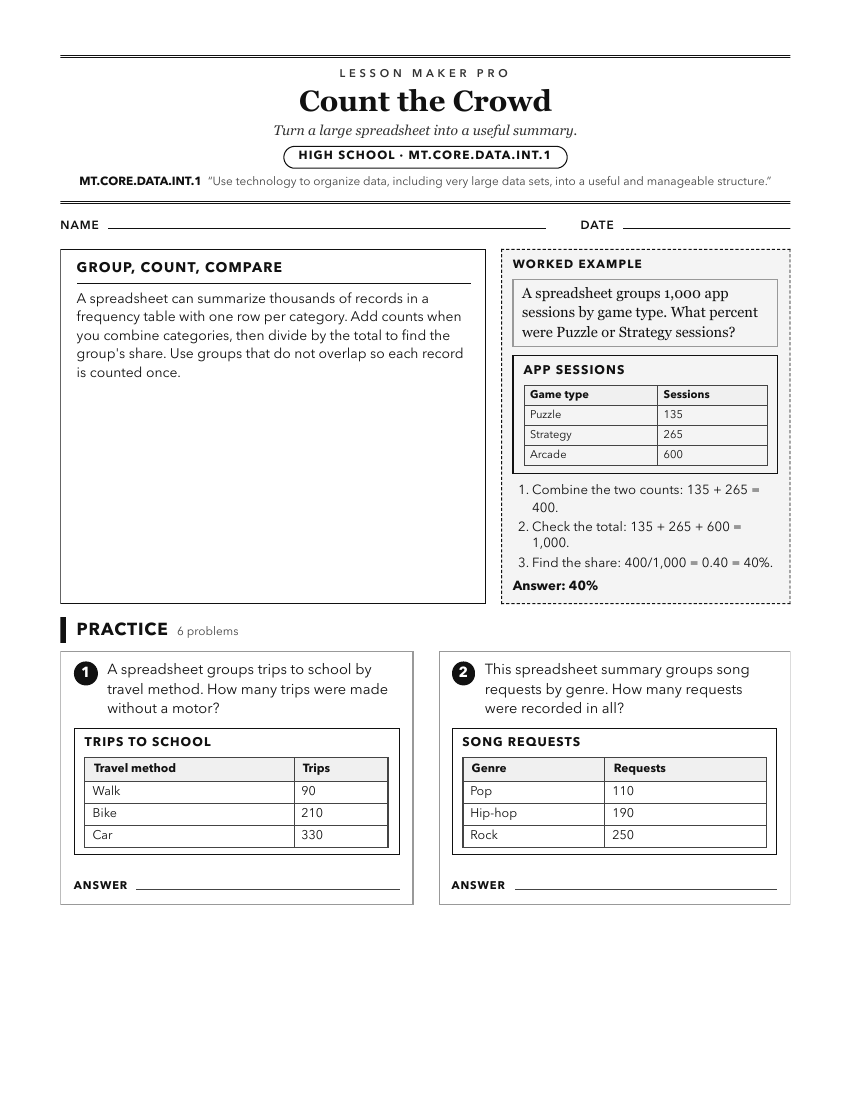
A ready-to-print activity worksheet aligned to MT.CORE.DATA.INT.1, with an answer key for the teacher on its own page. No account needed.
PDF, US Letter, prints cleanly in black and white.
Download the worksheetKeep exploring
Related Standards
- MT.CORE.DATA.INT.6.a
Using technology strategically, represent two quantitative data distributions on scatter plots,
- MT.CORE.DATA.LIT.1
Distinguish between quantitative and categorical data and use representations and analysis techniques that are appropriate for each type.
- MT.1.MD.5
Organize, represent, and interpret data with up to three categories by: Asking and answering questions about the total number of data points, Identifying how ma...
- MT.CORE.NUM.REAL.2
Represent and perform operations within very large and very small numbers using scientific notation.
Turn this exact standard into a lesson
Grade, subject, topic, and the complete standard are prefilled. Create one free, no account needed.
Also for this standard:Make a WorksheetMake a QuizMake a Sub Lesson