Montana Math MT.4.OA.5
The Standard
Analyze a number or shape pattern that follows a given rule, identify and explain informally features of the pattern that were not explicit in the rule itself, generate terms in the resulting sequence, and observe the pattern.
2026 Montana Mathematics Content Standards
Teacher's field guide
What This Standard Means
What Students Need to Do
- Students use a rule to make the next numbers or shapes in a pattern. They also find and explain something the rule does not say, such as every number being odd.
What Mastery Looks Like
- Given “start at 3, add 4,” a student writes 3, 7, 11, 15, 19 and explains why every number is odd. They can draw the next figure in a growing shape pattern and describe what changes.
Common Misconceptions
- Students may guess the next term from what they see instead of using the given rule. They may repeat “add 4” as their observation, rather than noticing that every number is odd. In shape patterns, they may add pieces in a way that breaks the rule.
How to Assess It
- Exit ticket: Start at 3 and add 4 each time. Write the first five terms, then explain one thing true of every term that the rule does not say.
Lesson moves
Ways to Teach It
Give pairs square tiles: start with one, add one to the right each turn, build four figures, and explain why perimeters stay even.
Ask students to write why starting at 3 and adding 4 makes only odd numbers, using counters or a drawing.
Play Pattern Detective: use cards reading “start at 3, add 4” to list five terms and name a feature beyond the rule.
On a locker-number chart from 1 to 20, circle locker 1 and every fourth locker after it; explain why every circled number is odd.
Free download
Printable MT.4.OA.5 Worksheet
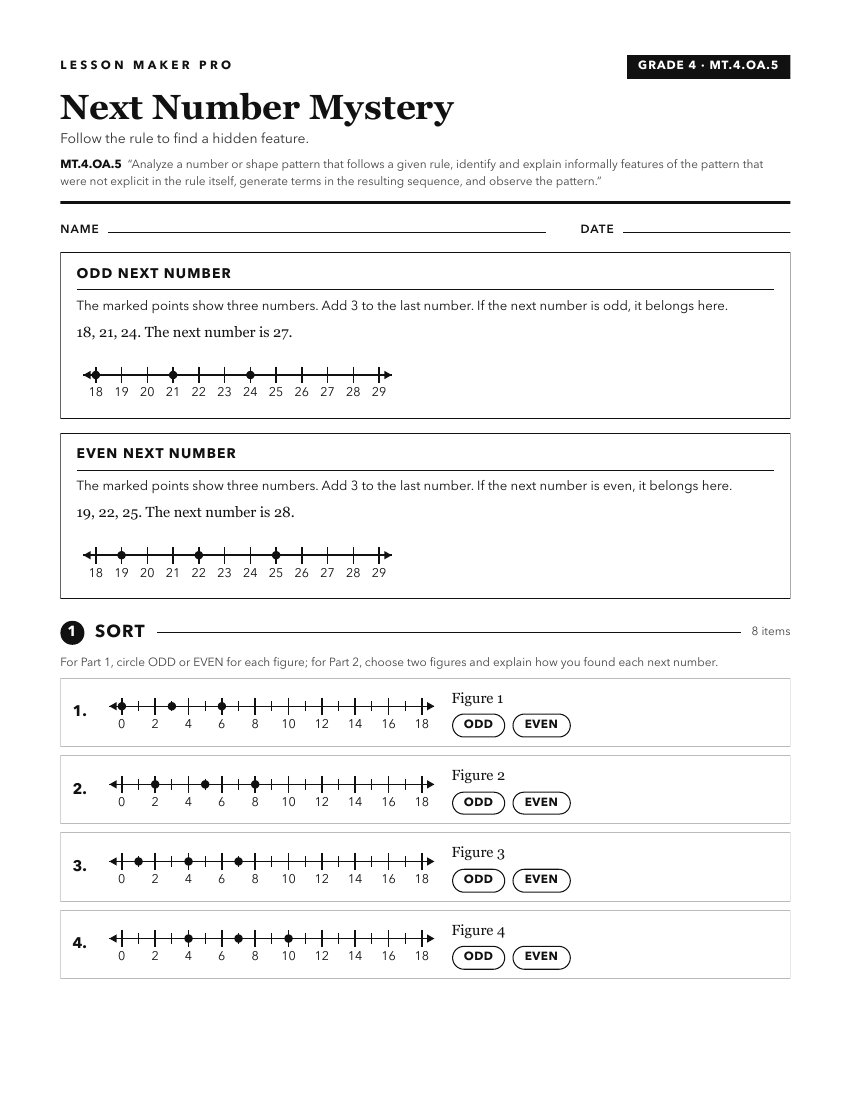
A ready-to-print activity worksheet aligned to MT.4.OA.5, with an answer key for the teacher on its own page. No account needed.
PDF, US Letter, prints cleanly in black and white.
Download the worksheetKeep exploring
Related Standards
- MT.5.OA.3
Generate two numerical patterns using given rules and complete an input-output table for the data, identify apparent relationships between corresponding terms, ...
- MT.2.G.1
Recognize and draw shapes having specified attributes.
- MT.K.G.4
Analyze and compare two- and three-dimensional shapes using informal language and other attributes.
Turn this exact standard into a lesson
Grade, subject, topic, and the complete standard are prefilled. Create one free, no account needed.
Also for this standard:Make a WorksheetMake a QuizMake a Sub Lesson