Mississippi Science MAQ.4.5
The Standard
- MAQ.4
- Students will examine characteristics of specific aquatic ecosystems and the effects of human and natural phenomena on those ecosystems.
Explore the importance of species diversity to the biological resources needed by human populations, including food (e.g., aquaculture and mariculture), medicine, and natural aesthetics.
2026 Mississippi College- and Career-Readiness Standards for Science · Flora and Fauna
Teacher's field guide
What This Standard Means
What Students Need to Do
- Students compare marine areas with different numbers of species and predict what people lose when a species disappears. They use examples from seafood farms, medicine, and reef tourism to explain their thinking.
What Mastery Looks Like
- Students can explain why an oyster disease leaves an oyster-only farm with no harvest, while a farm with mussels and kelp still has food to sell. They can explain that cone snail venom led to a pain medicine and that living reefs draw visitors.
Common Misconceptions
- Students may assume a farm growing one high-yield species is as secure as a farm growing several species. They may think marine species matter only as food, or that every marine animal can be made into medicine.
How to Assess It
- Exit ticket: An oyster disease strikes two farms, one raising only oysters and one raising oysters, mussels, and kelp. Which farm still has food to sell, and what is one benefit of marine species besides food?
Lesson moves
Ways to Teach It
Give groups cards for oysters, mussels, kelp, cone snails, and coral; have them sort the cards by food, medicine, and tourism benefits.
Show photos of a species-rich reef and a damaged reef; ask which one might support more fishing and visitors, and why.
Play a disease-draw game: teams choose oyster-only or oyster-mussel-kelp farms, draw an oyster disease card, and count the food crops left.
Use a seafood menu to name three species sold locally, then ask how losing one would affect food choices and restaurant sales.
Free download
Printable MAQ.4.5 Worksheet
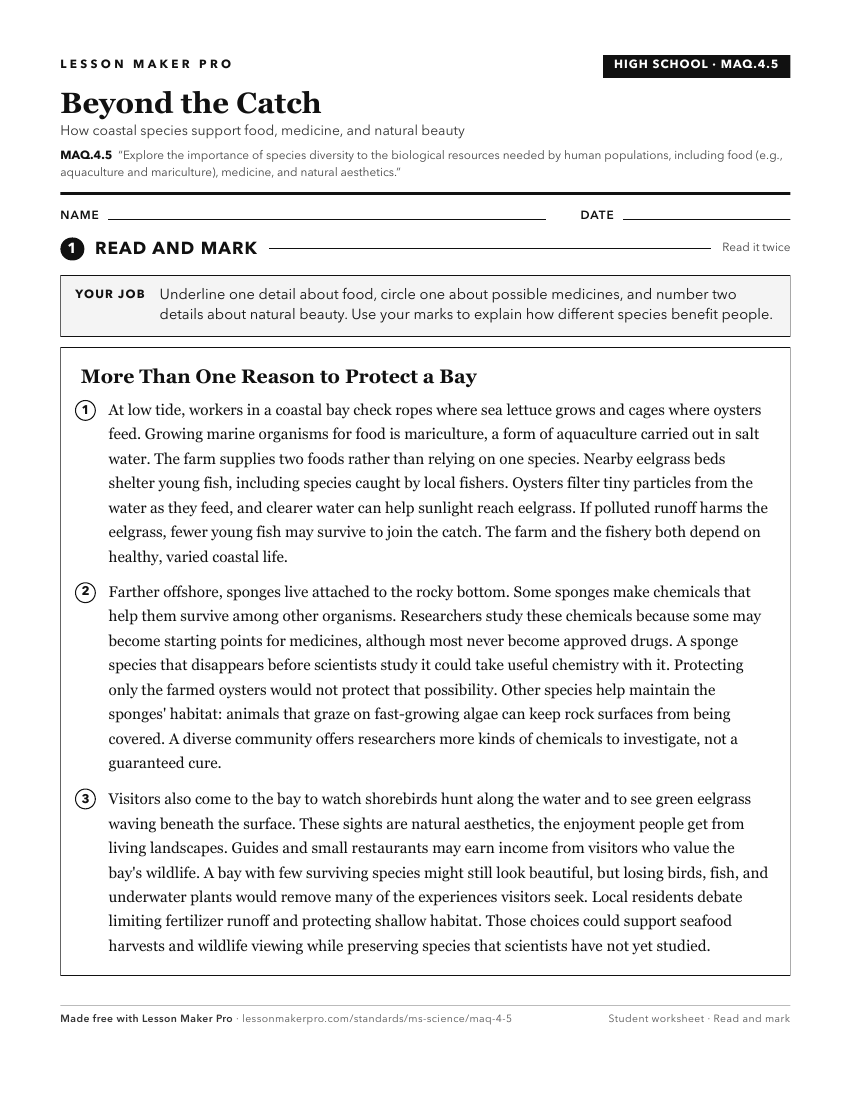
A ready-to-print activity worksheet aligned to MAQ.4.5, with an answer key for the teacher on its own page. No account needed.
PDF, US Letter, prints cleanly in black and white.
Download the worksheetKeep exploring
Related Standards
- L.7.3.5
Design solutions for sustaining the health of ecosystems to maintain biodiversity and the resources needed by humans for survival (e.g., water purification, nut...
- ZOO.7.6
Research, analyze, and communicate the effects of urbanization and continued expansion by humans on the biodiversity of fish species (e.g., overfishing, and inv...
- MAQ.4.4
Research, analyze, and communicate the effects of urbanization and continued expansion by humans on the aquatic ecosystems’ biodiversity (e.g., land use changes...
- ENV.1.9
Evaluate and communicate data that explains how human activity may impact biodiversity (e.g., introduction, removal, and reintroduction of an organism within an...
Turn this exact standard into a lesson
Grade, subject, topic, and the complete standard are prefilled. Create one free, no account needed.
Also for this standard:Make a WorksheetMake a QuizMake a Sub Lesson