Mississippi Science MAQ.4.3
The Standard
- MAQ.4
- Students will examine characteristics of specific aquatic ecosystems and the effects of human and natural phenomena on those ecosystems.
Determine the niches within trophic levels in the aquatic ecosystems by creating food webs and researching the symbiotic relationships that exist.
2026 Mississippi College- and Career-Readiness Standards for Science · Flora and Fauna
Teacher's field guide
What This Standard Means
What Students Need to Do
- Students draw a food web with arrows from food to eater. They label each organism's trophic level and describe its feeding role. They research symbiotic pairs and explain what each partner gains or loses.
What Mastery Looks Like
- A student can draw several connected food chains with accurate arrows. They can explain why zooplankton and parrotfish share a trophic level but eat different foods. They can describe how coral and its resident algae help each other.
Common Misconceptions
- Students often point feeding arrows toward the prey instead of the eater. They may think organisms at the same trophic level have identical niches, or that every symbiotic relationship helps both partners.
How to Assess It
- On an exit ticket, have students draw arrows among reef algae, phytoplankton, zooplankton, parrotfish, grouper, and reef shark. Ask them to label trophic levels and compare the primary consumers' food sources.
Lesson moves
Ways to Teach It
Give groups reef organism cards and yarn, then have them connect reef algae, parrotfish, grouper, and reef shark with feeding links.
Ask students to write why zooplankton and parrotfish share a trophic level but occupy different niches, naming what each eats.
Give pairs food-link cards; have them race to find reversed arrows, fix them, and label each organism's trophic level.
Show a reef bleaching photo, then use NOAA's coral bleaching page to explain what happens to coral and its resident algae.
Free download
Printable MAQ.4.3 Worksheet
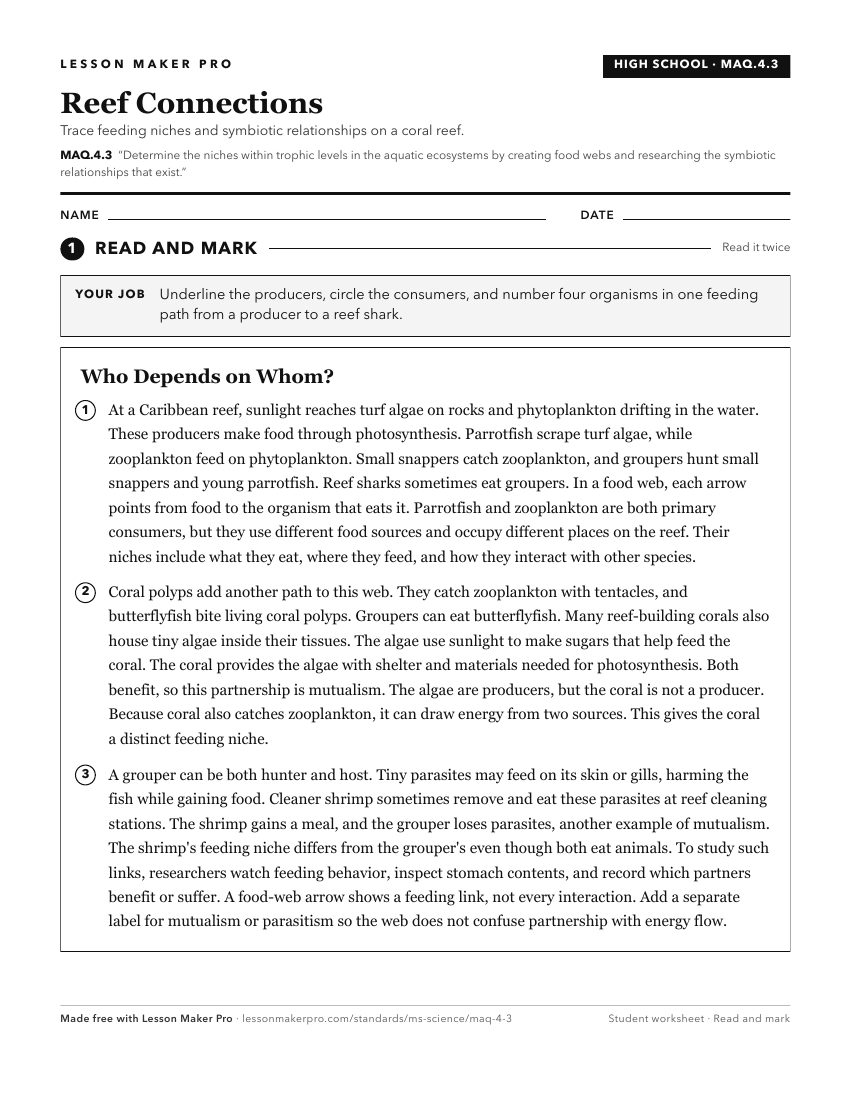
A ready-to-print activity worksheet aligned to MAQ.4.3, with an answer key for the teacher on its own page. No account needed.
PDF, US Letter, prints cleanly in black and white.
Download the worksheetKeep exploring
Related Standards
- BIO.5.4
Develop and use models to describe the flow of energy and amount of biomass through food chains, food webs, and food pyramids.
- L.5.3B.2
Develop and use a food chain model to classify organisms as producers, consumers, or decomposers. Trace the energy flow to explain how each group of organisms o...
- L.6.3.5
Develop and use food chains, webs, and pyramids to analyze how energy is transferred through an ecosystem from producers (autotrophs) to consumers (heterotrophs...
- L.6.3.4
Investigate organism interactions in a competitive or mutually beneficial relationship (predation, competition, cooperation, or symbiotic relationships).
Turn this exact standard into a lesson
Grade, subject, topic, and the complete standard are prefilled. Create one free, no account needed.
Also for this standard:Make a WorksheetMake a QuizMake a Sub Lesson