Mississippi Science L.7.3.4
The Standard
- L.7.3
- Students will demonstrate an understanding of the importance that matter cycles between living and non-living parts of the ecosystem to sustain life on Earth.
Explain how disruptions in cycles (e.g., water, oxygen, carbon, and nitrogen) affect biodiversity and ecosystem services (e.g., water, food, and medications) which are needed to sustain human life on Earth.
2026 Mississippi College- and Career-Readiness Standards for Science · Ecology and Interdependence
Teacher's field guide
What This Standard Means
What Students Need to Do
- Students trace what happens when a natural cycle is disrupted, such as when extra nitrogen washes into a lake or less rain reaches a wetland. They explain how the change affects living things and resources people use.
What Mastery Looks Like
- A student can link a disruption to a change in habitat, a loss of species, and an effect on people. For example, fertilizer runoff feeds an algae bloom. When the algae decay, oxygen drops, fish die, and people have fewer fish to catch.
Common Misconceptions
- Students may think extra nutrients help every organism in a lake. They may also think algae use up the oxygen right away, rather than recognizing the role of decay. Some assume losing fish affects only wildlife, not people's food supply.
How to Assess It
- Exit ticket: Extra fertilizer washes into a lake. Write a four-step chain linking the added nitrogen to dissolved oxygen, fish, and people's food supply.
Lesson moves
Ways to Teach It
Use blue paper lakes, fertilizer tokens, algae counters, oxygen counters, and fish cards to model the effects of runoff.
Ask pairs: How could a drought change wetland species and the clean water people get? Require three linked effects.
Give groups cards labeled runoff, algae growth, decay, oxygen loss, fish deaths, and lost catch; have them order and explain each link.
Read a short news report about an algae-related fishing closure; students underline the nitrogen source, affected species, and lost food supply.
Free download
Printable L.7.3.4 Worksheet
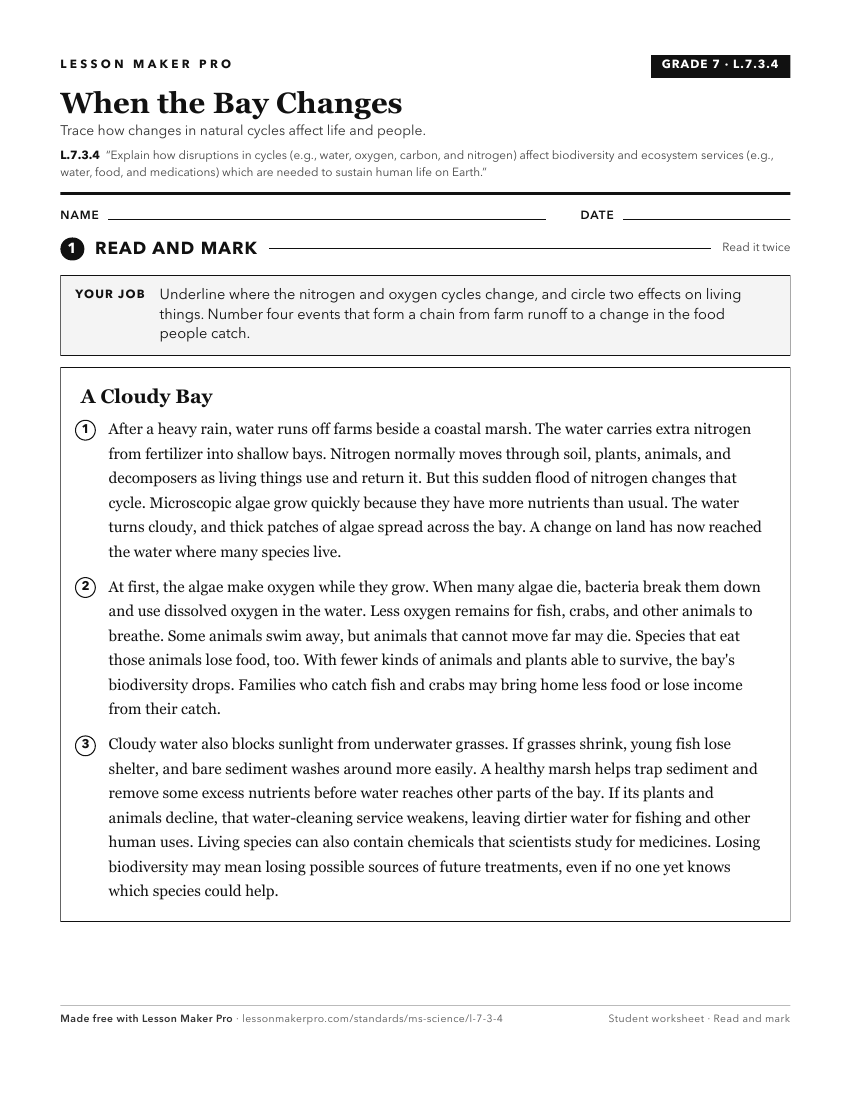
A ready-to-print activity worksheet aligned to L.7.3.4, with an answer key for the teacher on its own page. No account needed.
PDF, US Letter, prints cleanly in black and white.
Download the worksheetKeep exploring
Related Standards
- L.7.3.5
Design solutions for sustaining the health of ecosystems to maintain biodiversity and the resources needed by humans for survival (e.g., water purification, nut...
- BIO.5.2
Analyze models of the cycling of matter (e.g., carbon, nitrogen, phosphorus, and water) between abiotic and biotic factors in an ecosystem and evaluate the abil...
- L.7.3.1
Analyze diagrams to provide evidence of the importance of the cycling of water, oxygen, carbon, and nitrogen through ecosystems to organisms.
- MAQ.4.5
Explore the importance of species diversity to the biological resources needed by human populations, including food (e.g., aquaculture and mariculture), medicin...
Turn this exact standard into a lesson
Grade, subject, topic, and the complete standard are prefilled. Create one free, no account needed.
Also for this standard:Make a WorksheetMake a QuizMake a Sub Lesson