Mississippi Science L.4.1.4
The Standard
- L.4.1
- Students will demonstrate an understanding of the organization, functions, and interconnections of the major human body systems.
Research and communicate how noninfectious diseases (e.g., diabetes, heart disease) and infectious diseases (e.g., cold, flu) serve to disrupt the function of the body system.
2026 Mississippi College- and Career-Readiness Standards for Science · Hierarchical Organization
Teacher's field guide
What This Standard Means
What Students Need to Do
- Students use short sources to find out which diseases spread between people and which do not. They explain how each disease changes the job of a body system, using facts from their sources.
What Mastery Looks Like
- A student identifies a cold as infectious and heart disease as noninfectious. They use source facts to explain how extra mucus makes breathing through the nose harder and how narrowed arteries reduce blood flow.
Common Misconceptions
- Students may think diabetes or heart disease can be caught from someone who has it. They may name the heart or nose without explaining how blood flow or breathing changes.
How to Assess It
- Exit ticket: Give students these facts: 'A cold virus causes extra nasal mucus. Narrowed heart arteries reduce blood flow.' Ask them to classify each condition, name the body system affected, and explain the disrupted job.
Lesson moves
Ways to Teach It
Push cotton balls through a cardboard tube, then partly block it with tape to model how narrowed arteries limit blood flow.
Read short fact cards about colds and heart disease, then write how each affects a body system and whether it spreads.
Sort cards labeled cold, flu, diabetes, and heart disease into infectious and noninfectious groups, then match each to an affected body system.
Compare a school handwashing sign with a clinic heart-health flyer, then explain why their advice about preventing illness differs.
Free download
Printable L.4.1.4 Worksheet
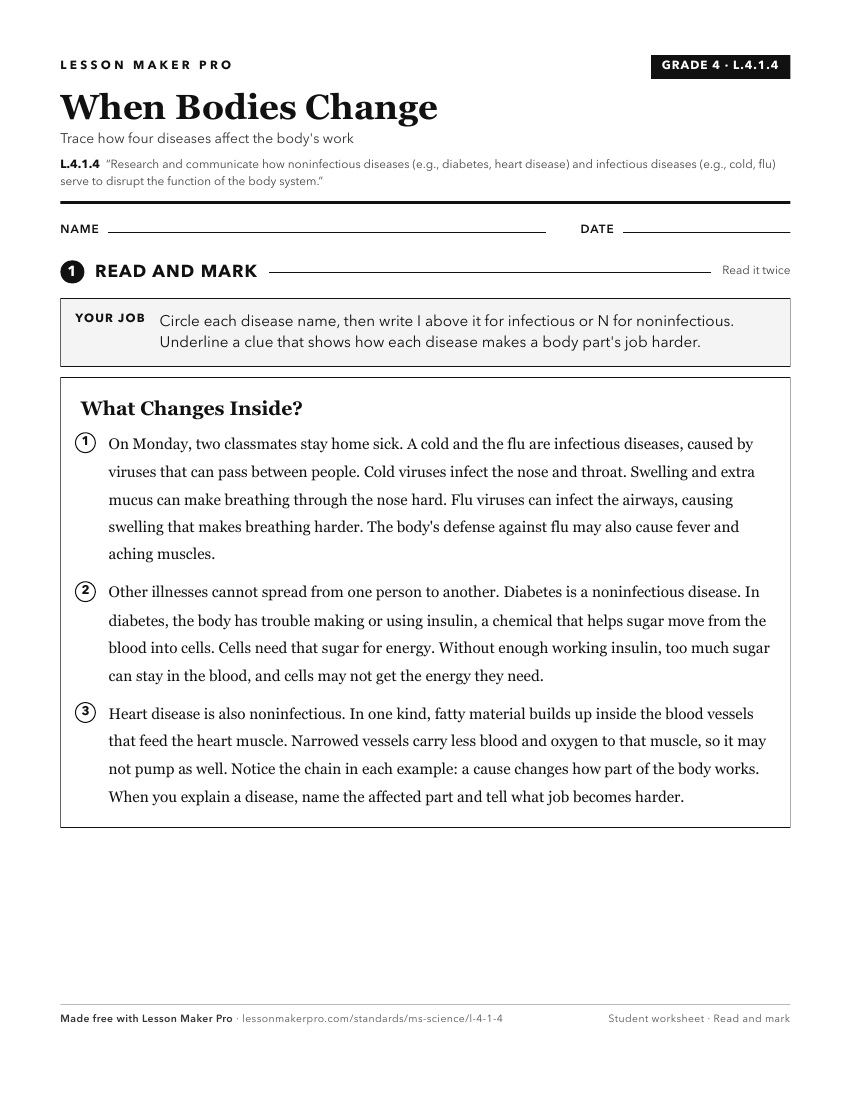
A ready-to-print activity worksheet aligned to L.4.1.4, with an answer key for the teacher on its own page. No account needed.
PDF, US Letter, prints cleanly in black and white.
Download the worksheetKeep exploring
Related Standards
- L.4.1.5
Using informational text, investigate how scientific fields, medical specialties, and research methods help us find new ways to maintain a healthy body and life...
- HAP.7.4
Research and analyze the effects of various pathological conditions (e.g., diabetes mellitus, pituitary dwarfism, Graves’ disease, Cushing’s syndrome, hypothyro...
- HAP.11.7
Research and analyze the causes and effects of various pathological conditions (e.g., viral infections, auto-immune disorders, immunodeficiency disorders, and l...
- HAP.1.3
Investigate the interdependence of the various body systems to each other and to the body as a whole.
Turn this exact standard into a lesson
Grade, subject, topic, and the complete standard are prefilled. Create one free, no account needed.
Also for this standard:Make a WorksheetMake a QuizMake a Sub Lesson