Mississippi Science HAP.1.3
The Standard
- HAP.1
- Students will demonstrate an understanding of how anatomical structures and physiological functions are organized and described using anatomical positions.
Investigate the interdependence of the various body systems to each other and to the body as a whole.
2026 Mississippi College- and Career-Readiness Standards for Science · Physiological Functions/Anatomical Structure
Teacher's field guide
What This Standard Means
What Students Need to Do
- Students use examples such as exercise to show how body systems work together. They trace how a change in one system affects other systems and the body as a whole.
What Mastery Looks Like
- A student can trace oxygen from the lungs through the heart and blood vessels to working muscles. They can explain how narrowed airways make exercise harder.
Common Misconceptions
- Students may think the lungs send oxygen straight to muscles, without the blood and heart. They may think a faster heart rate causes muscles to need more oxygen, rather than responding to that need.
How to Assess It
- Exit ticket: A student climbs stairs and starts breathing faster. Draw arrows linking the lungs, heart, blood vessels, and leg muscles, then explain what each does.
Lesson moves
Ways to Teach It
Count pulse and breaths before and after one minute of marching in place, then graph both changes.
Ask why a runner breathes faster after a sprint. Have students explain the roles of muscles, lungs, and blood in three sentences.
Give pairs lung, heart, blood vessel, and muscle cards to order along oxygen's path, then explain what happens if one link fails.
Read a runner's asthma attack scenario, then draw arrows showing how narrowed airways can lead to muscle fatigue.
Free download
Printable HAP.1.3 Worksheet
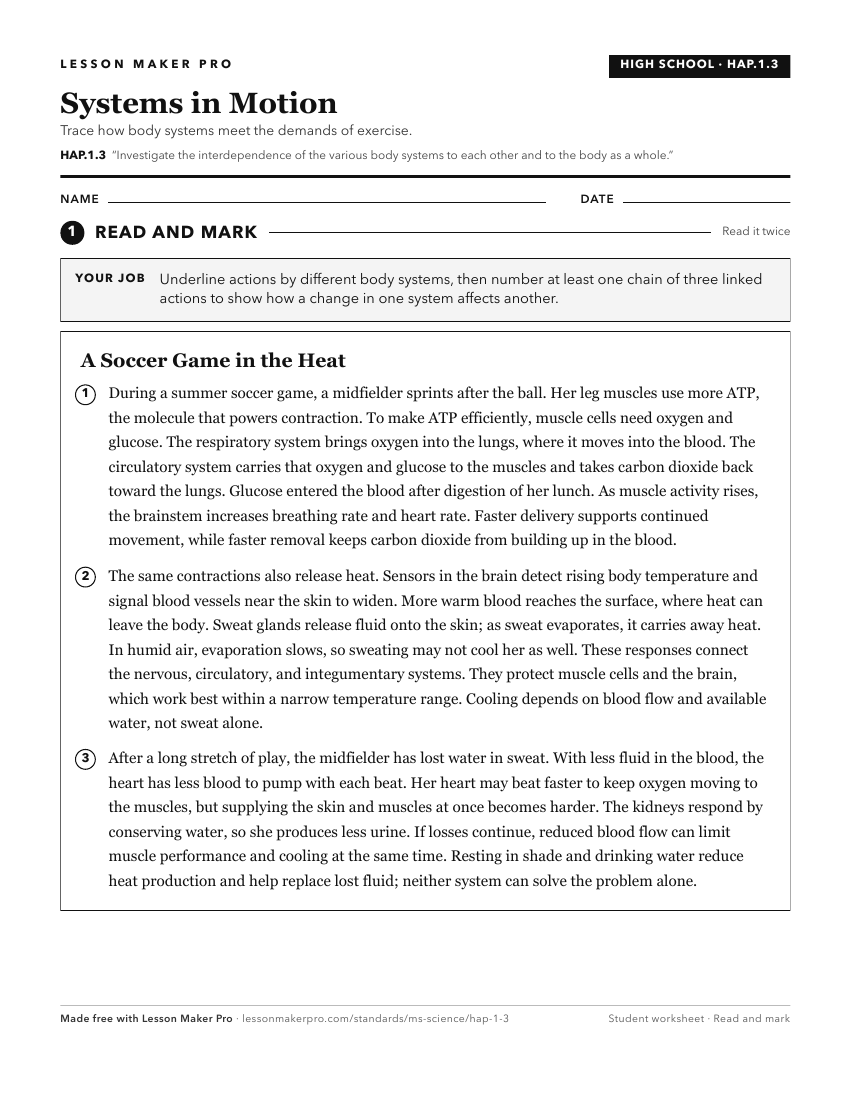
A ready-to-print activity worksheet aligned to HAP.1.3, with an answer key for the teacher on its own page. No account needed.
PDF, US Letter, prints cleanly in black and white.
Download the worksheetKeep exploring
Related Standards
- L.4.1.2
Obtain and communicate data to describe patterns that indicate the nature of relationships between human organ systems, which interact with one another to contr...
- L.4.1.1
Use technology or other resources to research and discover general system function (e.g., machines, water cycle) as they relate to human organ systems and ident...
- L.4.1
Students will demonstrate an understanding of the organization, functions, and interconnections of the major human body systems.
- HAP.6.1
Describe and evaluate how the nervous system functions and interconnects with all other body systems.
Turn this exact standard into a lesson
Grade, subject, topic, and the complete standard are prefilled. Create one free, no account needed.
Also for this standard:Make a WorksheetMake a QuizMake a Sub Lesson