Mississippi Science L.4.1.2
The Standard
- L.4.1
- Students will demonstrate an understanding of the organization, functions, and interconnections of the major human body systems.
Obtain and communicate data to describe patterns that indicate the nature of relationships between human organ systems, which interact with one another to control digestion, respiration, circulation, excretion, movement, coordination, and protection from infection.
2026 Mississippi College- and Career-Readiness Standards for Science · Hierarchical Organization
Teacher's field guide
What This Standard Means
What Students Need to Do
- Students collect or read simple body data, such as breathing and pulse rates, and look for patterns. They use those patterns to explain how body systems work together to move, digest food, remove waste, respond to signals, and fight infection.
What Mastery Looks Like
- A student can use a table to show that breathing and pulse rise together during exercise, then explain how lungs, heart, and muscles work together. They can also trace nutrients from digested food into the blood and wastes from the blood to the kidneys.
Common Misconceptions
- Students may think each organ system works alone, or that the heart makes oxygen instead of moving blood that carries it. Some think kidneys remove food waste directly from the stomach, rather than filtering wastes from the blood. Others confuse skin blocking germs with immune cells fighting germs that get in.
How to Assess It
- Exit ticket: A student's breathing rate rises from 16 to 28 breaths per minute, and pulse rises from 80 to 120 beats per minute after running. Name two body systems and explain how the numbers show they work together.
Lesson moves
Ways to Teach It
Students count breaths and pulse for 30 seconds before and after marching in place, then graph both changes.
Give students a food-to-blood diagram; ask them to write how nutrients reach muscles and how kidneys remove waste from blood.
Deal cards for lungs, heart, kidneys, muscles, brain, skin, intestines, and immune cells; teams link two cards to a body task.
Sketch a scraped knee on the board; students label where skin blocks germs and blood carries immune cells to the cut.
Free download
Printable L.4.1.2 Worksheet
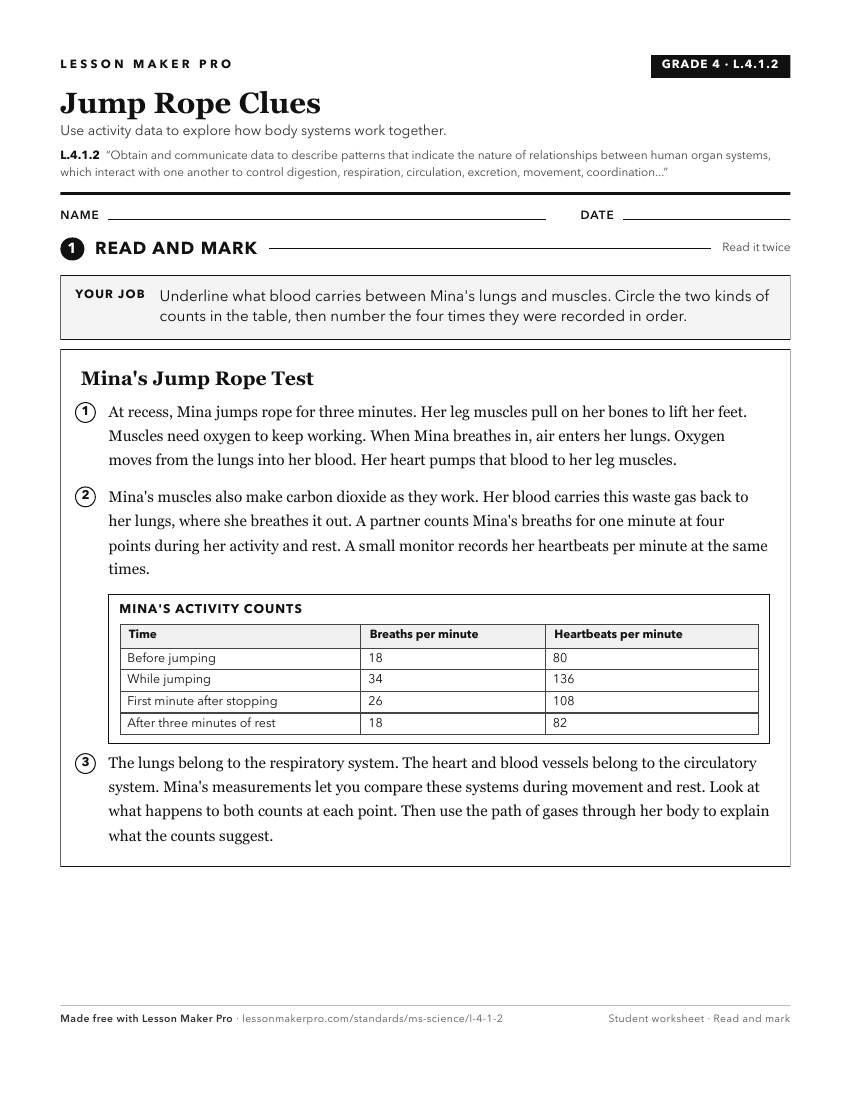
A ready-to-print activity worksheet aligned to L.4.1.2, with an answer key for the teacher on its own page. No account needed.
PDF, US Letter, prints cleanly in black and white.
Download the worksheetKeep exploring
Related Standards
- L.4.1.3
Construct models of organ systems (e.g., circulatory, digestive, respiratory, muscular, skeletal, nervous) to demonstrate both the unique function of the system...
- L.4.1.1
Use technology or other resources to research and discover general system function (e.g., machines, water cycle) as they relate to human organ systems and ident...
- HAP.13.1
Analyze the structure-function relationship in organs of the digestive system.
- HAP.1.3
Investigate the interdependence of the various body systems to each other and to the body as a whole.
Turn this exact standard into a lesson
Grade, subject, topic, and the complete standard are prefilled. Create one free, no account needed.
Also for this standard:Make a WorksheetMake a QuizMake a Sub Lesson