Mississippi Science HAP.8.6
The Standard
- HAP.8
- Students will investigate the structures and functions of the male and female reproductive system, including the cause and effect of diseases and disorders.
Describe the changes that occur during embryonic/fetal development, birth, and the growth and development from infancy, childhood, and adolescence to adulthood.
2026 Mississippi College- and Career-Readiness Standards for Science · Male and Female Reproductive Systems
Teacher's field guide
What This Standard Means
What Students Need to Do
- Students track human development from embryo to adult. They describe early organ formation, fetal growth, and the steps of birth. They compare growth in infancy and childhood with puberty and physical maturity.
What Mastery Looks Like
- Given a blank timeline, a student places organ formation in the embryonic stage and organ growth and maturation in the fetal stage. They label contractions, cervical dilation, and delivery at birth, then place early motor skills, steady growth, puberty, and full physical maturity in later stages.
Common Misconceptions
- Students may think embryo and fetus are interchangeable labels or that organs first form near birth. Some think a fetus breathes air in the uterus, rather than getting oxygen through the placenta. Others assume puberty starts at the same age for everyone.
How to Assess It
- Give students seven boxes labeled embryo, fetus, birth, infancy, childhood, adolescence, and adulthood. Ask them to write one event or physical change in each box and circle the stage when most organs first form.
Lesson moves
Ways to Teach It
Give pairs seven stage cards and seven change cards, including organ formation and cervical dilation, to match and arrange on a paper timeline.
Ask students to write: Why is forming organs an embryonic change, while gaining weight and maturing organs are fetal changes?
Play timeline bingo: students mark stage cards when you call out changes such as organ formation, cervical dilation, or puberty.
Show pediatric growth charts for ages 0 to 2 and 2 to 18, then have students compare growth patterns without judging individual bodies.
Free download
Printable HAP.8.6 Worksheet
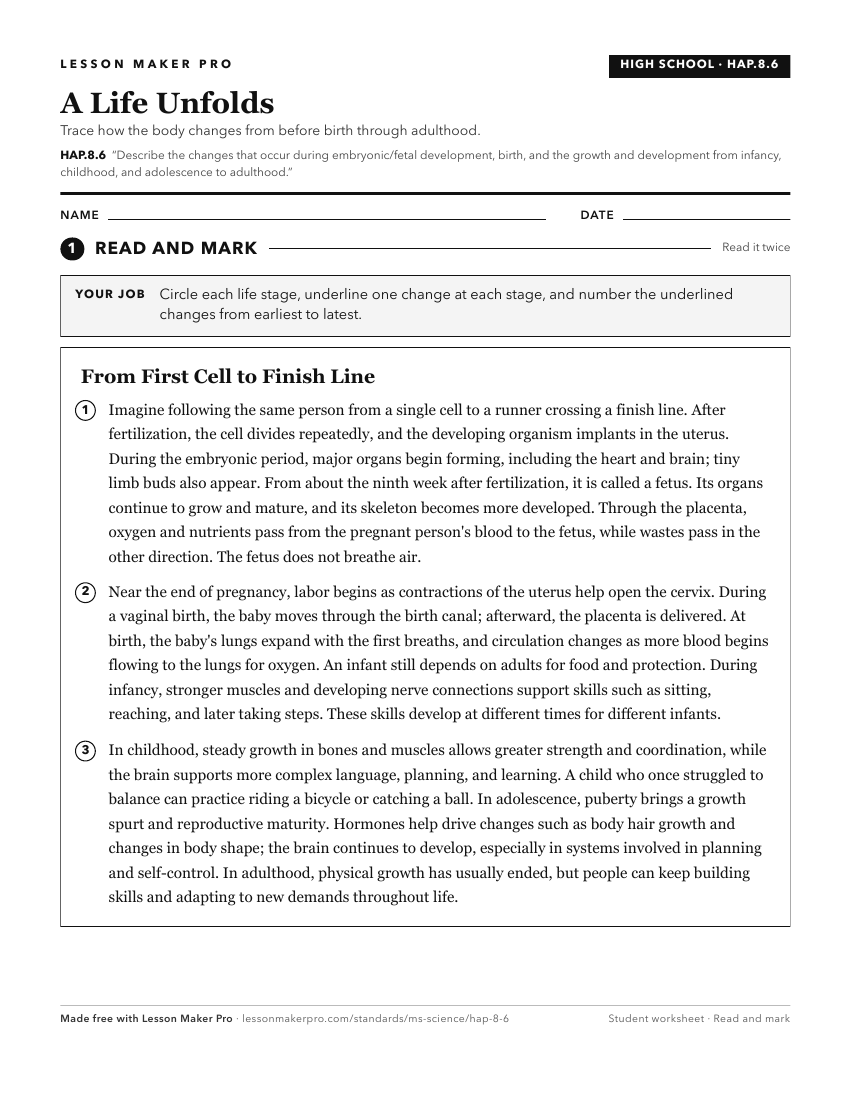
A ready-to-print activity worksheet aligned to HAP.8.6, with an answer key for the teacher on its own page. No account needed.
PDF, US Letter, prints cleanly in black and white.
Download the worksheetKeep exploring
Related Standards
- ZOO.8.1
Understand the evolution of tetrapods and the development of the structure and function of body systems and life cycles.
- HAP.4.4
Demonstrate an understanding of the growth and development of the skeletal system, differentiating between endochondral and intramembranous ossification.
- MAQ.7.4
Differentiate various life cycles found among animals (e.g., egg, tadpole, and adult stages of the amphibian life cycle; leathery eggs on land in reptiles; hard...
- BIO.1E.2
Identify and describe the changes that occur in a cell during the cell cycle. Explore problems that might occur if the cell does not progress through the cycle ...
Turn this exact standard into a lesson
Grade, subject, topic, and the complete standard are prefilled. Create one free, no account needed.
Also for this standard:Make a WorksheetMake a QuizMake a Sub Lesson