Mississippi Science HAP.6.7
The Standard
- HAP.6
- Students will investigate the structures and functions of the nervous system, including the cause and effect of diseases and disorders.
Describe the structure and function of the special senses (i.e., vision, hearing, taste, and olfaction).
2026 Mississippi College- and Career-Readiness Standards for Science · Nervous System
Teacher's field guide
What This Standard Means
What Students Need to Do
- Students identify the main parts involved in seeing, hearing, tasting, and smelling. They trace how light, sound vibrations, and chemicals become nerve signals sent to the brain.
What Mastery Looks Like
- A student can trace light through the lens to receptors in the retina, and sound vibrations through the middle ear to hair cells in the cochlea. They can explain how taste cells and smell receptors detect chemicals.
Common Misconceptions
- Students may think the lens detects light or the eardrum sends hearing signals to the brain. They may think each taste has its own tongue zone, or that smell has no effect on flavor.
How to Assess It
- Ask students to make a four-row chart for sight, hearing, taste, and smell. For each sense, have them name the stimulus, the receptor that detects it, and one structure the stimulus passes through first.
Lesson moves
Ways to Teach It
Shine a flashlight through a magnifying glass onto paper, then label the lens and retina on an eye diagram.
Ask: If the eardrum vibrates, why do we still need hair cells in the cochlea?
Give pairs cards for stimuli, structures, receptors, and nerves; have them build four sensory pathways and check their order against a diagram.
Use a school lunch menu to ask why a stuffy nose makes pizza seem bland even when taste buds still work.
Free download
Printable HAP.6.7 Worksheet
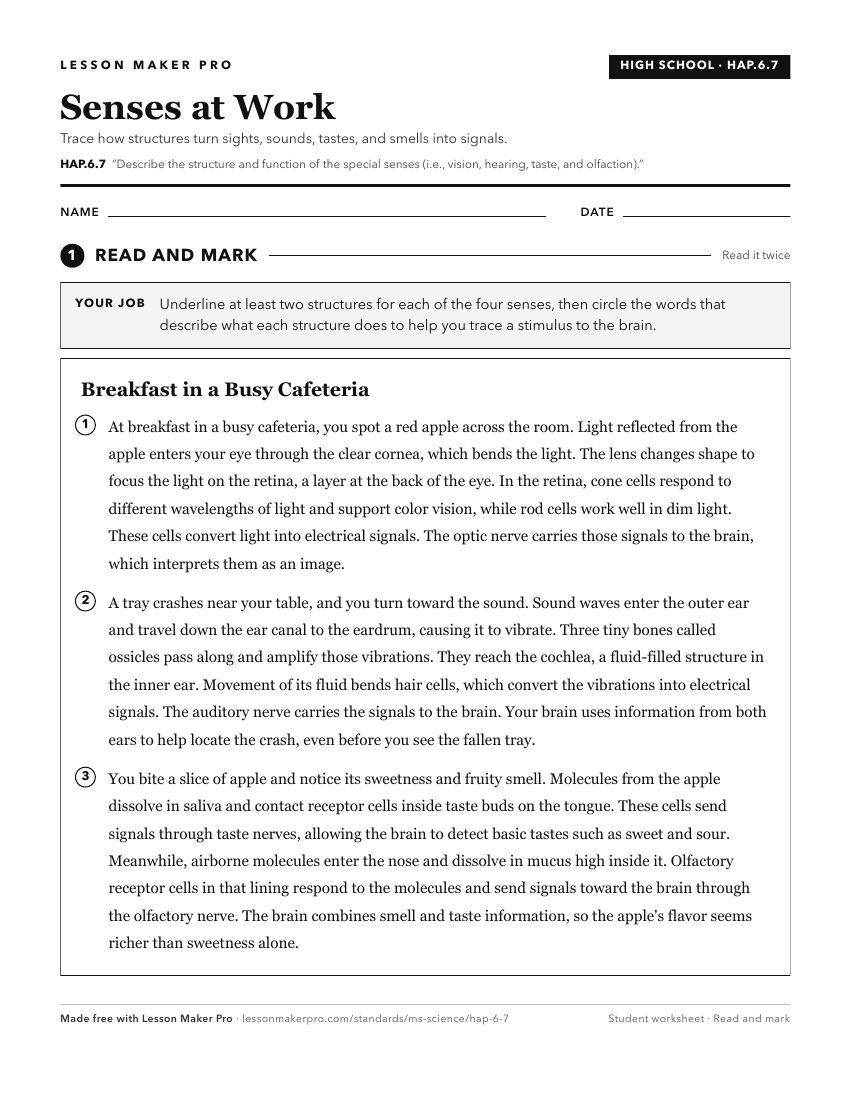
A ready-to-print activity worksheet aligned to HAP.6.7, with an answer key for the teacher on its own page. No account needed.
PDF, US Letter, prints cleanly in black and white.
Download the worksheetKeep exploring
Related Standards
- L.K.1B.2
Identify and describe examples of how animals use their sensory body parts (eyes to detect light and movement, ears to detect sound, skin to detect temperature ...
- HAP.6.3
Discuss the structure and function of the brain and spinal cord.
- HAP.6.4
Compare and contrast the structures and functions of the central and peripheral nervous systems. Investigate how the systems interact to maintain homeostasis (e...
- BOT.1.3
Describe the relationship between the structure and purpose of plant organs (e.g., roots, stems, and leaves).
Turn this exact standard into a lesson
Grade, subject, topic, and the complete standard are prefilled. Create one free, no account needed.
Also for this standard:Make a WorksheetMake a QuizMake a Sub Lesson