Mississippi Science HAP.13.3
The Standard
- HAP.13
- Students will investigate the structures and functions of the digestive system, including the cause and effect of diseases and disorders.
Identify the accessory organs (i.e., salivary glands, liver, gallbladder, and pancreas) for digestion and describe their function.
2026 Mississippi College- and Career-Readiness Standards for Science · Digestive System
Teacher's field guide
What This Standard Means
What Students Need to Do
- Students identify the salivary glands, liver, gallbladder, and pancreas on a digestive diagram. They explain how each helps digest food and where its secretion goes.
What Mastery Looks Like
- Students link saliva to starch breakdown in the mouth. They explain that the liver makes bile, the gallbladder stores and releases it, and bile disperses fat. They explain that the pancreas sends enzymes and acid-neutralizing bicarbonate to the small intestine.
Common Misconceptions
- Students may say the gallbladder makes bile instead of storing it. Some think bile is an enzyme that chemically breaks down fat. Others assume food travels through the pancreas or that saliva only wets food.
How to Assess It
- Give students a blank digestive diagram. Ask them to label the four accessory organs and write what each makes or stores and how it helps digestion.
Lesson moves
Ways to Teach It
Shake two jars of oil and water, add dish soap to one, and compare the droplets as a model of bile's action.
Ask students to write why salivary glands count as digestive organs even though food never passes through them.
Give pairs organ cards and function cards; have them match all four, then defend their liver and gallbladder matches.
Present a patient who has had their gallbladder removed; ask where bile comes from now and how it reaches the small intestine.
Free download
Printable HAP.13.3 Worksheet
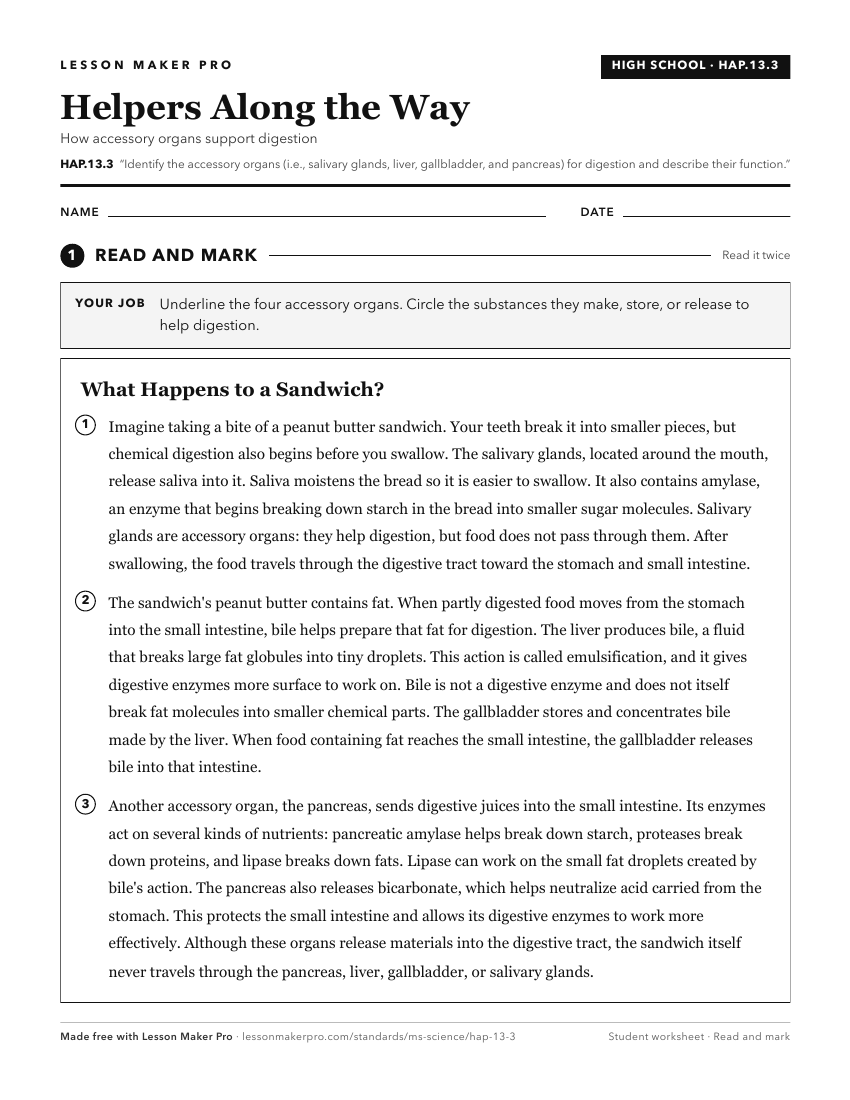
A ready-to-print activity worksheet aligned to HAP.13.3, with an answer key for the teacher on its own page. No account needed.
PDF, US Letter, prints cleanly in black and white.
Download the worksheetKeep exploring
Related Standards
- HAP.1.2
Locate organs and their applicable body cavities and systems.
- HAP.13.2
Use models to describe structural adaptations present in each organ of the tract and correlate the structures to specific processing of food at each stage (e.g....
- HAP.7.2
Discuss the function of each endocrine gland and the various hormones secreted.
- HAP.13.1
Analyze the structure-function relationship in organs of the digestive system.
Turn this exact standard into a lesson
Grade, subject, topic, and the complete standard are prefilled. Create one free, no account needed.
Also for this standard:Make a WorksheetMake a QuizMake a Sub Lesson