Mississippi Science HAP.1.2
The Standard
- HAP.1
- Students will demonstrate an understanding of how anatomical structures and physiological functions are organized and described using anatomical positions.
Locate organs and their applicable body cavities and systems.
2026 Mississippi College- and Career-Readiness Standards for Science · Physiological Functions/Anatomical Structure
Teacher's field guide
What This Standard Means
What Students Need to Do
- Students locate organs in the cranial, vertebral, thoracic, abdominal, and pelvic cavities. They name the body system each organ belongs to.
What Mastery Looks Like
- A student places the heart in the thoracic cavity and identifies it as part of the cardiovascular system. They can do the same for the brain, lungs, stomach, and bladder.
Common Misconceptions
- Students may put the stomach in the thoracic cavity because it sits near the ribs. They may also assume organs in one system share a cavity, even though the kidneys and bladder do not.
How to Assess It
- On an exit ticket, ask students to name the cavity and body system for the heart, brain, stomach, and bladder.
Lesson moves
Ways to Teach It
Give pairs a paper torso and organ cards; have them mark the diaphragm, place each organ, and write its cavity and system.
Ask: Do organs in the same system always share a cavity? Have students use the kidney and bladder to defend their answer.
Play a matching race with organ, cavity, and system cards; pairs check each completed set against a labeled body diagram.
Show a chest X-ray request for lungs and an abdominal ultrasound request for liver; students label each organ's cavity and system.
Free download
Printable HAP.1.2 Worksheet
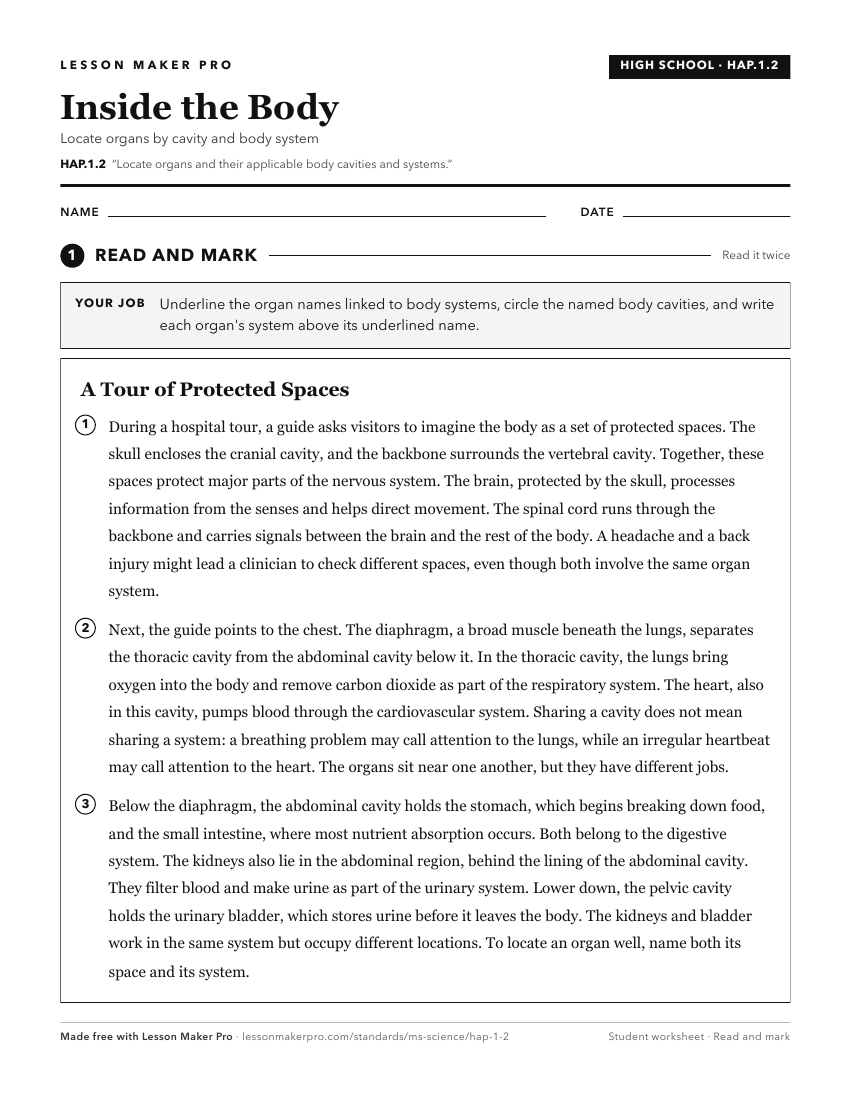
A ready-to-print activity worksheet aligned to HAP.1.2, with an answer key for the teacher on its own page. No account needed.
PDF, US Letter, prints cleanly in black and white.
Download the worksheetKeep exploring
Related Standards
- L.4.1.3
Construct models of organ systems (e.g., circulatory, digestive, respiratory, muscular, skeletal, nervous) to demonstrate both the unique function of the system...
- L.4.1.1
Use technology or other resources to research and discover general system function (e.g., machines, water cycle) as they relate to human organ systems and ident...
- L.4.1
Students will demonstrate an understanding of the organization, functions, and interconnections of the major human body systems.
- HAP.1.1
Apply appropriate anatomical terminology when explaining the orientation of regions, directions, and body planes or sections.
Turn this exact standard into a lesson
Grade, subject, topic, and the complete standard are prefilled. Create one free, no account needed.
Also for this standard:Make a WorksheetMake a QuizMake a Sub Lesson