Mississippi Science E.8.9A.7
The Standard
- E.8.9A
- Students will demonstrate an understanding that physical processes and major geological events (e.g., plate movement, volcanic activity, mountain building, weathering, erosion) are powered by the Sun and the Earth's internal heat and have occurred over millions of years.
Explain the interconnected relationship between surface water and groundwater.
2026 Mississippi College- and Career-Readiness Standards for Science · Earth’s Systems and Cycles
Teacher's field guide
What This Standard Means
What Students Need to Do
- Students trace water as it runs over land, soaks into soil, and moves through spaces in rock and sediment. They explain how streams can feed groundwater and how groundwater can feed streams.
What Mastery Looks Like
- A student can draw a stream, a nearby well, and the water table. They add arrows showing water moving between the stream and the ground, and explain what makes it move each way.
Common Misconceptions
- Students may picture groundwater as a large underground lake or a fast-moving river, rather than water in pores and cracks. Some think streams only lose water to the ground and cannot receive water from it.
How to Assess It
- Exit ticket: Draw and label one path from a stream into a nearby well and another path from underground water into a stream.
Lesson moves
Ways to Teach It
Fill a clear tub with gravel, cut a shallow channel, pour water slowly away from it, and watch the channel fill.
Ask, “If a stream dries up during a drought, what might happen to the water level in a nearby well? Explain.”
Give pairs two stream sketches, one with the water table above stream level and one below; have them draw flow arrows.
Show a sketch of a farm beside a creek and a well; trace how spilled fertilizer could reach both after rain.
Free download
Printable E.8.9A.7 Worksheet
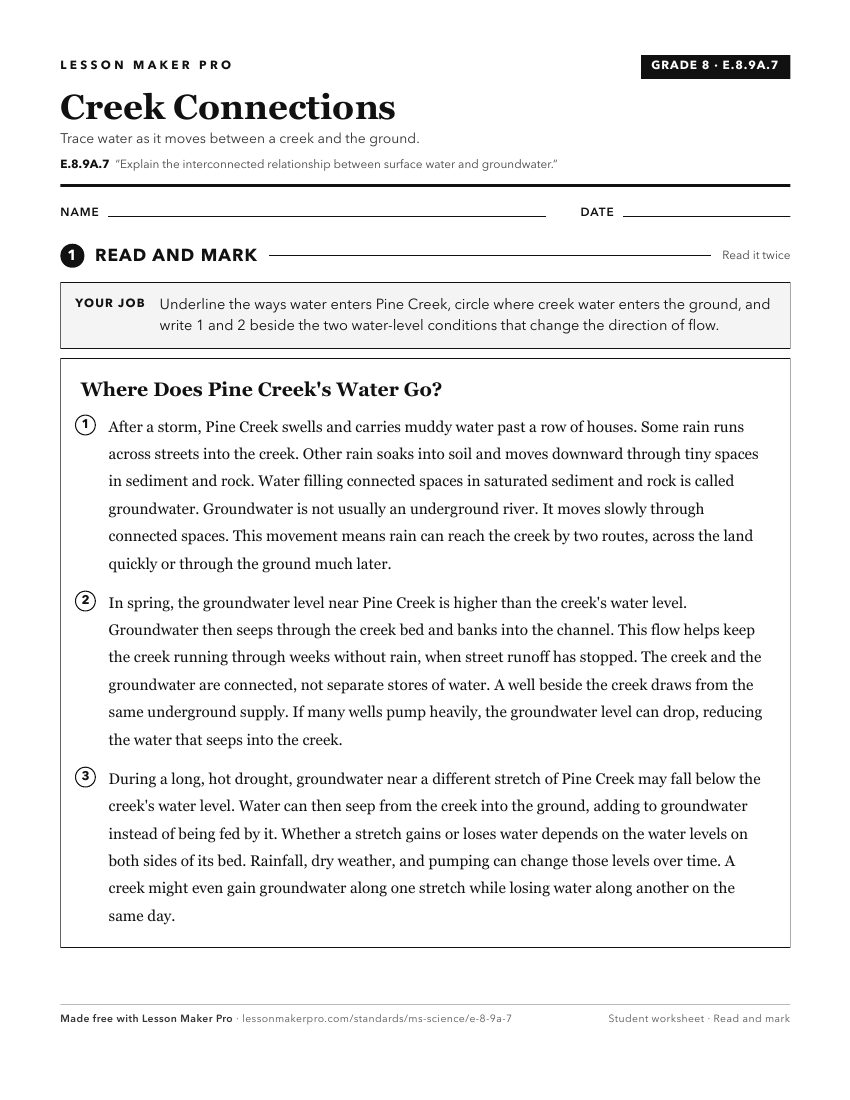
A ready-to-print activity worksheet aligned to E.8.9A.7, with an answer key for the teacher on its own page. No account needed.
PDF, US Letter, prints cleanly in black and white.
Download the worksheetKeep exploring
Related Standards
- MAQ.1.3
Diagram, utilizing digital or physical models, the water cycle and how it relates to the total amount of fresh water available to living things at any given tim...
- E.3.9.2
Construct explanations of how different landforms and surface features result from the location and movement of water on Earth’s surface (e.g., watersheds, drai...
- E.3.9.3
Use graphical representations to communicate the distribution of freshwater and saltwater on Earth (e.g., oceans, lakes, rivers, glaciers, groundwater, or polar...
- E.4.9A.1
Develop and use models to explain how the sun's energy drives the water cycle. (e.g., evaporation, condensation, precipitation, transpiration, runoff, and groun...
Turn this exact standard into a lesson
Grade, subject, topic, and the complete standard are prefilled. Create one free, no account needed.
Also for this standard:Make a WorksheetMake a QuizMake a Sub Lesson