Mississippi Science E.7.9A.1
The Standard
- E.7.9A
- Students will demonstrate an understanding of how complex changes in the movement and patterns of air and water molecules caused by the sun, winds, landforms, ocean temperatures, and currents in the atmosphere are major determinants of local and global weather patterns.
Analyze and interpret weather patterns from various regions to differentiate between weather and climate.
2026 Mississippi College- and Career-Readiness Standards for Science · Earth’s Systems and Cycles
Teacher's field guide
What This Standard Means
What Students Need to Do
- Students read daily weather records and long-term temperature and rainfall averages from different regions. They spot short-term changes and lasting patterns, then use the time span to tell weather from climate.
What Mastery Looks Like
- Given a week of forecasts and 30-year rainfall averages for two cities, students label each set correctly and explain which city is usually wetter. They use the averages, not one rainy day, to support their answer.
Common Misconceptions
- Students may call one rainy day proof that a region has a wet climate. They may also think two places have the same climate because today's temperatures match.
How to Assess It
- Exit ticket: Phoenix is rainy today but averages 20 cm of rain a year over 30 years; Seattle is sunny today but averages 95 cm. Which city has a wetter climate, and which facts describe today's weather?
Lesson moves
Ways to Teach It
Give pairs seven-day rainfall strips and 30-year rainfall graphs for Phoenix and Seattle; have them mark daily changes and long-term patterns.
Ask students to write: If Seattle is sunny today and Phoenix is rainy, what evidence would show which place is usually wetter?
Run a card-sort relay with daily forecast cards and 30-year average cards; partners label each card and explain one tricky choice.
Use a seven-day forecast and 30-year rain averages for two vacation spots; students choose what to pack and when to go.
Free download
Printable E.7.9A.1 Worksheet
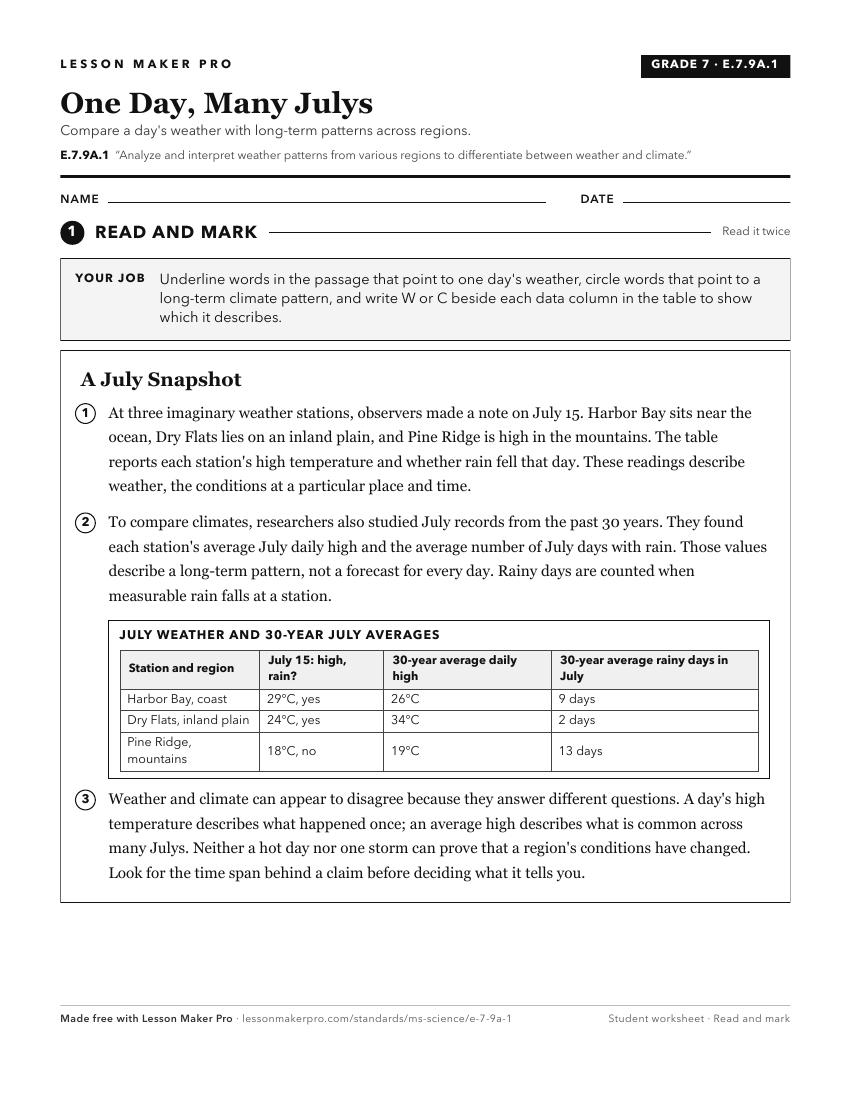
A ready-to-print activity worksheet aligned to E.7.9A.1, with an answer key for the teacher on its own page. No account needed.
PDF, US Letter, prints cleanly in black and white.
Download the worksheetKeep exploring
Related Standards
- E.1.9A.1
Analyze and interpret data from observations and measurements to describe local weather conditions (including temperature, wind, and forms of precipitation).
- ESS.3.5
Analyze and interpret weather data using maps and global weather systems to explain and communicate the relationships among air masses, pressure systems, and fr...
- E.4.9B.1
Analyze and interpret data (e.g., temperature, precipitation, wind speed/direction, relative humidity, or cloud types) to predict changes in weather over time.
- E.7.9A.3
Interpret atmospheric data from satellites, radar, and weather maps to predict weather patterns and conditions.
Turn this exact standard into a lesson
Grade, subject, topic, and the complete standard are prefilled. Create one free, no account needed.
Also for this standard:Make a WorksheetMake a QuizMake a Sub Lesson