Mississippi Science E.4.9C.4
The Standard
- E.4.9C
- Students will demonstrate an understanding of how natural processes and human activities affect the features of Earth's landforms and oceans.
Research and explain how systems (i.e., the atmosphere, geosphere, and/or hydrosphere) interact and support life in the biosphere.
2026 Mississippi College- and Career-Readiness Standards for Science · Earth’s Systems and Cycles
Teacher's field guide
What This Standard Means
What Students Need to Do
- Students use a short reading or diagram to find out how air, water, and soil help living things. They explain how these parts work together to help a plant survive.
What Mastery Looks Like
- A student can trace rainwater into soil and then into a plant’s roots. They can explain that roots take up water and minerals from soil, while leaves take in carbon dioxide from air.
Common Misconceptions
- Students may say plants get their food from soil, rather than making it using light, water, and carbon dioxide. They may also describe rain, air, and soil separately without showing how water moves from rain into soil and roots.
How to Assess It
- Give students this fact card: “Bean roots take up water and minerals from soil. Leaves take in carbon dioxide from air.” Ask: “How do rain, soil, and air help a bean plant live?”
Lesson moves
Ways to Teach It
Pass around a potted bean plant, a cup of water, and a soil sample; have students place labeled arrows at roots and leaves.
Ask students to write: “After rain, how do water, soil, and air help a bean plant grow?”
Give pairs cards labeled rain, soil, roots, air, and leaves; have them arrange the cards and explain their connections.
Visit a school planter and ask students to point out where its plants get water, minerals, and carbon dioxide.
Free download
Printable E.4.9C.4 Worksheet
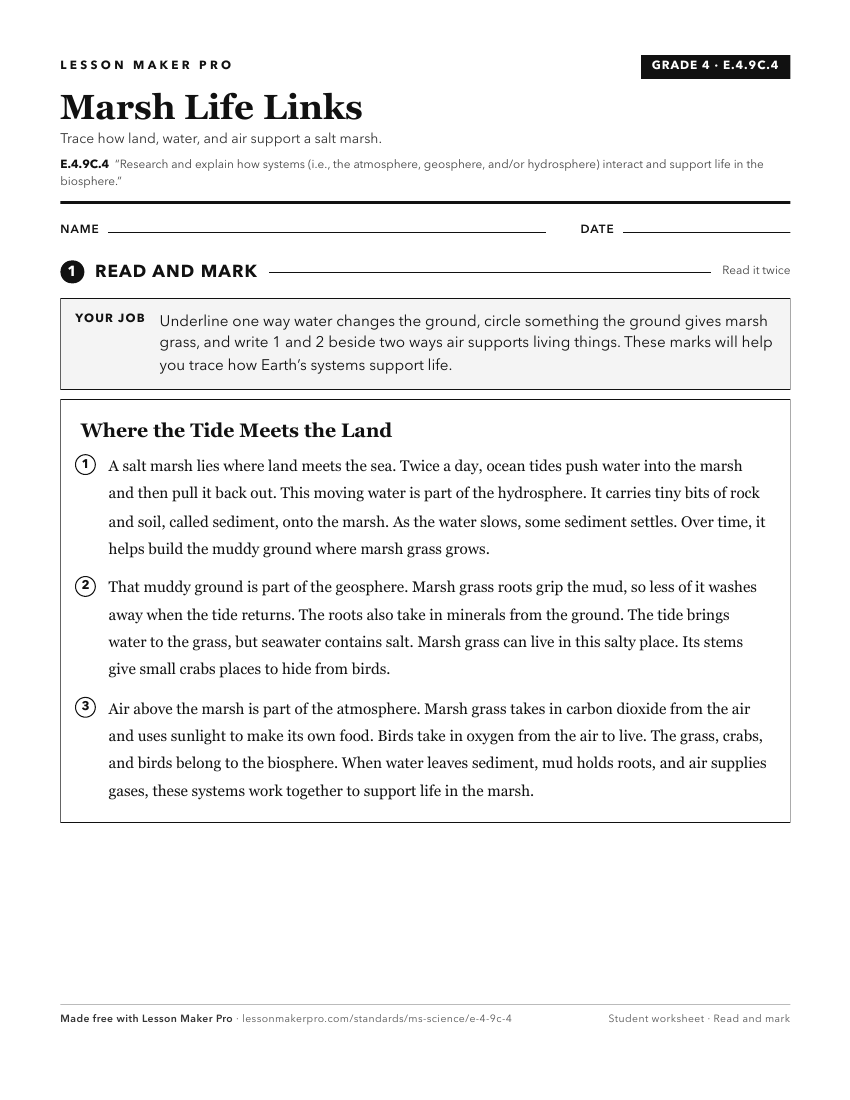
A ready-to-print activity worksheet aligned to E.4.9C.4, with an answer key for the teacher on its own page. No account needed.
PDF, US Letter, prints cleanly in black and white.
Download the worksheetKeep exploring
Related Standards
- ESS.4.2
Research, assess, and communicate how Earth’s systems influence the distribution of life, including how various natural hazards and geologic events (e.g., volca...
- E.3.9
Students will demonstrate an understanding of how the Earth’s systems (i.e., geosphere, hydrosphere, atmosphere, and biosphere) interact in multiple ways to aff...
- ENV.1.1
Identify, investigate, and evaluate the interactions of the abiotic and biotic factors that determine the types of organisms that live in major biomes.
- ESS.4.1
Research, evaluate, and communicate about how human life on Earth shapes Earth’s systems and responds to the interaction of Earth’s systems (e.g., geosphere, hy...
Turn this exact standard into a lesson
Grade, subject, topic, and the complete standard are prefilled. Create one free, no account needed.
Also for this standard:Make a WorksheetMake a QuizMake a Sub Lesson