Mississippi Science BOT.5.2
The Standard
- BOT.5
- Students will explore adaptations that allow plants to survive in various habitats.
Relate atmospheric factors to biodiversity (e.g., climate as determined by temperature and precipitation).
2026 Mississippi College- and Career-Readiness Standards for Science · Plant Adaptations to Varying Habitats
Teacher's field guide
What This Standard Means
What Students Need to Do
- Students compare long-term temperature and rainfall across habitats. They use plant species counts to describe biodiversity and explain how climate may affect which plants can live there.
What Mastery Looks Like
- Given climate data and plant species counts for two places, a student identifies which has more kinds of plants. They use temperature or rainfall to explain the pattern without claiming climate is the only cause.
Common Misconceptions
- Students may mistake one rainy day for a place's climate or confuse more individual plants with more plant species. They may assume a warmer place always has more species, even when rainfall is scarce.
How to Assess It
- Exit ticket: Two sites both average 20°C. Site A gets 200 mm of rain a year and has 8 plant species; Site B gets 1,800 mm and has 42. Which has greater plant biodiversity, and how might rainfall help explain the difference?
Lesson moves
Ways to Teach It
Tape a temperature and rainfall grid on the floor; students place desert, tundra, and rainforest cards showing climate averages and plant species counts.
Ask students, 'Why might a hot desert have fewer plant species than a warm, wet forest?' Require temperature and rainfall in their answers.
Run four rounds of predict and check: show annual climate figures, collect species-count predictions, then reveal the counts on habitat cards.
Show Phoenix and Miami yard photos with annual rainfall figures; ask how watering could change which plant species grow in each yard.
Free download
Printable BOT.5.2 Worksheet
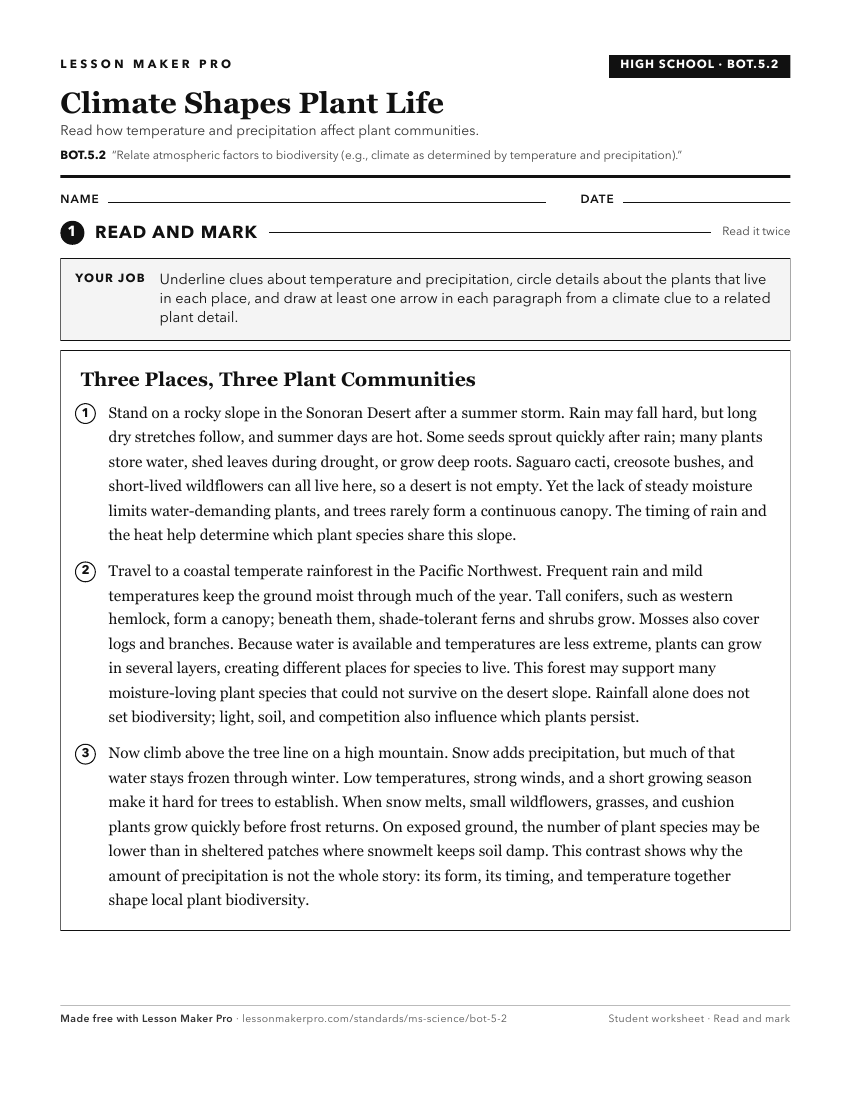
A ready-to-print activity worksheet aligned to BOT.5.2, with an answer key for the teacher on its own page. No account needed.
PDF, US Letter, prints cleanly in black and white.
Download the worksheetKeep exploring
Related Standards
- FB.6.4
Develop and use models to discuss the climate, flora, and fauna of the terrestrial and aquatic biomes of the world.
- E.4.9B.2
Construct explanations about regional climate differences using maps and long-term data from various regions.
- ENV.1.1
Identify, investigate, and evaluate the interactions of the abiotic and biotic factors that determine the types of organisms that live in major biomes.
- E.7.9A.4
Construct an explanation for how climate is determined in an area using global and surface features (e.g. latitude, elevation, shape of the land, distance from ...
Turn this exact standard into a lesson
Grade, subject, topic, and the complete standard are prefilled. Create one free, no account needed.
Also for this standard:Make a WorksheetMake a QuizMake a Sub Lesson