Mississippi Science BIO.1C.3
The Standard
- BIO.1C
- Students will relate the diversity of organelles to a variety of specialized cellular functions.
Contrast the structure of viruses with that of cells and explain why viruses must use living cells to reproduce.
2026 Mississippi College- and Career-Readiness Standards for Science · Cells as a System
Teacher's field guide
What This Standard Means
What Students Need to Do
- Students compare a virus's genetic material and protein coat with a cell's membrane, cytoplasm, and ribosomes. They explain how a virus uses a living cell to make viral parts and assemble new viruses.
What Mastery Looks Like
- Given a diagram, students can label the main parts of a virus and a cell. They can explain that a virus has no ribosomes, so it must use a host cell to make viral proteins.
Common Misconceptions
- Students may think viruses are tiny cells or that they divide in two. Others think viruses have ribosomes and can make proteins without a host.
How to Assess It
- Exit ticket: Sketch a virus and a cell. Label the protein coat, genetic material, cytoplasm, and ribosomes where they belong, then explain why the virus needs the cell.
Lesson moves
Ways to Teach It
Give students paper cutouts of a protein coat, genetic material, a cell membrane, cytoplasm, and ribosomes to build a virus and a cell.
Ask students to write two sentences answering: Why can a virus carry genes but not make more viruses on its own?
Give pairs part-name cards and have them race to sort each into virus, cell, or both.
Show an amoxicillin label and ask why a drug targeting bacterial cell parts cannot stop flu viruses reproducing in human cells.
Free download
Printable BIO.1C.3 Worksheet
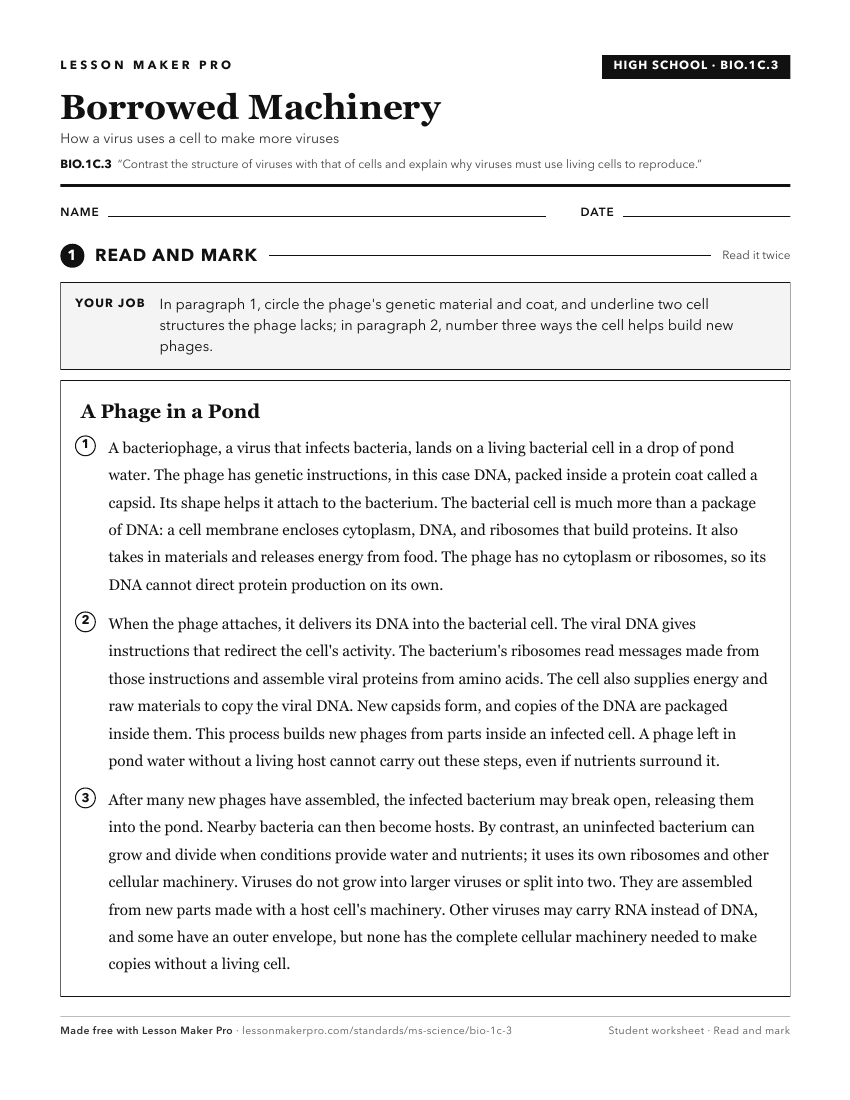
A ready-to-print activity worksheet aligned to BIO.1C.3, with an answer key for the teacher on its own page. No account needed.
PDF, US Letter, prints cleanly in black and white.
Download the worksheetKeep exploring
Related Standards
- L.6.1.1
Use argument supported by evidence in order to distinguish between living and non-living things, including viruses and bacteria.
- BIO.1E.3
Relate the processes of cellular reproduction to asexual reproduction in simple organisms (i.e., budding, vegetative propagation, regeneration, binary fission)....
- L.8.2A.5
Compare and contrast advantages and disadvantages of asexual and sexual reproduction.
- BIO.1A.4
Use evidence from current scientific literature to support whether a virus is living or non-living
Turn this exact standard into a lesson
Grade, subject, topic, and the complete standard are prefilled. Create one free, no account needed.
Also for this standard:Make a WorksheetMake a QuizMake a Sub Lesson