Maryland Math 4.NOS.D.9
Standard Cluster
Understand and generate equivalent fractions. Identify and generate equivalent fractions using representations and the Identity Property of Multiplication. Explain why fractions are equivalent (c/d = (n × c)/(n × d)).
Maryland College and Career Ready Standards for Mathematics (2025) · EXTEND UNDERSTANDING OF FRACTION EQUIVALENCE AND ORDERING.
Cluster contents
Standards in This Cluster
4.NOS.D.9 is a cluster heading. These are the individual standards under it.
Teacher's field guide
What This Cluster Means
What Students Need to Do
- Students use fraction strips or drawings to show when two fractions name the same amount. They make equivalent fractions by multiplying the numerator and denominator by the same number, which means multiplying by 1.
What Mastery Looks Like
- A student draws equal-length bars to show that 3/4 and 6/8 cover the same amount. They write 3/4 × 2/2 = 6/8 and explain that 2/2 equals 1, so the value stays the same.
Common Misconceptions
- Some students add the same number to the top and bottom, treating 1/2 as equal to 2/3. Others multiply only the numerator or compare shaded parts in drawings with different-sized wholes.
How to Assess It
- Exit ticket: Draw equal-length bars to show whether 2/3 equals 4/6. Write a multiplication equation and explain why the value stays the same.
Lesson moves
Ways to Teach It
Fold equal-length paper strips into thirds and sixths, shade 2/3 and 4/6, and place them side by side.
Ask, "Why does 3/4 equal 6/8 but not 4/5?" Have students explain with a drawing and an equation.
Give pairs cards showing fractions, shaded bars, and equations; have them match 2/3, 4/6, and 2/3 × 2/2.
Use a ruler to mark 1/2 inch and 2/4 inch, then explain why both marks land in the same place.
Free download
Printable 4.NOS.D.9 Worksheet
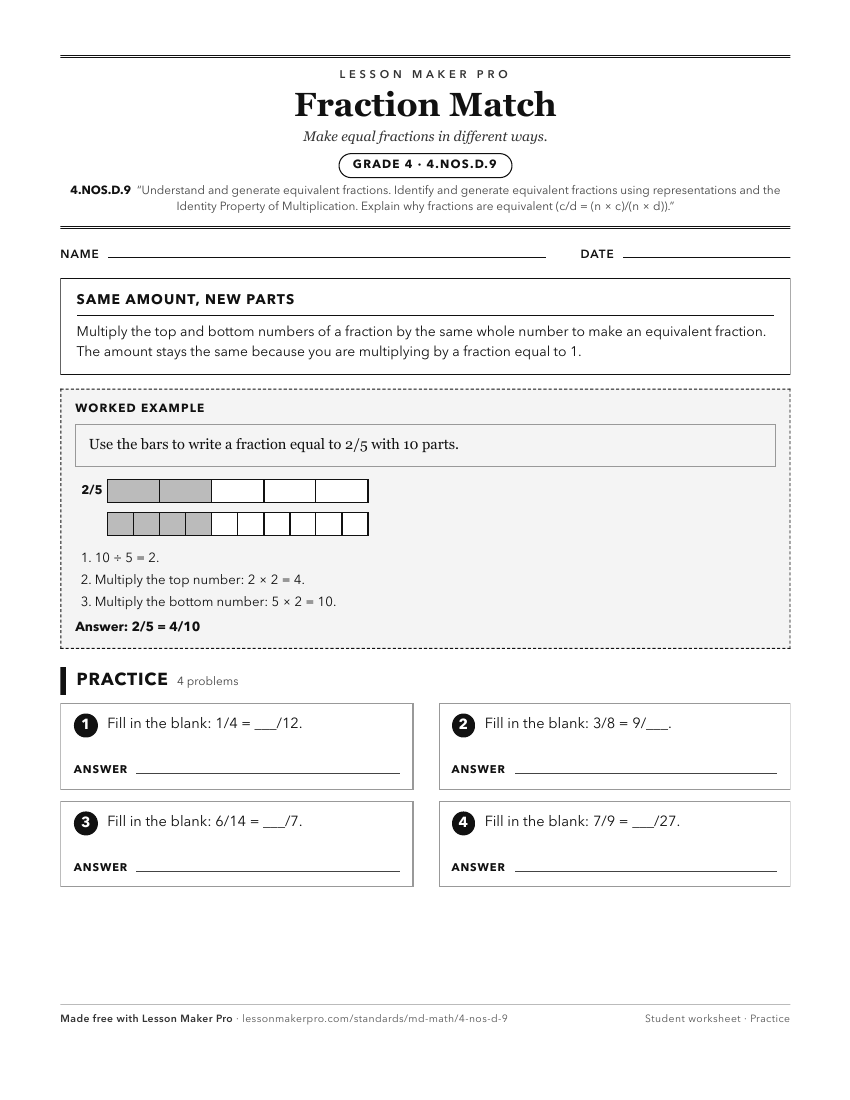
A ready-to-print activity worksheet aligned to 4.NOS.D.9, with an answer key for the teacher on its own page. No account needed.
PDF, US Letter, prints cleanly in black and white.
Download the worksheetKeep exploring
Related Standards
- 3.NOS.F.13
Explain equivalence of fractions and compare fractions by reasoning about their size, recognizing that comparisons are valid only when the two fractions refer t...
- 3.NOS.F.13.b
Identify and generate equivalent fractions, (e.g., 1/2 = 2/4, 4/6 = 2/3.) and explain why the fractions are equivalent using concrete materials, drawings, numbe...
Turn this cluster into a lesson
Grade, subject, topic, and the complete cluster are prefilled. Create one free, no account needed.
Also for this cluster:Make a WorksheetMake a QuizMake a Sub Lesson