Maryland Math 3.NOS.F.13
Standard Cluster
Explain equivalence of fractions and compare fractions by reasoning about their size, recognizing that comparisons are valid only when the two fractions refer to the same whole. Represent two fractions as equivalent if they are the same size, or they represent the same point on the number line. Identify and generate equivalent fractions, (e.g., 1/2 = 2/4, 4/6 = 2/3.) and explain why the fractions are equivalent using concrete materials, drawings, number lines, or equations. Express whole numbers as fractions, and identify fractions that are equivalent to whole numbers, (e.g., express 3 in the form 3 = 3/1; recognize that 6 = 6/1; locate 4/4 and 1 at the same point on a number line). Compare two fractions with the same numerator or the same denominator by reasoning about their size. Record the results of comparisons with the symbols >, =, or <, and justify the conclusions (e.g., by using concrete materials, drawings, number lines, and/or equations).
Maryland College and Career Ready Standards for Mathematics (2025) · DEVELOP UNDERSTANDING OF FRACTIONS AS NUMBERS.
Cluster contents
Standards in This Cluster
3.NOS.F.13 is a cluster heading. These are the individual standards under it.
- 3.NOS.F.13.a
Represent two fractions as equivalent if they are the same size, or they represent the same point on the number line.
- 3.NOS.F.13.b
Identify and generate equivalent fractions, (e.g., 1/2 = 2/4, 4/6 = 2/3.) and explain why the fractions are equivalent using concrete materials, drawings, numbe...
- 3.NOS.F.13.d
Compare two fractions with the same numerator or the same denominator by reasoning about their size. Record the results of comparisons with the symbols >, =, or...
Teacher's field guide
What This Cluster Means
What Students Need to Do
- Students show when fractions are equal using strips, drawings, or number lines. They write whole numbers as fractions and compare fractions with the same numerator or denominator, using the same whole.
What Mastery Looks Like
- A student can show that 1/2 and 2/4 cover the same length and land at the same point on a number line. They can write 3 as 3/1, place 4/4 at 1, and explain why 3/8 < 5/8.
Common Misconceptions
- Students may think a larger denominator means a larger piece. They may compare pieces from different-sized wholes, treat 1/2 and 2/4 as different sizes, or think whole numbers cannot be fractions.
How to Assess It
- Exit ticket: On a number line from 0 to 1, mark 1/2, 2/4, and 4/4. Then compare 2/6 and 4/6 using <, >, or =, and explain with a sketch.
Lesson moves
Ways to Teach It
Fold two equal-size paper strips into halves and fourths; shade 1/2 and 2/4, then line up the shaded lengths.
Show half of a small square and half of a large square; ask, "Are the shaded pieces the same size? Why?"
Deal paired cards such as 1/3 and 1/4; partners place >, <, or = between them and sketch equal-size wholes to prove it.
Draw two equal-size pizzas cut into thirds and sixths; ask students to show why one third equals two sixths.
Free download
Printable 3.NOS.F.13 Worksheet
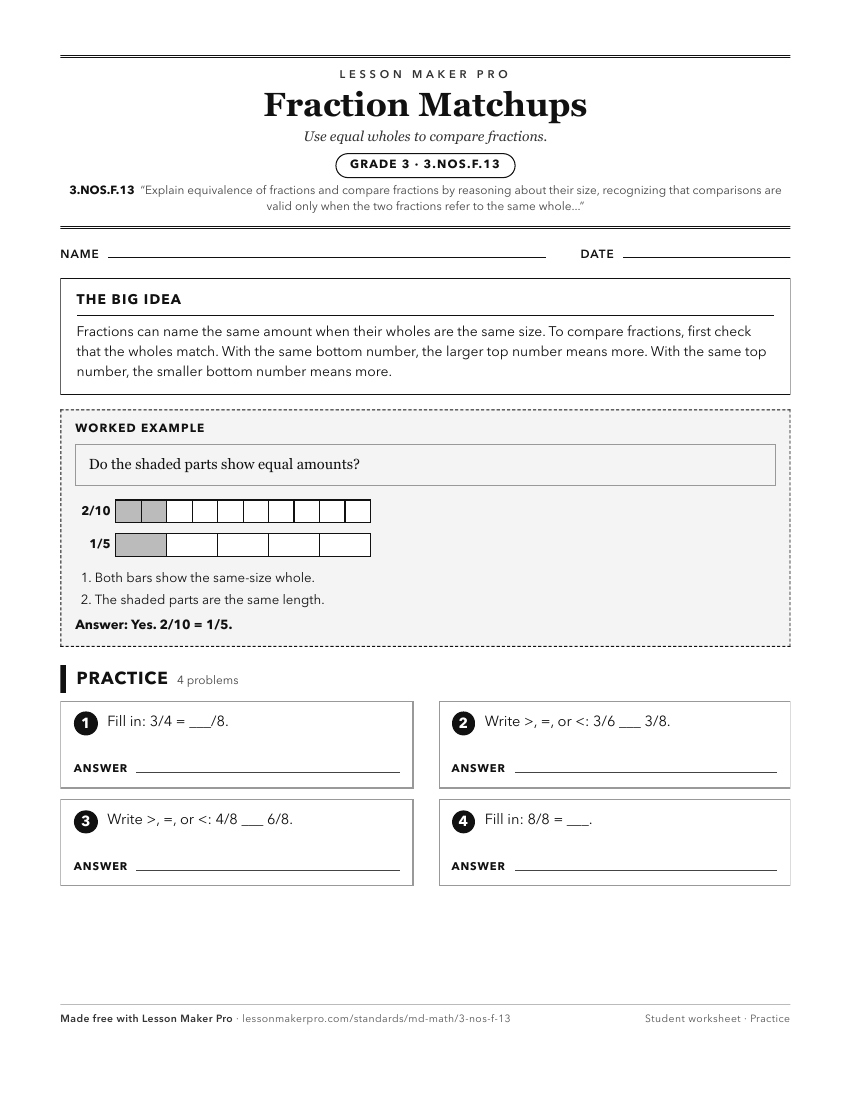
A ready-to-print activity worksheet aligned to 3.NOS.F.13, with an answer key for the teacher on its own page. No account needed.
PDF, US Letter, prints cleanly in black and white.
Download the worksheetKeep exploring
Related Standards
Turn this cluster into a lesson
Grade, subject, topic, and the complete cluster are prefilled. Create one free, no account needed.
Also for this cluster:Make a WorksheetMake a QuizMake a Sub Lesson