Maryland Math 4.NOS.D.9.b
The Standard
- 4.NOS.D.9
- Understand and generate equivalent fractions.
Explain why fractions are equivalent (c/d = (n × c)/(n × d)).
Maryland College and Career Ready Standards for Mathematics (2025) · EXTEND UNDERSTANDING OF FRACTION EQUIVALENCE AND ORDERING.
Teacher's field guide
What This Standard Means
What Students Need to Do
- Students split each part of a fraction into the same number of smaller, equal parts. They explain why the number of shaded parts changes but the amount shaded stays the same.
What Mastery Looks Like
- A student can draw 2/3 and 6/9 using bars of the same size. They show that splitting each third into three pieces gives six shaded ninths, with no change in the shaded amount.
Common Misconceptions
- Students may multiply only the numerator or add the same number to the numerator and denominator. Some think a fraction with a larger denominator must be smaller, even when the numerator changes too.
How to Assess It
- Exit ticket: Draw a bar to show why 2/5 = 6/15. Write one sentence explaining what happened to each fifth.
Lesson moves
Ways to Teach It
Fold a paper strip into four equal parts, shade three, then split each part in half and label 3/4 and 6/8.
Ask: Why does splitting every third into two pieces change 2/3 to 4/6 without changing the shaded amount?
Play a card match with fraction bars and labels such as 1/2, 2/4, and 3/6; require an explanation for each match.
Draw a measuring cup marked in eighths and show why 3/4 cup of oats reaches the 6/8 mark.
Free download
Printable 4.NOS.D.9.b Worksheet
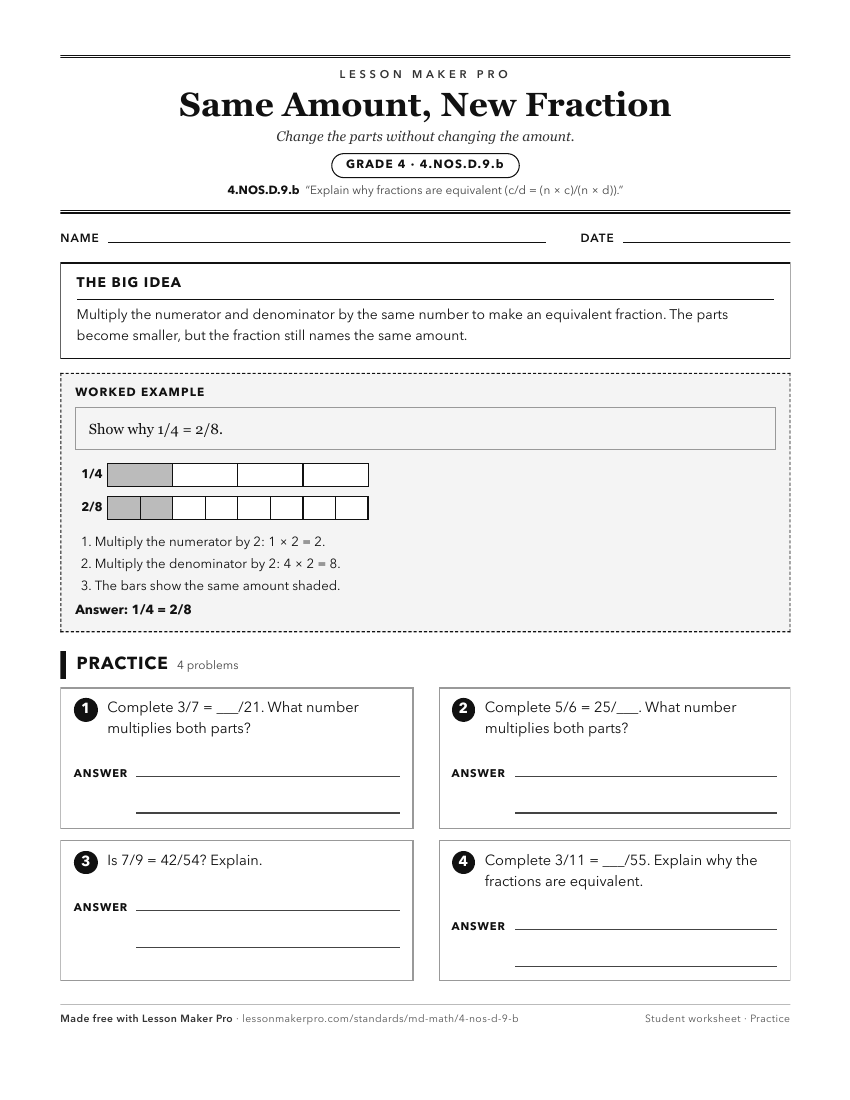
A ready-to-print activity worksheet aligned to 4.NOS.D.9.b, with an answer key for the teacher on its own page. No account needed.
PDF, US Letter, prints cleanly in black and white.
Download the worksheetKeep exploring
Related Standards
- 3.NOS.F.11
Explain a fraction of a set c/d as the quantity formed by c items as part of the given set of d objects.
- 3.NOS.F.10.b
Explain that a fraction 1/d represents one part of a whole that is divided into d equal parts, and that a fraction c/d represents c parts of size 1/d.
- 5.NOS.C.8.c
Use equivalent fractions to produce an equivalent sum or difference of fractions with like denominators (e.g. 2/3 + 5/4 = 8/12 + 15/12 = 23/12. In general, a/b ...
Turn this exact standard into a lesson
Grade, subject, topic, and the complete standard are prefilled. Create one free, no account needed.
Also for this standard:Make a WorksheetMake a QuizMake a Sub Lesson