Maryland Math 3.NOS.E.9.b
The Standard
- 3.NOS.E.9
- Recall or quickly derive multiplication and division facts within 100 (e.g., factors less than or equal to 10 and quotients less than or equal to 10).
Derive unknown facts from known facts using double facts (e.g., to solve 4 × 3, double 3 to get 6 and double 6 to get 12) to multiply and divide.
Maryland College and Career Ready Standards for Mathematics (2025) · MULTIPLY AND DIVIDE WITHIN 100.
Teacher's field guide
What This Standard Means
What Students Need to Do
- Students use a fact they know to find a new multiplication fact by doubling one factor and the product. For division, they double the number being divided and the answer while keeping the divisor the same.
What Mastery Looks Like
- Given 3 × 4 = 12, a student finds 6 × 4 = 24 by doubling 3 and 12. They use 12 ÷ 4 = 3 to find 24 ÷ 4 = 6 and explain why 4 stays the same.
Common Misconceptions
- Some students double both factors but double the product only once. In division, some double the divisor along with the number being divided, then incorrectly double the answer.
How to Assess It
- Exit ticket: Given 3 × 4 = 12, find 6 × 4 and 24 ÷ 4. Show what doubles in each problem.
Lesson moves
Ways to Teach It
Build 2 rows of 3 counters, add 2 matching rows, and use 2 × 3 = 6 to find 4 × 3.
Ask students to write how 12 ÷ 3 = 4 helps them find 24 ÷ 3, including what doubles.
Play fact-match with cards for 3 × 5, 6 × 5, 12 × 5, 15, 30, and 60; match and explain each doubling.
Show boxes holding 6 markers each; ask how the total for 4 boxes helps find the total for 8 boxes.
Free download
Printable 3.NOS.E.9.b Worksheet
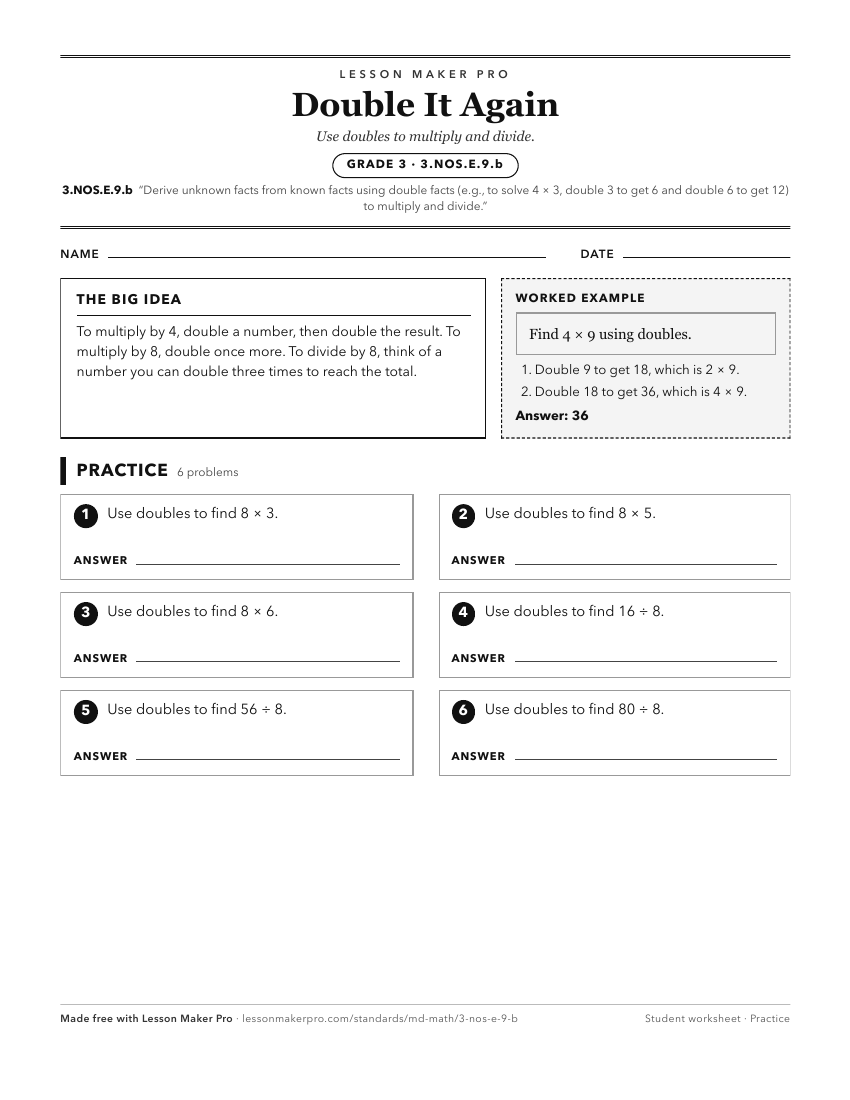
A ready-to-print activity worksheet aligned to 3.NOS.E.9.b, with an answer key for the teacher on its own page. No account needed.
PDF, US Letter, prints cleanly in black and white.
Download the worksheetKeep exploring
Related Standards
- 1.NOS.D.9.d
Use the doubles to add and subtract (e.g., 6 + 6 = 12, 14 – 7 = 7, etc.)
- 4.NOS.C.7.d
Use the inverse relationship between multiplication and division (e.g., think of 4 × ? = 28 to solve 28 ÷ 4 = ?) to multiply and divide.
- 3.NOS.E.9.d
Use the inverse relationship between multiplication and division (e.g., think of 4 × ? = 28 to solve 28 ÷ 4 = ?) to multiply and divide.
- 4.NOS.C.7.b
Derive unknown facts from known facts using double facts (e.g., to solve 4 × 3, double 3 to get 6 and double 6 to get 12) to multiply and divide.
Turn this exact standard into a lesson
Grade, subject, topic, and the complete standard are prefilled. Create one free, no account needed.
Also for this standard:Make a WorksheetMake a QuizMake a Sub Lesson