Maryland Math 4.NOS.C.7.d
The Standard
- 4.NOS.C.7
- Recall or quickly derive multiplication and division facts within 100 (e.g., factors less than or equal to 10 and quotients less than are equal to 10).
Use the inverse relationship between multiplication and division (e.g., think of 4 × ? = 28 to solve 28 ÷ 4 = ?) to multiply and divide.
Maryland College and Career Ready Standards for Mathematics (2025) · GAIN FAMILIARITY WITH FACTORS AND MULTIPLES.
Teacher's field guide
What This Standard Means
What Students Need to Do
- Students treat a division question as a missing-factor question. They use related equations to find a quotient or a missing factor, then check their work.
What Mastery Looks Like
- Given 63 ÷ 9, a student writes 9 × 7 = 63 and answers 7. Given 7 × ___ = 56, they use 56 ÷ 7 = 8 to fill the blank.
Common Misconceptions
- Some students write 8 ÷ 56 when the problem asks for 56 ÷ 8. Others multiply the two given numbers instead of finding the missing factor.
How to Assess It
- Exit ticket: Solve 42 ÷ 6 by writing a related multiplication fact. Then complete 8 × ___ = 56 by writing a related division fact.
Lesson moves
Ways to Teach It
Pairs share 24 counters among six cups, then write 6 × 4 = 24 and 24 ÷ 6 = 4.
Ask students to explain how 7 × 6 = 42 helps them solve 42 ÷ 7, using a drawing or two sentences.
Give students cards with 9 × 5 = 45, 45 ÷ 9 = 5, and 45 ÷ 5 = 9; have them find matches.
A teacher has 36 pencils and puts six in each bag; students find the bag count and write a matching multiplication fact.
Free download
Printable 4.NOS.C.7.d Worksheet
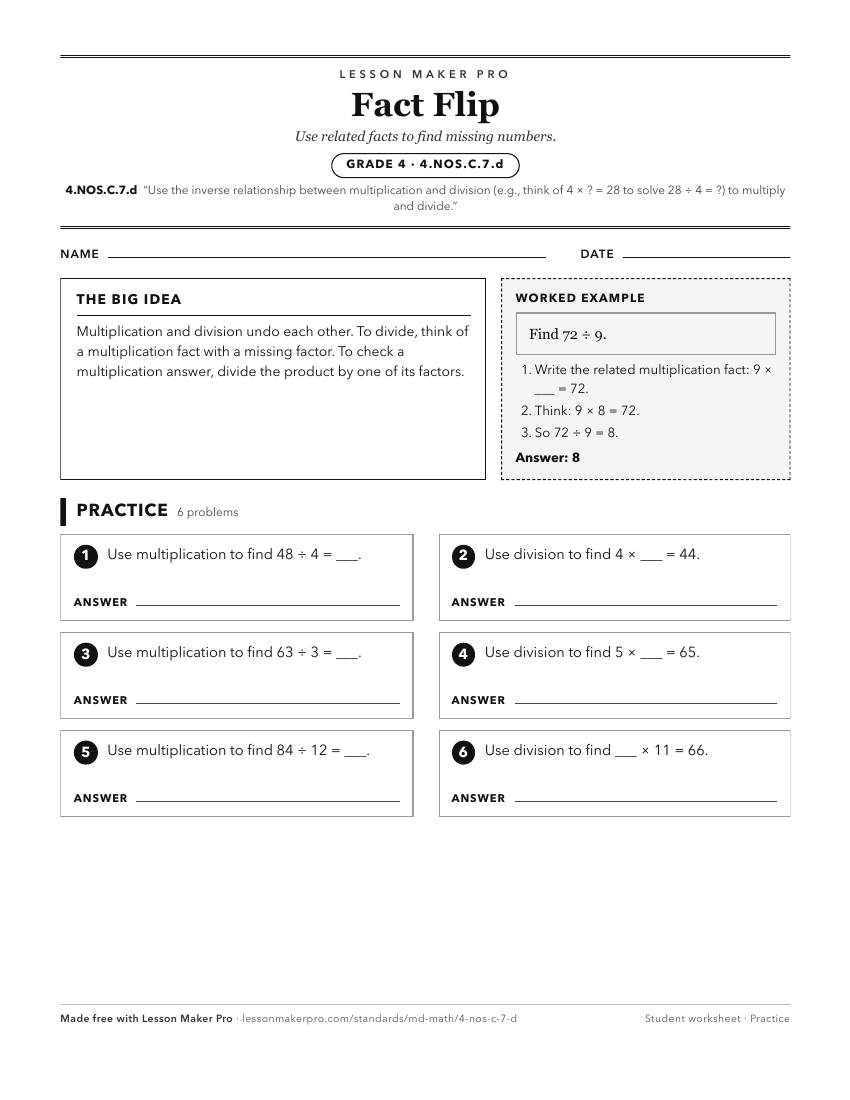
A ready-to-print activity worksheet aligned to 4.NOS.C.7.d, with an answer key for the teacher on its own page. No account needed.
PDF, US Letter, prints cleanly in black and white.
Download the worksheetKeep exploring
Related Standards
- 3.NOS.C.5
Explain and use the inverse relationship between multiplication and division to determine the unknown whole number in a multiplication or division equation invo...
- 3.NOS.E.9.d
Use the inverse relationship between multiplication and division (e.g., think of 4 × ? = 28 to solve 28 ÷ 4 = ?) to multiply and divide.
- 5.NOS.B.7.d
Use properties of operations and/or the inverse relationship between multiplication and division to multiply and divide.
- 5.NOS.B.5.c
Use properties of operations and/or the inverse relationship between multiplication and division to divide.
Turn this exact standard into a lesson
Grade, subject, topic, and the complete standard are prefilled. Create one free, no account needed.
Also for this standard:Make a WorksheetMake a QuizMake a Sub Lesson