Kentucky Reading and Writing C.7.1
Standard Cluster
Compose arguments to support claims with clear reasons and relevant evidence. Produce clear and coherent writing in which the development, organization and style are appropriate to task, purpose and audience. Introduce claim(s), acknowledge opposing claims and counter/refute them and organize the reasons and evidence logically. Support claim(s) with logical reasoning and relevant evidence, using accurate, credible sources and demonstrating an understanding of the topic or text. Use transitions to create cohesion and clarify the relationships among claims. Establish and maintain a task-appropriate writing style. Provide a concluding statement or section that supports the argument presented. With some guidance, develop and strengthen writing as needed by planning, revising, editing, rewriting or trying a new approach, focusing on how well purpose and audience have been addressed.
Kentucky Academic Standards for Reading and Writing (2025) · Text Types and Purpose
Cluster contents
Standards in This Cluster
C.7.1 is a cluster heading. These are the individual standards under it.
- C.7.1.b
Introduce claim(s), acknowledge opposing claims and counter/refute them and organize the reasons and evidence logically.
- C.7.1.d
Use transitions to create cohesion and clarify the relationships among claims.
- C.7.1.e
Establish and maintain a task appropriate writing style.
- C.7.1.f
Provide a concluding statement or section that supports the argument presented.
- C.7.1.g
With some guidance, develop and strengthen writing as needed by planning, revising, editing, rewriting or trying a new approach, focusing on how well purpose an...
Teacher's field guide
What This Cluster Means
What Students Need to Do
- Students write a claim for a named audience and back it with reasons and evidence from trustworthy sources. They address an opposing view and explain why their claim still stands. They organize their ideas, choose a fitting tone, and revise their draft.
What Mastery Looks Like
- A student can argue for a later school start time using a cited fact about teen sleep and the school bell schedule. They fairly explain a concern about bus routes and answer it. Their ending reinforces the claim without adding a new reason.
Common Misconceptions
- Students may treat a personal preference as evidence or use a number without checking its source. They may misstate the other side, then answer it with only “I disagree.” They may use “however” where no contrast exists or add a new reason in the ending.
How to Assess It
- Give students the school bell schedule and a short CDC excerpt on teen sleep. Ask for a five-sentence argument to the principal that cites the excerpt, answers one objection, and ends with a clear takeaway.
Lesson moves
Ways to Teach It
Give pairs CDC sleep facts and the school bell schedule; have them arrange claim, evidence, and bus-route objection cards on a desk.
Ask: “Would a friend’s sleep story or a CDC report better support a letter to the principal, and why?”
Give pairs four argument sentences and cards marked “because,” “however,” and “therefore”; have them choose links and explain each fit.
Have students draft a six-sentence proposal for the school council about start times, citing a CDC fact and addressing bus routes.
Free download
Printable C.7.1 Worksheet
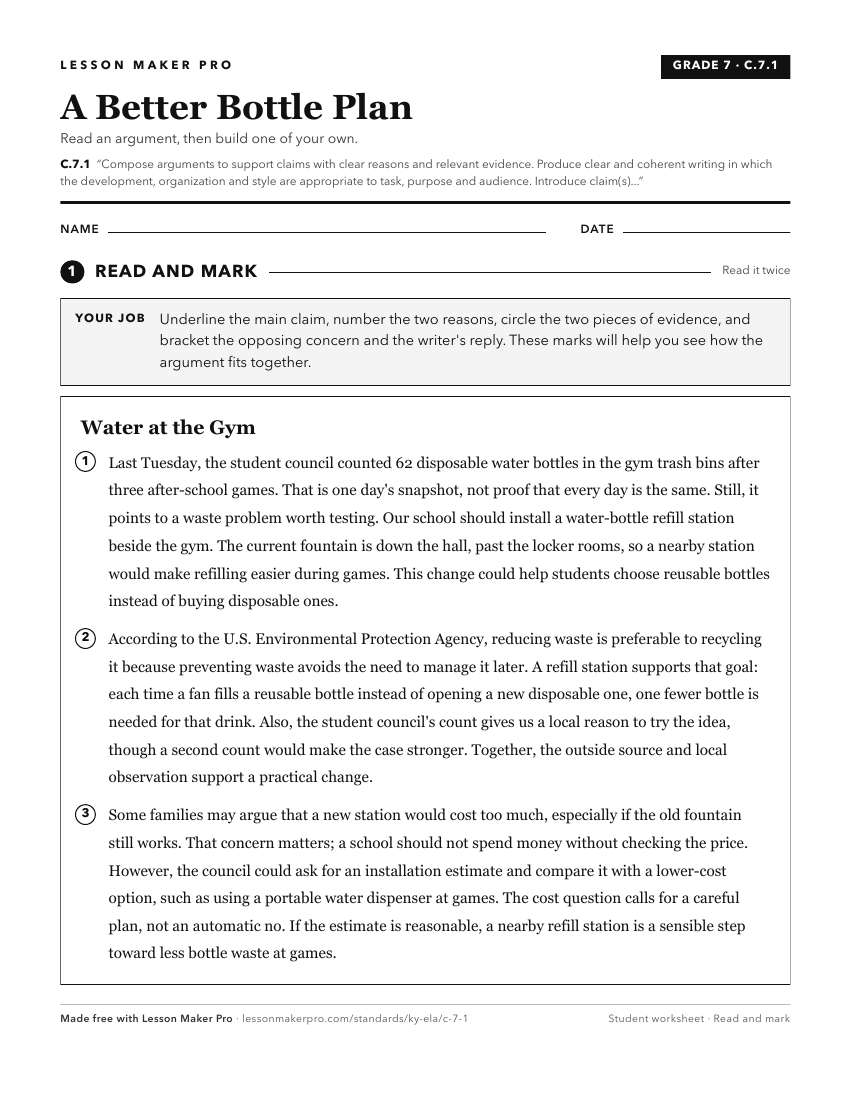
A ready-to-print activity worksheet aligned to C.7.1, with an answer key for the teacher on its own page. No account needed.
PDF, US Letter, prints cleanly in black and white.
Download the worksheetKeep exploring
Related Standards
Turn this cluster into a lesson
Grade, subject, topic, and the complete cluster are prefilled. Create one free, no account needed.
Also for this cluster:Make a WorksheetMake a QuizMake a Sub Lesson