Kentucky Reading and Writing C.6.1
Standard Cluster
Compose arguments to support claims with clear reasons and relevant evidence. Produce clear and coherent writing in which the development, organization and style are appropriate to task, purpose and audience. Introduce claim(s), acknowledge opposing claims and organize the reasons and evidence clearly. Support claim(s) with clear reasons and relevant evidence, using credible sources and demonstrating an understanding of the topic or text. Use words, phrases and clauses to clarify the relationships among claim(s) and reasons. Establish and maintain a formal style. Provide a concluding statement or section that follows from the argument presented. With some guidance, develop and strengthen writing as needed by planning, revising, editing, rewriting or trying a new approach.
Kentucky Academic Standards for Reading and Writing (2025) · Text Types and Purpose
Cluster contents
Standards in This Cluster
C.6.1 is a cluster heading. These are the individual standards under it.
Teacher's field guide
What This Cluster Means
What Students Need to Do
- Students write an argument for a specific audience with a clear claim, organized reasons, and evidence from trustworthy sources. They address an opposing claim and explain how their evidence supports their position. They use a formal tone, write a conclusion, and revise with feedback.
What Mastery Looks Like
- A student supports each reason with a relevant fact from a named, reliable source and explains why it matters. They answer a fair objection, use linking words to show their logic, and close without adding a new point. With feedback, they can replace weak evidence or move a reason to a better spot.
Common Misconceptions
- Students may treat a personal preference as evidence or cite a website without checking who wrote it. They may mention an opposing view but never answer it. Some list reasons with “first” and “second” without explaining how the evidence supports the claim.
How to Assess It
- Show a snack package nutrition label and the objection, “Students will buy it because it tastes good.” Ask students to write five formal sentences arguing whether the cafeteria should sell it, citing a number from the label, answering the objection, and concluding.
Lesson moves
Ways to Teach It
Give pairs index cards with a claim, reasons, menu facts, and objections; have them arrange the cards into a paragraph outline.
Ask: “Should school start ten minutes later?” Have students write a claim, one reason, and the strongest likely objection.
Play a revision relay: teams replace vague evidence and casual phrases in a sample paragraph, then add a linking phrase and conclusion.
Compare a city recycling guide with a company ad, then write the principal a letter using the stronger source to request bins.
Free download
Printable C.6.1 Worksheet
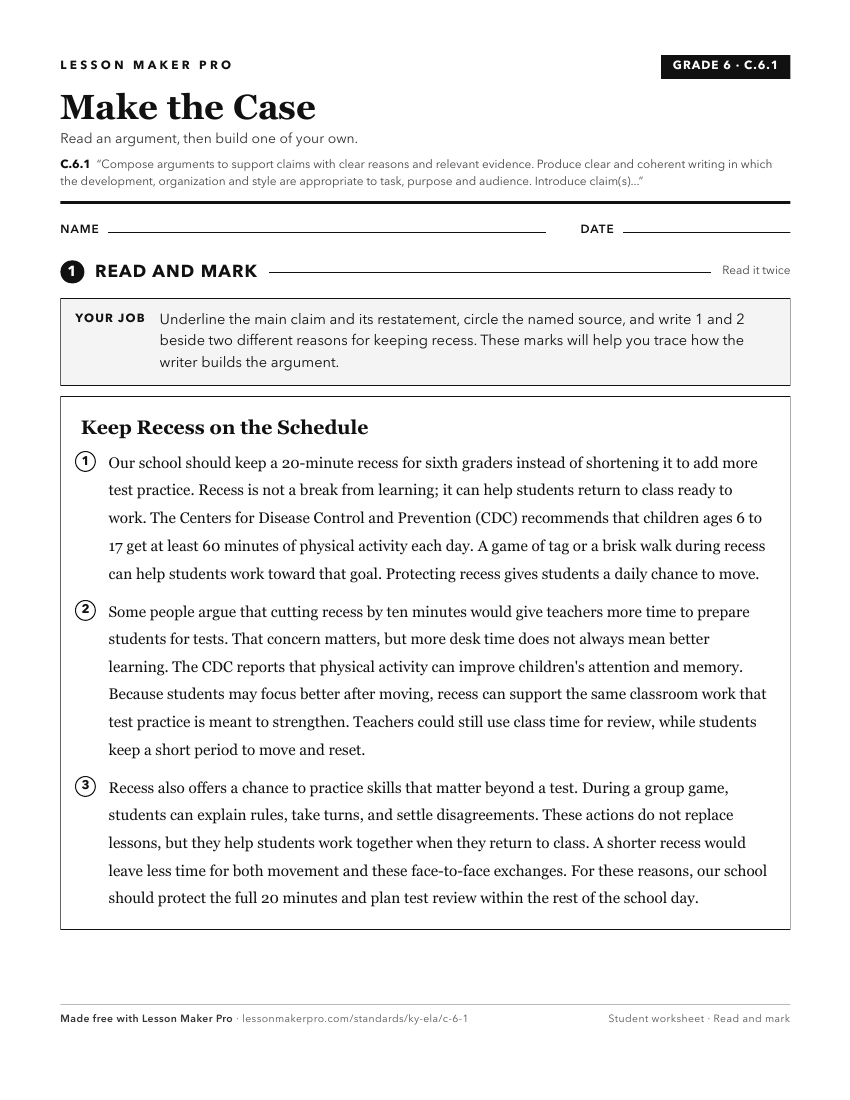
A ready-to-print activity worksheet aligned to C.6.1, with an answer key for the teacher on its own page. No account needed.
PDF, US Letter, prints cleanly in black and white.
Download the worksheetKeep exploring
Related Standards
Turn this cluster into a lesson
Grade, subject, topic, and the complete cluster are prefilled. Create one free, no account needed.
Also for this cluster:Make a WorksheetMake a QuizMake a Sub Lesson