Indiana Social Studies WH.6.9
The Standard
Trace the rise of communism in China including its foundations, the Cultural Revolution, and modern day developments.
2026 Indiana Academic Standards: K-12 Social Studies
Teacher's field guide
What This Standard Means
What Students Need to Do
- Students explain how anger over foreign influence and land inequality helped China's Communist Party gain support. They trace its 1949 victory and the Cultural Revolution. They explain how economic reforms changed China while the party kept political control.
What Mastery Looks Like
- A student places the 1919 May Fourth protests, the party's 1921 founding, and its 1949 victory in order. They describe Red Guard attacks during the Cultural Revolution and explain why reforms after 1978 did not end one-party rule.
Common Misconceptions
- Students may think communism began in China in 1949, rather than seeing the party's earlier growth. They may mistake the Cultural Revolution for a war against another country. Some assume market reforms ended Communist Party rule.
How to Assess It
- Exit ticket: Label what happened in 1921, 1949, 1966, and 1978. Then name one economic change after 1978 and one political feature that stayed the same.
Lesson moves
Ways to Teach It
Give groups five event cards: May Fourth protests, party founding, 1949 victory, Cultural Revolution, and 1978 reforms; place them on a taped floor timeline.
Show a 1966 Red Guard poster and a 1980s Shenzhen factory photo; ask: What change in priorities do these images suggest?
Play a sorting game: match cards naming land reform, Red Guards, farm contracts, and party founding to their periods and effects.
Check labels on classroom supplies for 'Made in China,' then link China's exports to the market reforms begun in 1978.
Free download
Printable WH.6.9 Worksheet
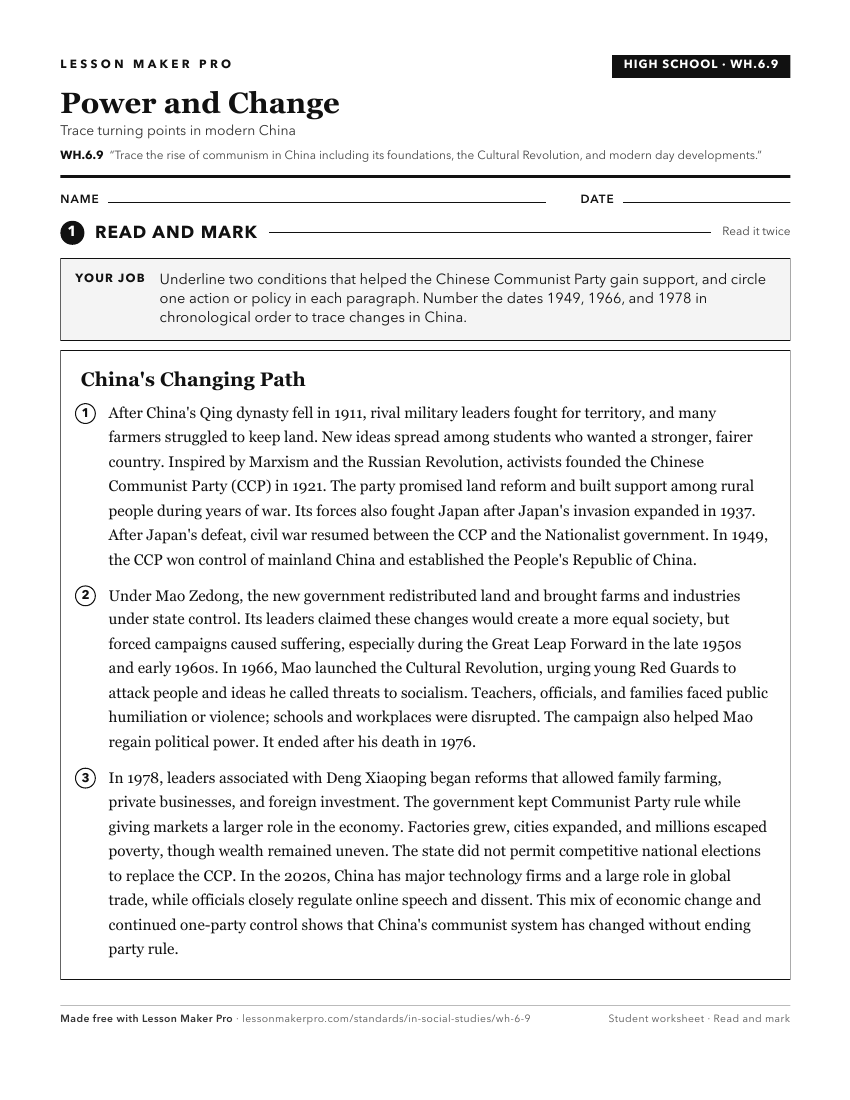
A ready-to-print activity worksheet aligned to WH.6.9, with an answer key for the teacher on its own page. No account needed.
PDF, US Letter, prints cleanly in black and white.
Download the worksheetKeep exploring
Related Standards
- WH.2.7
Trace the developments and achievements of the Qin and Han Dynasties.
- 7.H.7
Trace the rise, spread, and influence of the Mongols.
- USH.6.3
Explain the origins and cultural, economic, and political implications of the Cold War.
- WH.3.9
Examine the role of the Tang and Song Chinese dynasties in establishing political, social, economic, and cultural trends in China.
Turn this exact standard into a lesson
Grade, subject, topic, and the complete standard are prefilled. Create one free, no account needed.
Also for this standard:Make a WorksheetMake a QuizMake a Sub Lesson