Indiana Social Studies WH.6.3
The Standard
Explain the causes and consequences of the Russian Revolutions of 1917 and the establishment of the Union of Soviet Socialist Republics.
2026 Indiana Academic Standards: K-12 Social Studies
Teacher's field guide
What This Standard Means
What Students Need to Do
- Students explain why the tsar fell in February 1917 and why the Bolsheviks took power in October. They connect those events to civil war and the creation of the Soviet Union.
What Mastery Looks Like
- Students use war losses, food shortages, and demands for land to explain the unrest. They explain why the provisional government lost support and how Bolshevik victory led to one-party rule and the USSR's formation in 1922.
Common Misconceptions
- Students may treat the February and October revolutions as one event or think Lenin replaced the tsar directly. Some assume the USSR formed immediately after the Bolsheviks took power, skipping the civil war.
How to Assess It
- Exit ticket: Name two causes of the February uprising, explain why the Bolsheviks gained support, and give one result of their victory by 1922.
Lesson moves
Ways to Teach It
Give pairs cards for wartime shortages, the February uprising, Bolshevik takeover, civil war, and the 1922 union; have them build a timeline.
Ask students to write: Why did the provisional government lose support, and how did Bolshevik promises of peace and land help?
Run a team match game pairing evidence cards with the February uprising, October takeover, civil war, or Soviet state formation.
Compare a 1980 Soviet map with a current map; mark Russia and Ukraine, then note that both belonged to the USSR.
Free download
Printable WH.6.3 Worksheet
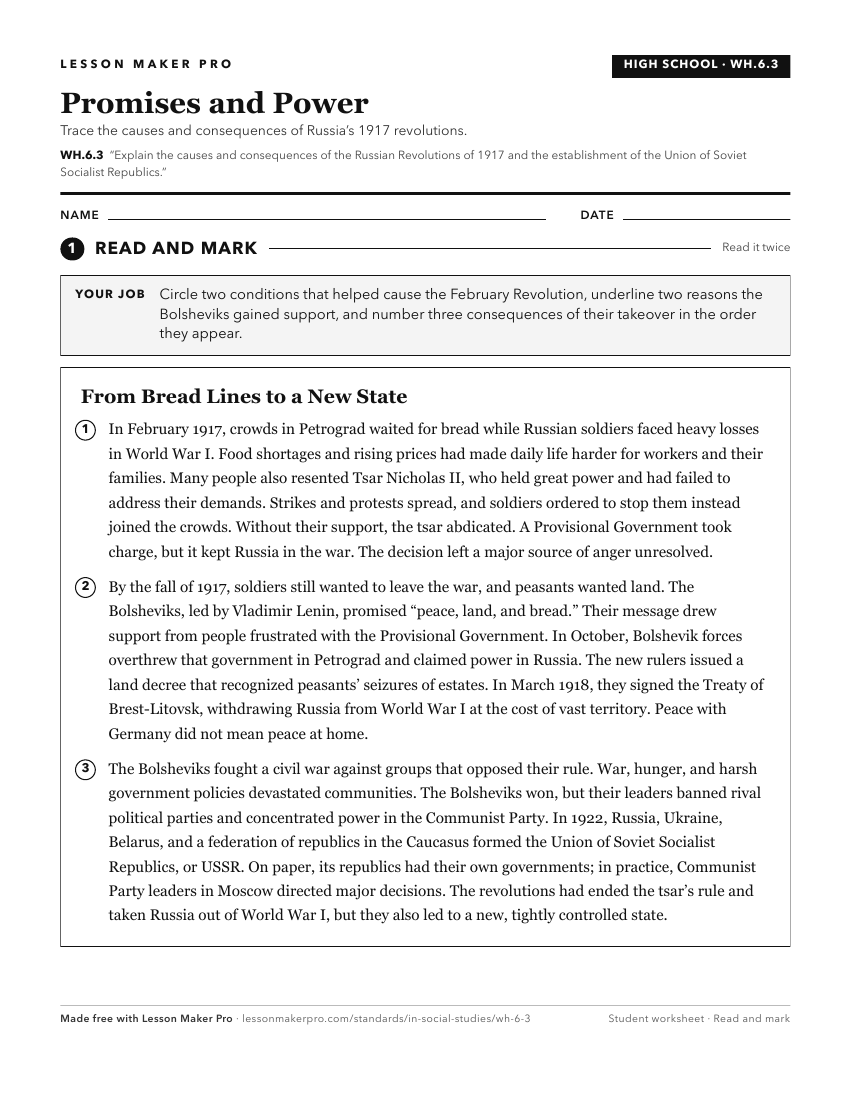
A ready-to-print activity worksheet aligned to WH.6.3, with an answer key for the teacher on its own page. No account needed.
PDF, US Letter, prints cleanly in black and white.
Download the worksheetKeep exploring
Related Standards
- 5.H.9
Analyze the causes of the American Revolution as outlined in the Declaration of Independence.
- USH.2.1
Explain the causes of the Industrial Revolution and its social, political, and economic outcomes.
- WH.6.6
Explain the causes and consequences of the Cold War, and describe the role it played in ethnic or nationalistic conflicts in various parts of the world.
- WH.5.3
Examine the causes, events, and consequences of the Atlantic Revolutions, including the American, French, Haitian, and Latin American revolutions.
Turn this exact standard into a lesson
Grade, subject, topic, and the complete standard are prefilled. Create one free, no account needed.
Also for this standard:Make a WorksheetMake a QuizMake a Sub Lesson