Indiana Social Studies WH.3.3
The Standard
Explain the role of Christianity as a unifying force in medieval Europe.
2026 Indiana Academic Standards: K-12 Social Studies
Teacher's field guide
What This Standard Means
What Students Need to Do
- Students explain how worship, feast days, and pilgrimages connected people across different kingdoms. They use an example to show how people could share a faith without sharing a ruler.
What Mastery Looks Like
- A student can explain why people in England and France might observe Easter on the same day despite having different kings. They can also explain that shared religion did not end wars or erase local customs.
Common Misconceptions
- Students may think the pope ruled every European kingdom or that all Christians followed the same practices. They may also assume that shared faith kept kingdoms from fighting.
How to Assess It
- On an exit ticket, ask: How did one shared Church practice connect people in two medieval kingdoms? Give an example and name one limit to that unity.
Lesson moves
Ways to Teach It
Plot Rome, Canterbury, and Santiago on a map, then use string to show how pilgrims crossed kingdom borders to visit church sites.
Ask: How could an English pilgrim and a French pilgrim feel connected despite having different kings? Name a shared practice.
Sort cards labeled Latin Mass, Easter, local king, and regional law into shared Church ties or political differences.
Compare a school holiday calendar with a medieval feast-day calendar, then write how shared dates help people plan gatherings across towns.
Free download
Printable WH.3.3 Worksheet
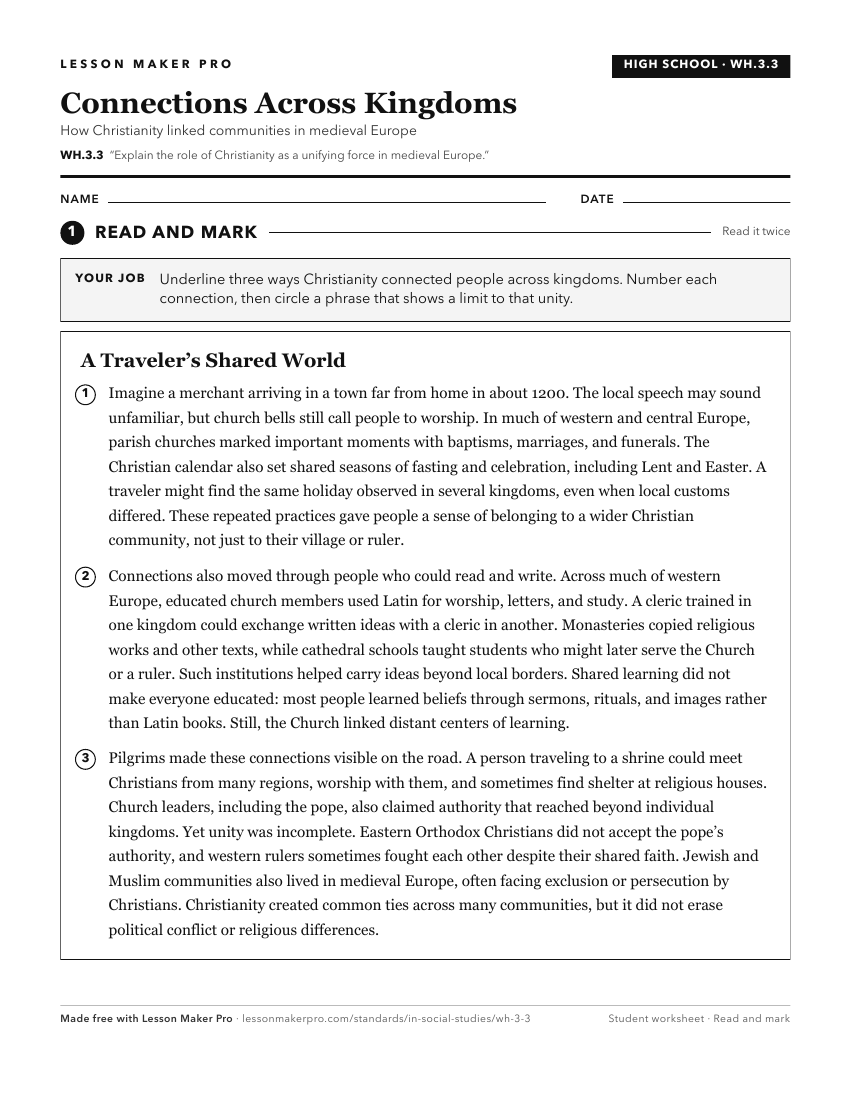
A ready-to-print activity worksheet aligned to WH.3.3, with an answer key for the teacher on its own page. No account needed.
PDF, US Letter, prints cleanly in black and white.
Download the worksheetKeep exploring
Related Standards
- WH.4.3
Discuss the emergence of nation-states as well as the increased impact of the citizen as a result of the decline of the European medieval period.
- WH.3.4
Explain the cultural, political, economic, and religious causes of the Crusades and their consequences for Europe and Southwest Asia, including the growth in po...
- 6.H.4
Analyze the diverse points of view and motivations of those involved in the Crusades, and give examples of the changes brought about by the Crusades.
- 6.H.2
Describe and compare the beliefs, the spread, and the influence of religions throughout Europe and Mesoamerica.
Turn this exact standard into a lesson
Grade, subject, topic, and the complete standard are prefilled. Create one free, no account needed.
Also for this standard:Make a WorksheetMake a QuizMake a Sub Lesson