Indiana Social Studies WH.2.1
The Standard
Review the development and fundamental beliefs and features of major world religions and philosophies, including Hinduism, Buddhism, Sikhism, Judaism, Christianity, Islam, and examine the origins of monotheism, as the source of many moral and ethical traditions of Western Civilization.
2026 Indiana Academic Standards: K-12 Social Studies
Teacher's field guide
What This Standard Means
What Students Need to Do
- Students locate Hinduism, Buddhism, Sikhism, Judaism, Christianity, and Islam on a map and timeline. They compare beliefs and practices, then examine how belief in one God developed in ancient Israel and influenced later ethical teachings.
What Mastery Looks Like
- A student can give an approximate origin date and place for each tradition and name a belief or practice that distinguishes it. They can connect a Jewish teaching about caring for others to a later Christian or Islamic teaching, using an example from each.
Common Misconceptions
- Students may call Buddhism monotheistic or assume all Hindus hold the same beliefs about gods. They may place Islam or Sikhism before 600 CE, or describe Sikhism as a branch of another religion.
How to Assess It
- On an exit ticket, ask students to place Islam and Sikhism on a timeline and explain one way a Jewish teaching about caring for others appears in Christianity or Islam.
Lesson moves
Ways to Teach It
Give pairs six origin cards, six belief cards, and a blank map; have them match the cards and mark each tradition's birthplace.
Read Leviticus 19:34 and Matthew 25:35; ask students to write two sentences comparing how the passages treat strangers.
Have teams sort dated cards for Buddhism, Christianity, Islam, and Sikhism, then check their order against a reference sheet.
Give students a printed interfaith calendar; have them choose two observances, identify the traditions, and write one respectful question about each.
Free download
Printable WH.2.1 Worksheet
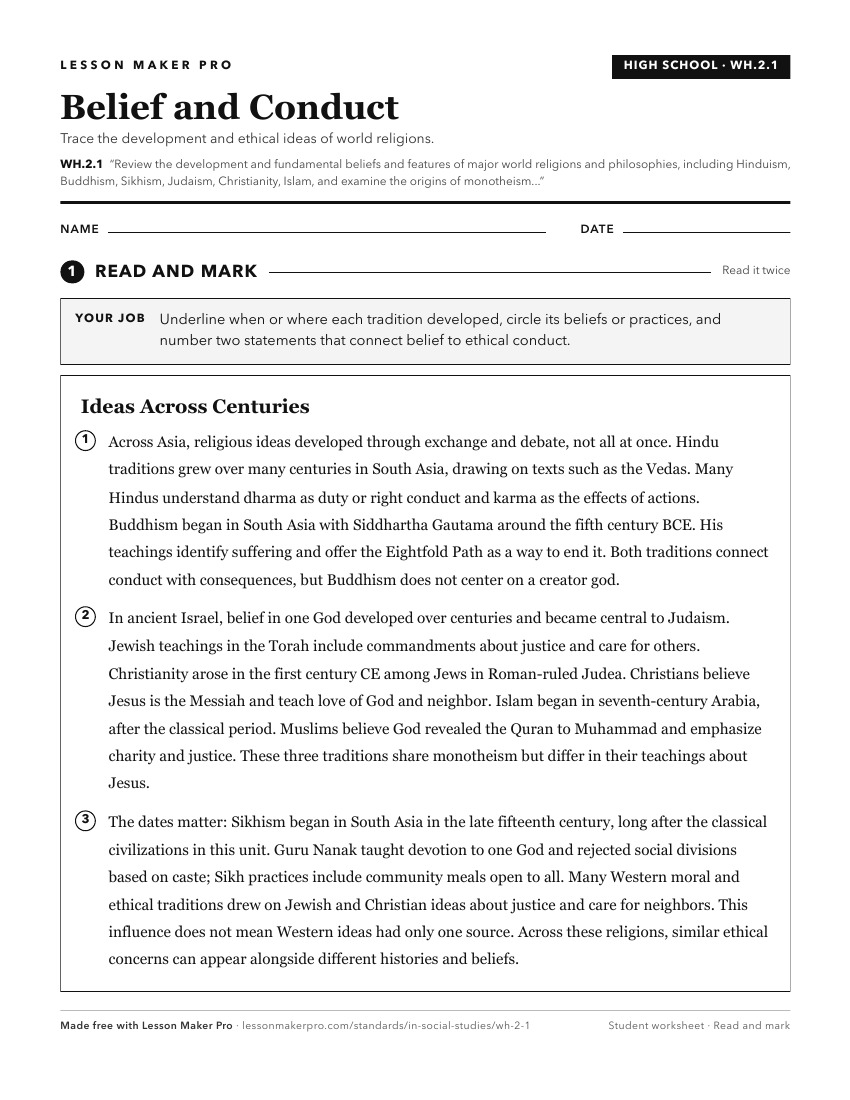
A ready-to-print activity worksheet aligned to WH.2.1, with an answer key for the teacher on its own page. No account needed.
PDF, US Letter, prints cleanly in black and white.
Download the worksheetKeep exploring
Related Standards
- GHW.2.2
Analyze and assess the rise of fundamentalist movements in the world’s major religions during contemporary times (1980–present), and describe the relationships ...
- WH.1.5
Examine the development of Judaism and the civilization of Ancient Israel, including the origins of monotheism, the significance of the Exodus from Egypt, the H...
- 7.H.2
Describe, compare, and contrast the historical origins, central beliefs and features, and spread of major religions, including Hinduism, Buddhism, Judaism, Chri...
- WH.2.6
Examine the origins, developments, and major achievements of civilizations in India, such as the Mauryan and Gupta empires. Compare and contrast the influence o...
Turn this exact standard into a lesson
Grade, subject, topic, and the complete standard are prefilled. Create one free, no account needed.
Also for this standard:Make a WorksheetMake a QuizMake a Sub Lesson